Vegetos

(An International Journal of Plant Research & Biotechnology)
(eISSN: 2229-4473)
Algal diversity of economically important species from a selected site of the Veraval coast, Gujarat, India
*Article not assigned to an issue yet
Gadhiya Dinesh, Joshi Jignasa B., Joshi Nilesh, Jani Manish, Kavane Aarti
Short Communications | Published: 15 June, 2026
First Page: 0
Last Page: 0
Views: 84
Keywords: Biodiversity u0026 conservation, Dictyotaceae, Macroalgae, Veraval coast, Species diversity, n Ulva fasciatan
Abstract
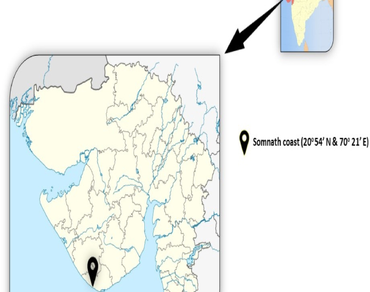
Marine algae are a heterogeneous group of autotrophic organisms that are a viable source of valuable compounds with potential applications in the nutraceutical, pharmaceutical, food, and cosmetic industries. Looking at the immense importance of these algae and the inadequate literature resources available on them in the Indian cohort, the present pilot investigation has been aimed at the identification of economically important algal species using biodiversity analysis at the Veraval coast. The Somnath Veraval coastal region, bordering the Arabian sea, offers a variety of habitats like rocky shores, sandy beaches, and coral reefs that support the growth of different macroalgae species. Data collection and observations were carried out using the belt transect method of random sampling from different sites. The study revealed the occurrence of a total of 10 families with 15 genera and 21 species, and the distribution percentage of species in each class (Chlorophyceae, Phaeophyceae, and Rhodophyceae) remains the same (33.33%). During the investigation, it was found that economically important species like Ulva lactuca, Ulva fasciata, and Caulerpa sp. were present in the collected samples. The species belonging to the family Dictyotaceae were found dominant (71%) followed by the members of the Caulerpaceae family (43%). The findings provide baseline information for future long-term monitoring of macroalgal diversity along the Veraval coast. Further studies focusing on seasonal variation, biomass estimation, biochemical profiling, and bioactive compound characterization may support sustainable utilization and conservation of these economically important marine resources. It supports sustainable collection and conservation strategies, contributing to the UN Sustainable Development Goals, particularly SDG 14 (Life Below Water).
References
Barbot Y, Hashem A, Benz R (2016) A review on the valorization of macroalgal wastes for biomethane production. Mar Drugs 14:120. https://doi.org/10.3390/md14060120
Biris-Dorhoi ES (2018) Cercetari privind utilizarea algelor marine in bioremedierea apelor uzate industrial–o tehnica eco-friendly in rezolvarea poluarii mediului. Mega, Cluj-Napoca, Romania, pp 66–117
Biris-Dorhoi ES, Michiu D, Pop CR, Rotar AM, Tofana M, Pop OL, Socaci SA, Farcas AC (2020) Macroalgae-a sustainable source of chemical compounds with biological activities. Nutrients 12(10):3085. https://doi.org/10.3390/nu12103085
Boukhari EL, Barakate M, Bouhia Y, Lyamlouli K (2020) Trends in seaweed extract based biostimulants: manufacturing process and beneficial effect on soil-plant systems. Plants 9:359. https://doi.org/10.3390/plants9030359
Brodie J, Lewis J (2007) Introduction. In: Brodie J, Lewis J (eds) Unravelling the algae: the past, present, and future of algal systematics. CRC, Boca Raton, p 1
Bueno AM, Marcílio Candido T, Morocho-Jácome AL, Rolim Baby A, Robles Velasco MV, de Carvalho JC (2017) Cosmetic attributes of algae-a review. Algal Res 25:483–487. https://doi.org/10.1016/j.algal.2017.05.019
Chen S, Liu H, Zhang H, Li K, Wang N, Sun W, Liu X, Niu L, Ma B, Yang F, Li H (2023) Temporal patterns of algae in different urban lakes and their correlations with environmental variables in Xi’an, China. J Environ Sci 133:138–151. https://doi.org/10.1016/j.jes.2022.07.036
Falkowski PG, Knoll AH (2007) An introduction to primary producers in the sea: who they are, what they do, and when they evolved. In: Falkowski PG (ed) Evolution of primary producers in the sea. Academic Press, pp 1–6
Ganesan A, Tiwari U, Rajauria G (2019) Seaweed nutraceuticals and their role in disease prevention. Food Sci Hum Wellness 8:252–263. https://doi.org/10.1016/j.fshw.2019.08.001
Garcia-Vaquero M, Ummat V, Tiwari B, Rajauria G (2020) Exploring ultrasound, microwave and ultrasound–microwave assisted extraction technologies to increase the extraction of bioactive compounds and antioxidants from brown macroalgae. Mar Drugs 18:172. https://doi.org/10.3390/md18030172
Guiry MD (2024) How many species of algae are there? A reprise. Four kingdoms, 14 phyla, 63 classes and still growing. J Phycol 60(2):214–228. https://doi.org/10.1111/jpy.13431
Hakim MM, Solanki AD, Patel IC (2022) Marine algae diversity at coastal area of Veraval. Gujarat IABCD 2:22–30
Hayes M (2015) Seaweeds: a nutraceutical and health food. In: Tiwari BK, Troy DJ (eds) Seaweed sustainability. Academic, London, pp 365–387
Indira K, Balakrishnan S, Srinivasan M, Bragadeeswaran S, Balasubramanian T (2013) Evaluation of in vitro antimicrobial property of seaweed (Halimeda tuna) from Tuticorin coast, Tamil Nadu, southeast coast of India. Afr J Biotechnol 12:284–289. https://doi.org/10.5897/AJB12.014
Jha B, Reddy CRK, Thakur MC, Rao MU (2009) Seaweeds of India: the diversity and distribution of seaweeds of Gujarat coast, vol 3. Springer, Dordrecht
Khan N, Sudhakar K, Mamat R (2024) Macroalgae farming for sustainable future: navigating opportunities and driving innovation. Heliyon. https://doi.org/10.1016/j.heliyon.2024.e28208
Mahadevan K (2015) Seaweeds: a sustainable food source. In: Tiwari BK, Troy DJ (eds) Seaweed sustainability. Academic, London, pp 347–364. https://doi.org/10.1016/B978-0-12-418697-2.00013-5
Manisseri MK, Antony G, Rao GS (2012) Common seaweeds and seagrasses of India. CMFRI Herbarium, 1
Negreanu-Pîrjol B, Negreanu-Pîrjol T, Paraschiv GM, Bratu MM, Sirbu R, Roncea F, Meghea A (2011) Physical-chemical characterization of some green and red macrophyte algae from the Romanian Black Sea littoral. Sci Study Res Chem Chem Eng Biotechnol Food Ind 12:173–184
Oza RM, Zaidi SH (2001) A revised check list of Indian marine algae. CSIR-CSMCRI, Bhavnagar, pp 24–29
Pandey R, Kejariwal M (2021) Marine macroalgae diversity at Bhuigaon Coast, District Palghar, Maharashtra. J Sci Res 65(6):126–131
Pathak S, Bhatt AJ, Vandarvala UG, Vyas UD (2020) Seaweed species diversity from Veraval and Sikka Coast, Gujarat, India. Int J Curr Microbiol App Sci 9(11):3667–3675. https://doi.org/10.20546/ijcmas.2020.911.439
Paulus E (2021) Shedding light on deep-sea biodiversity—a highly vulnerable habitat in the face of anthropogenic change. Front Mar Sci 8:667048. https://doi.org/10.3389/fmars.2021.667048
Punya P, Nidamanuri RR (2024) Analysis of long-term changes in algal bloom pattern and their association with ocean, atmosphere, and land-based processes across the northern Indian Ocean. Adv Space Res 74(3):1103–1119
Rao PSN, Gupta RK (2015) Algae of India volume 3: a checklist of Indian marine algae (excluding diatoms & dinoflagellates). Botanical Survey of India. Ministry of Environment, Forests & Climate Change, Government of India, Kolkata
Skrovankova S (2011) Seaweed vitamins as nutraceuticals. In: Toldrá F (ed) Advances in food and nutrition research 64:357–369. https://doi.org/10.1016/B978-0-12-387669-0.00028-4
Subba Rao PV, Mantri VA (2006) Indian seaweed resources and sustainable utilization: scenario at the dawn of a new century. Curr Sci 91(2):164–174
Thaker PN, Brahmbhatt N, Shah KD (2023) The diversity of marine seaweeds from coastal zones of Saurashtra. Int J Bot Stud 8:29–33
Author Information
Department of Botany, Christ College, Rajkot, India