Vegetos

(An International Journal of Plant Research & Biotechnology)
(eISSN: 2229-4473)
Allelopathic effect of aqueous extracts of some invasive plant species on the germination of Solanum lycopersicum L.
*Article not assigned to an issue yet
Uwalaka Nelson Obinna, Umeh Evelyn Odinaka, Obiekee Vitalian Odira, Emeka Emmanuella Chiamaka, Ekeh Chinenye Sylverline, Anum Obinna Augustine
Research Articles | Published: 16 July, 2026
First Page: 0
Last Page: 0
Views: 78
Keywords: Allelopathy, Inhibitory, Time, Germination, Invasive
Abstract
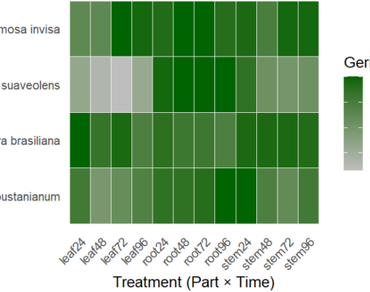
Allelopathy which is the direct or indirect harmful or beneficial effect of one plant on another through the release of certain chemical compounds into the environment, remains a key phenomenon influencing the performance of agricultural crops. Fresh whole samples of four invasive weed species viz. Ageratum houstanianum, Alternanthera brasiliana, Hyptis suaveolens and Mimosa invisa were collected from natural population and examined for the allelopathic effect of their component parts on the germination of Solanum lycopersicum. Aqueous extracts of parts of the selected invasive plant species at four extraction times (24, 48, 72 and 96 h) were tested on the seeds of S. lycopersicum L. and a three-way analysis of variance was carried out to determine the interaction effect among fixed variables. The leaf aqueous extracts of selected invasive species significantly inhibited germination of S. lycopersicum, although only M. invisa had all its parts inhibiting the germination of S. lycopersicum (p < 0.05). The fixed‑effects three‑way analysis of variance revealed significant main effects of species, plant part, and extraction time on inhibition percentage (p < 0.001) for all factors, and the three‑way interaction (species × part × time) was also significant (p < 0.05), demonstrating that the inhibitory response to extraction time depended jointly on both species identity and the plant part extracted. The allelopathic effect of the invasive species depended on extraction time and was more pronounced in the aqueous leaf extract 72 h before extraction. This study concluded that inhibition of germination of seeds of S. lycopersicum was species-specific and the leaves of H. suaveolens possessed the highest inhibitory effect of all the aqueous extracts used in this study.
References
Abrahim D, Braguini WL, Kelmer-Bracht AM, Ishii-Iwamoto EL (2000) Effects of four monoterpenes on germination, primary root growth, and mitochondrial respiration of maize. J Chem Ecol 26:611–624
Arzoo A, Khatoon A, Nayak SK, Mohapatra A, Satapathy KB (2016) Assessment of the allelopathic potential of an invasive alien weed Hyptis suaveolens (L.) Poit. on germination of Oryza sativa L. J Food Sci Eng 6:212–214. https://doi.org/10.17265/2159-5828/2016.04.003
Bari IN, Kato-Noguchi H (2017) Phytotoxic effects of Cerbera manghas L. leaf extracts on seedling elongation of four monocot and four dicot test species. Acta Agrobot 70(3):1720. https://doi.org/10.5586/aa.1720
Chaïb S, Pistevos JC, Bertrand C, Bonnard I (2021) Allelopathy and allelochemicals from microalgae: an innovative source for bio-herbicidal compounds and biocontrol research. Algal Res 54:102213. https://doi.org/10.1016/j.algal.2021.102213
Chatiyanon B, Tanee T, Talubmook C, Wongwattana C (2012) Effect of Hyptis suaveolens Poit leaf extracts on seed germination and subsequent seedling growth of Pennisetum setosum (Swartz.) L.C. Rich and Mimosa invisa Mart. Agric J 7(1):17–20
Chon SU, Jennings JA, Nelson CJ (2016) Alfalfa (Medicago sativa L.) autotoxicity: current status. Allelopathy J 18:57–80
De Albuquerque MB, Santos RC, Lima LM, Filho M, Nogueira PA, Da RJMC, Câmara CAG, Ramos AR (2018) Allelopathy, an alternative tool to improve cropping systems. A review. Agron Sustain Dev 31:379–395
Eichenberg D, Ristok C, Kroeber W, Bruelheide H (2014) Plant polyphenols—implications of different sampling, storage and sample processing in biodiversity-ecosystem functioning experiments. Chem Ecol 30:676–692
Gatti AB, Perez SC, Lima MIS (2014) Atividade alelopática de extratos aquosos de Aristolochia esperanzae O. Kuntze na germinação e no crescimento de Lactuca sativa L. e Raphanus sativus L. Acta Bot Brasilica 18:459–472
Guido A, Hoss D, Pillar VD (2017) Exploring seed to seed effects for understanding invasive species success. Perspect Ecol Conserv 15:234–238. https://doi.org/10.1016/j.pecon.2017.07.006
Hammer Ø, Harper DAT, Ryan PD (2001) PAST: paleontological statistics software package for education and data analysis. Palaeontol Electron 4(1):1–9. http://palaeo-electronica.org/2001_1/past/issue1_01.htm
Iganci JRV, Bobrowski VL, Heiden G, Stein VC, Rocha BHG (2006) Efeito do extrato aquoso de diferentes espécies de boldo sobre a germinação e índice mitótico de Allium cepa L. Arq Inst Biol 73:79–82
Islam AKMM, Kato-Noguchi H (2013) Plant growth inhibitory activity of medicinal plant Hyptis suaveolens: Could allelopathy be a cause? Emir J Food Agric 25:692–701. https://doi.org/10.9755/ejfa.v25i9.16073
Islam AKMM, Ohno O, Suenaga K, Kato-Noguchi H (2014) Suaveolic acid: a potent phytotoxic substance of Hyptis suaveolens. Sci World J 2014:425942. https://doi.org/10.1155/2014/425942
Islam AKMM, Suttiyut T, Anwar MP, Juraimi AS, Kato-Noguchi H (2022) Allelopathic properties of Lamiaceae species: prospects and challenges to use in agriculture. Plants 11(11):1478. https://doi.org/10.3390/plants11111478
Javaid N, Shah MH, Khan IH, Javaid A, Waleed SM (2022) Herbicidal activity of Ageratum conyzoides against parthenium. Pak J Weed Sci Res 26:137–146
Kato-Noguchi H (2001) Effects of lemon balm (Melissa officinalis L.) extract on germination and seedling growth of six plants. Acta Physiol Plant 23(1):49–53
Kong CH, Zhang SZ, Li YH, Xia ZC, Yang XF, Meiners SJ, Wang P (2018) Plant neighbor detection and allelochemical response are driven by root-secreted signaling chemicals. Nat Commun 9(1):3867. https://doi.org/10.1038/s41467-018-06429-1
Krishna V, Gowtham GN, Priyanka P, Sona S, Sandesh MA, Pratap CR (2019) Evaluation of allelopathic activity of aqueous leaf extracts of Alternanthera brasiliana (L.) Kuntze on growth parameters of Vigna radiata seeds. Int J Adv Res Biol Sci 6(6):114–120
Kruse M, Strandberg M, Strandberg B (2017) Ecological effects of allelopathic plants. A review, Department of Terrestrial Ecology, Silkeborg, Denmark, Rep. p 315
Mehmood A, Tanveer A, Nadeem MA, Zahir ZA (2014) Comparative allelopathic potential of metabolites of two Alternanthera species against germination and seedling growth of rice. Planta Daninha 32(1):1–10
Ogbuagu DH, Okoli CG (2013) What influence does removal of riparian vegetation have on primary productivity of a river. Cent Eur J Exp Biol 2:5–12
Ononiwu N (1990) The physiological properties of soil and associated cropping/land use system in Eziobodo village, Owerri, Nigeria. Unpublished B. Agric. Tech. Project. School of Agriculture and Agricultural Technology, Federal University of Technology Owerri. F.U.T.O
Oraon S, Mondal S (2021) Allelopathic effect of Lamiaceous weeds on seed germination and early growth of aromatic rice (Oryza sativa ‘Gobindobhog’). Acta Agrobot 74(1):741. https://doi.org/10.5586/aa.741
Owoseni O, Awodoyin RO (2013) Allelopathic effect of aqueous shoot and root extracts of Alternanthera brasiliana (L.) O. Kuntze on the germination and seedling growth of Amaranthus cruentus L. and Zea mays L. Ib J Agricultural Res 9:257–264
Pires NM, Souza IRP, Prates HT, Faria TCL, Pereira Filho IA, Magalhães PC (2001) Efeito do extrato aquoso de leucena sobre o desenvolvimento, índice mitótico e atividade da peroxidase em plântulas de milho. Rev Bras Fisiol Vegetal 13:55–65
POWO (2024) Plants of the World Online. Facilitated by the Royal Botanic Gardens, Kew. Published on the Internet; https://www.plantsoftheworldonline.org/. Accessed 08 April 2023
Putnam AR, Tang CS (1986) Allelopathy: state of the science. In: Putnam AR and Tang C.S. (ed) The science of allelopathy. Wiley, Hoboken, NJ, USA, pp 1–19
R Core Team (2026) R: a language and environment for statistical computing. R Foundation for Statistical Computing, Vienna, Austria. https://doi.org/10.32614/R.manuals. https://www.R-project.org/
Radosevich SR, Holt JS, Ghersa C (2017) Ecology of weeds and invasive plants: relationship to agriculture and natural resource management. Wiley, New York, p 454
Rao E, Kumary DS, Satyanarayana A (1987) Allelopathic potential of Hyptis suaveolens Poit. on seed germination of weeds and crops. Indian Bot Rep 6:77–78
Rice EL (2014) Allelopathy, 2nd edition. Rice EL (ed) Orlando, Academic Press. p 422
Riti TK (2012) Phytotoxic potential of fresh leaf leachates and Dry leaf extracts of Hyptis suavaolens to control Parthenium hysterophorous L. International conference on chemical process and environmental issues (ICCEEI. 2012) July 15-16th
Rodrigues AC, Artioli FA, Polo M, Barbosa LCA, Beijo LA (2012) Efeito alelopático de folhas de bamburral [Hyptis suaveolens (L.) Poit.] sobre a germinação de sementes de sorgo (Sorghum vulgare Pers.), rabanete (Raphanus sativus L.) e alface (Lactuca sativa L). Rev Bras Plantas Med 14:487–493
Scavo, A., Restuccia, A. and Mauromicale, G. (2018) Allelopathy: principles and basic aspects for agroecosystem control. In: Gaba S, Smith B, Lichtfouse E (eds) Sustainable agriculture reviews 28, Ecology for agriculture, Springer. Cham, Switzerland, vol 28, pp 47–101
Tanveer A, Rehman A, Javaid MM, Abbas RN, Sibtain M, Ahmad AU, Ibin-I-Zamir MS, Chaudhary KM, Aziz A (2010) Allelopathic potential of Euphorbia helioscopia L. against wheat (Triticum aestivum L.), chickpea (Cicer arietinum L.) and lentil (Lens culinaris Medic). Turk J Agric For 34(1):75–81. https://doi.org/10.3906/tar-0903-53
Tsombou FM, El-Keblawy A, Elsheikh EAE, AbuQamar SF, El-Tarabily KA (2022) Allelopathic effects of native and exotic Prosopis congeners in Petri dishes and potting soils: assessment of the congeneric approach. Botany 100(3):329–339. https://doi.org/10.1139/cjb-2021-0064
Zambelli A, Nocito FF, Araniti F (2025) Unveiling the multifaceted roles of root exudates: chemical interactions, allelopathy, and agricultural applications. Agronomy 15:845–875. https://doi.org/10.3390/agronomy15040845
Zohaib A, Tabassum T, Anjum SA, Abbas T, Nazir U (2018) Allelopathic effect of some associated weeds of wheat on germinability and biomass production of wheat seedlings. Planta Daninha 35:e017167321. https://doi.org/10.1590/s0100-83582017350100089
Author Information
Centre for Forest Interdisciplinary Research, The University of Winnipeg, Winnipeg, Canada