Vegetos

(An International Journal of Plant Research & Biotechnology)
(eISSN: 2229-4473)
Antimicrobial potential of Abrus precatorius Linn. against multidrug resistance and biofilm-producing foodborne pathogens
*Article not assigned to an issue yet
Adejoh Olubunmi Pauline, Akande Akinsola Adegboye, Ojebola Mariam, Fashogbon Racheal Oluwayemisi, Aboaba Sherifat Adeyinka
Research Articles | Published: 14 October, 2026
First Page: 0
Last Page: 0
Views: 110
Keywords: n Abrus precatorius Linn., Gas chromatography-mass spectrometry, Antibiotic susceptibility, Microbial biofilms
Abstract
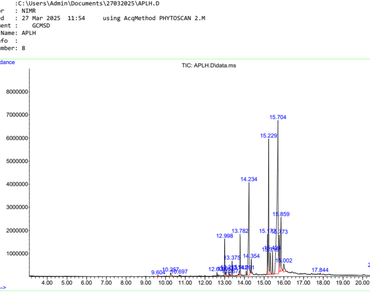
The emergence of drug-resistant microorganisms and multidrug-tolerant biofilms has become a serious global public health problem due to increase antibiotics abuse. Microbial biofilms pose a serious threat because they are highly resistant to eradication. Abrus precatorius Linn. hexane, ethyl acetate and methanol leaf (APLH, APLE and APLM, respectively) extracts were characterized for their phytoconstituents by Gas Chromatography–Mass Spectrometry analysis and investigated for their antimicrobial potential against multidrug-resistance and biofilm producing foodborne pathogens. Antibiotic susceptibility, biofilm formation and antimicrobial potential of the extracts were determined using Kirby-Buaer disc diffusion, Congo red agar and agar well diffusion methods, respectively. (Z,Z,Z)?9,12,15-octadecatrienoic acid (37.59%), (Z,Z,Z)??9,12,15-octadecatrienoic acid, methyl ester (23.86%), and hexadecanoic acid, methyl ester (23.56%) dominated APLH, APLE and APLM extracts, respectively. Acinetobacter baumanni and Klebsiella pneumoniae had high multiple antibiotic resistance index (57.1%) while K. pneumoniae and Staphylococcus aureus were strong biofilm producers among the pathogenic microbes employed. However, APLM extract, showed promising antimicrobial potential as natural alternative to combat multidrug-resistant foodborne pathogens and biofilm formation. This study demonstrates that methanol extract of Abrus precatorius shows broad-spectrum antimicrobial activity.
References
Adams RP (2017) Identification of essential oil components by gas chromatography/mass spectrometry. Allured Publ Crop, Carol Stream IL, USA
Adnan M, Patel M, Deshpande S, Alreshidi M, Siddiqui AJ, Reddy MN et al (2020) Effect of Adiantum philippense extract on biofilm formation, adhesion with its antibacterial activities against foodborne pathogens and characterization of bioactive metabolites: an in vitro-in silico approach. Front Microbiol 11:823. https://doi.org/10.3389/fmicb.2020.00823
Ahamefula C, Okeke CO, Nnaoma IE (2024) Evaluation of antimicrobial activity of methanol extract of Abrus precatorius leaf against selected clinical isolates (Escherichia coli, Pseudomonas aeruginosa, Staphylococcus aureus and Candida albican). Sch Acad J Pharm 13(8):368–371. https://doi.org/10.36347/sajp.2024.v13i08.002
Ahmed SK, Hussein S, Qurbani K, Ibrahim RH, Fareeq A, Mahmood KA et al (2024) Antimicrobial resistance: impacts, challenges and future prospects. J Med Surg Public Health 2:100081. https://doi.org/10.1016/j.glmedi.2024.100081
Akinola PO, Akande A, Aboaba S (2025) Chemical composition and cytotoxicity of Araucaria heterophylla (Salisb.) franco essential oils. Int J Second Metab 12(1):109–118. https://doi.org/10.21448/ijsm.1485410
Alqurashi AS, Al Masoudi LM, Hamdi H, Abu Zaid A (2022) Chemical composition and antioxidant, antiviral, antifungal, antibacterial and anticancer potentials of Opuntia ficus-indica seed oil. Molecules 27(17):5453. https://doi.org/10.3390/molecules27175453
Alzayed RM, Alaida MF, Alhajouj SA (2025) Chemical profile of Senna italica and Senna velutina seed and their pharmacological properties. Open Chem 23(1):20250163. https://doi.org/10.1515/chem-2025-0163
Anik TA, Uzzaman R, Rahman KT, Hossain A, Islam F, Tasnim MN, Begum SA, Akhter H, Begum A (2025) Comparative analysis of biofilm formation and antibiotic resistance in five ESKAPE pathogen species from a tertiary hospital in Bangladesh. Antibiotics (Basel) 14(8):842. https://doi.org/10.3390/antibiotics14080842
Ansari H, Dabhi RC, Trivedi PG, Thakar MS, Maru JJ, Sindhav GM (2023) Isolation and characterization of undescribed flavonoid from Abrus precatorius L. based on HPTLC?DPPH bioautography and its cytotoxicity evaluation. Futur J Pharm Sci 9:119. https://doi.org/10.1186/s43094-023-00571-4
Bindu BS, Mishra DP, Narayan B (2015) Inhibition of virulence of Staphylococcus aureus–a food borne pathogen–by squalene, a functional lipid. J Funct Foods 18:224–234. https://doi.org/10.1016/j.jff.2015.07.008
Cheng L, Ji T, Zhang M, Fang B (2024) Recent advances in squalene: biological activities, sources, extraction and delivery systems. Trends Food Sci Technol 146:104392. https://doi.org/10.1016/j.tifs.2024.104392
dos Santos Alves CP, Bonez PC, Casagrande C, Clerici DJ, Verdi CM, Urquhart CG et al (2023) Antibiofilm activity of Equisetum hyemale: Interference with quorum sensing. J Herb Med 42:100688. https://doi.org/10.1016/j.hermed.2023.100688
Folliero V, Franci G, Dell’Annunziata F, Giugliano R, Foglia F, Sperlongano R et al (2021) Evaluation of antibiotic resistance and biofilm production among clinical strain isolated from medical devices. Int J Microbiol. https://doi.org/10.1155/2021/9033278
Gunasekaran K, Sudarsan TI, Paul CP, Yadav B, Rajendran S, Shankar A et al (2025) Acinetobacter baumannii and Klebsiella pneumoniae coinfection–a dual threat in healthcare setting. Curr Med Issues 23(4):331–333. https://doi.org/10.4103/cmi.cmi_88_25
Her E, Seo S, Choi J, Pool V, Ilic S (2019) Assessment of food safety at university food courts using surveys, observations and microbial testing. Food Control 103:167–174. https://doi.org/10.1016/j.foodcont.2019.04.002
Ho CS, Wong CTH, Aung TT, Lakshminarayanan R, Mehta JS, Rauz S et al (2025) Antimicrobial resistance: a concise update. Lancet Microbe 6(1):100947. https://doi.org/10.1016/j.lanmic.2024.07.010
Javed MR, Salman M, Tariq A, Tawab A, Zahoor MK, Naheed S et al (2022) The antibacterial and larvicidal potential of bis-(2-ethylhexyl) phthalate from Lactiplantibacillus plantarum. Molecules 27(21):7220. https://doi.org/10.3390/molecules27217220
Jomehzadeh N, Koolivand Z, Dahdouh E, Akbari A, Zahedi A, Chamkouri N (2021) Investigating in-vitro antimicrobial activity, biosynthesis and characterization of silver nanoparticles, zinc oxide nanoparticles and silver-zinc oxide nanocomposites using Pistacia atlantica resin. Mater Today Commun 27:102457. https://doi.org/10.1016/j.mtcomm.2021.102457
Kaiser TDL, Pereira EM, Dos Santos KRN, Macel ELN, Schuenck RP, Nunes APF (2013) Modification of the Congo red agar method to detect biofilm by Staphylococcus epidermidis. Diagn Microbiol Infect Dis 75(3):235–239. https://doi.org/10.1016/j.diagmicrobio.2012.11.014
Kavitha K, Yuvaraj U, Rajalakshmi A, Suresh G, Harini M, Prabakaran V et al (2025) Antibacterial activity, GC-MS analysis and in silico validation of bioactive compound from endophytic fungus Lasiodiplodia pseudotheobromae EF-9. Chem Biodivers 22(3):e202401448. https://doi.org/10.1002/cbdv.202401448
Li Y, Kumar S, Zhang L (2024) Mechanisms of antibiotic resistance and developments in therapeutic strategies to combat Klebsiella pneumoniae infection. Infect Drug Resist 17:1107–1119. https://doi.org/10.2147/IDR.S453025
Lotfy WA, Mostafa SW, Adel AA, Ghanem KM (2018) Production of di-(2-ethylhexyl) phthalate by Bacillus subtilis AD35: Isolation, purification, characterization and biological activities. Microb Pathog 1(124):89–100. https://doi.org/10.1016/j.micpath.2018.08.014
Mickymaray S, Al Aboody MS, Rath PK, Annamalai P, Nooruddin T (2016) Screening and antibacterial efficacy of selected Indian medicinal plants. Asian Pac J Trop Biomed 6(3):185–191. https://doi.org/10.1016/j.apjtb.2015.12.005
Oka CU, Nweze EI (2020) Antibacterial activity of Abrus precatorius (Linn.) leaf extract against multi-resistant wound bacterial isolates. Res. J. Med. Plant. 14(2):88–95. https://doi.org/10.3923/rjmp.2020.88.95
Prabakaran S, Sowmyapriya R (2024) Abrus precatorius: a deep insight into ethnobotanical, phytochemical and potential application. Int J Adv Biochem Res 8(8):1339–1345. https://doi.org/10.33545/26174693.2024.v8.i8q.1985
Sunday OJ, Babatunde SK, Ajiboye AE, Adedayo RM, Ajao MA, Ajuwon BI (2016) Evaluation of phytochemical properties and in-vitro antibacterial activity of the aqueous extracts of leaf, seed and root of Abrus precatorius Linn. against Salmonella and Shigella. Asian Pac J Trop Biomed 6(9):755–759. https://doi.org/10.1016/j.apjtb.2016.07.002
Tang D, Yu S, Zhang R, Li N, Zhao J, Luo Y et al (2025) Squalene-based nanostructured lipid carriers for quorum-sensing inhibitor delivery: a multifunctional platform to disrupt P. Aeruginosa biofilms and suppress virulence. Int J Pharm. https://doi.org/10.1016/j.ijpharm.2026.127019
Viksne R, Racenis K, Broks R, Balode AO, Kise L, Kroica J (2023) In vitro assessment of biofilm production, antibacterial resistance of Staphylococcus aureus, Klebsiella pneumoniae, Pseudomonas aeruginosa and Acinetobacter spp. obtained from tonsillar crypts of healthy adults. Microorganisms 11(2):258. https://doi.org/10.3390/microorganisms11020258
Zore GB, Awad V, Thakre AD, Halde UK, Meshram NS, Surwase BS (2007) Activity-directed-fractionation and isolation of four antibacterial compounds from Abrus precatorius L., roots. Nat Prod Res 21(9):838–845. https://doi.org/10.1080/14786410701474928
Author Information
Microbiology Research Unit, Patent and Enterprise Incubation Centre, Forestry Research Institute of Nigeria (FRIN), Ibadan, Nigeria