Vegetos

(An International Journal of Plant Research & Biotechnology)
(eISSN: 2229-4473)
Assessing the antioxidant capacity of caulerpa peltata via phytochemical insights
*Article not assigned to an issue yet
Research Article | Published: 15 June, 2026
First Page: 0
Last Page: 0
Views: 86
Keywords: n Caulerpa peltatan , Antioxidant profiling, GCMS, Phytocompounds
Abstract
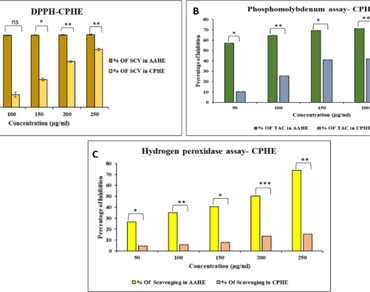
In pharmaceutical research, finding new, safe, and effective natural compounds remains a significant problem, especially for medicines with antioxidant potential and low toxicity. Caulerpa peltata is one of the marine algae that have drawn interest due to its varied chemical profile and potential medical uses. The phytochemical content, antioxidant activity of the hexane extract of Caulerpa peltata (CPHE) were assessed in this study. Flavonoids, alkaloids, terpenoids, tannins, steroids, phytosterols, and saponins were found by phytochemical screening; quantitative analysis showed a high flavonoid content and a low tannin level. 29 compounds were found by GC–MS profiling. Antioxidant assays showed dose-dependent action; at 250 µg/ml, CPHE showed the greatest inhibition in the DPPH (76 ± 0.007%) and phosphomolybdenum (69 ± 0.001%) assays. In contrast to the conventional ascorbic acid hexane extract (73 ± 0.082%, p < 0.05), H2O2 scavenging activity was rather low (15 ± 0.005%). Together, our results show that CPHE's varied phytochemical composition and moderate antioxidant capability make it a promising option for pharmacological and biological uses. Its very low hydrogen peroxide (H2O2) scavenging capacity highlights a drawback, highlighting the necessity of additional mechanistic research, dosage modification, and preclinical animal validation to prove therapeutic applicability.
References
Akbar, S. A., Hasan, M., Pravitasari, A., & Nuzlia, C. (2023). Evaluation of phytochemical composition and metabolite profiling of macroalgae Caulerpa taxifolia and C. peltata from the Banda Aceh coast, Indonesia. Biodiversitas Journal of Biological Diversity, https://doi.org/10.13057/biodiv/d241009
Anokwah D, Kwatia EA, Amponsah IK, Jibira Y, Harley BK, Ameyaw EO, Obese E, Biney RP, Mensah AY (2022) Evaluation of the anti-inflammatory and antioxidant potential of the stem bark extract and some constituents of Aidia genipiflora (DC.) Dandy (rubiaceae). Heliyon 8(8):e10082. https://doi.org/10.1016/j.heliyon.2022.e10082
Belkacemi L, Belalia M, Djendara AC, Bouhadda Y (2020) Antioxidant and antibacterial activities and identification of bioactive compounds of various extracts of Caulerpa racemosa from Algerian coast. Asian Pac J Trop Biomed. https://doi.org/10.4103/2221-1691.275423
Bouafir Y, Bouhenna MM, Nebbaki A, Belfarhi L, Aouzal B, Boufahja F, Bendif H, Bruno M (2025) Algal bioactive compounds: a review on their characteristics and medicinal properties. Fitoterapia 183:106591. https://doi.org/10.1016/j.fitote.2025.106591
Chelliah R, Banan-MwineDaliri E, & Oh D-H (2022). Screening for antioxidant activity: hydrogen peroxide scavenging assay. In D. Dharumadurai (Ed.), Methods in Actinobacteriology (pp. 461–462). Springer US. https://doi.org/10.1007/978-1-0716-1728-1_65
Chi Y, Wang P (2023) Structure, preparation, and biological activity of sulfated polysaccharides from the genus Caulerpa (Chlorophyta): a review. J Appl Phycol. https://doi.org/10.1007/s10811-023-03090-0
Choudhary B, Khandwal D, Gupta NK, Patel J, Mishra A (2023) Nutrient composition, physicobiochemical analyses, oxidative stability and antinutritional assessment of abundant tropical seaweeds from the Arabian Sea. Plants Basel. https://doi.org/10.3390/plants12122302
Dewi E, Purnamayati L, Yuliani Y, Matanjun P (2025) GC-MS analysis and in silico molecular docking study of Caulerpa racemosa microcapsules under heat exposure. Ilmu Kelaut 30:359–372. https://doi.org/10.14710/ik.ijms.30.3.359-372
Dissanayake IH, Bandaranayake U, Keerthirathna LR, Manawadu C, Silva RM, Mohamed B, Ali R, Peiris DC (2022) Integration of in vitro and in-silico analysis of Caulerpa racemosa against antioxidant, antidiabetic, and anticancer activities. Sci Rep 12(1):20848. https://doi.org/10.1038/s41598-022-24021-y
Gedlu M (2022) Phytochemical analysis of some selected traditional medicinal plants in Ethiopia. Bulletin National Res Centre. https://doi.org/10.1186/s42269-022-00770-8
Gulcin İ, Alwasel SH (2023) DPPH radical scavenging assay. Processes Basel. https://doi.org/10.3390/pr11082248
Hejna M, Dell’Anno M, Liu Y, Rossi L, Aksmann A, Pogorzelski G, Jóźwik A (2024) Assessment of the antibacterial and antioxidant activities of seaweed-derived extracts. Sci Rep 14(1):21044. https://doi.org/10.1038/s41598-024-71961-8
Jomova K, Alomar SY, Valko R, Liska J, Nepovimova E, Kuca K, Valko M (2025) Flavonoids and their role in oxidative stress, inflammation, and human diseases. Chem Biol Interact 413:111489. https://doi.org/10.1016/j.cbi.2025.111489
Jomova K, Raptova R, Alomar SY, Alwasel SH, Nepovimova E, Kuca K, Valko M (2023) Reactive oxygen species, toxicity, oxidative stress, and antioxidants: chronic diseases and aging. Arch Toxicol 97(10):2499–2574. https://doi.org/10.1007/s00204-023-03562-9
Kumar A, P N, Kumar M, Jose A, Tomer V, Oz E, Proestos C, Zeng M, Elobeid T, K S, Oz F (2023) Major phytochemicals: recent advances in health benefits and extraction method. Molecules (Basel, Switzerland). https://doi.org/10.3390/molecules28020887
Kurniawan R, Nurkolis F, Taslim NA, Subali D, Surya R, Gunawan WB, Alisaputra D, Mayulu N, Salindeho N, Kim B (2023) Carotenoids composition of green algae Caulerpa racemosa and their antidiabetic, anti-obesity, antioxidant, and anti-inflammatory properties. Molecules Basel. https://doi.org/10.3390/molecules28073267
Lee H, Selvaraj B, Lee J (2021) Anticancer effects of seaweed-derived bioactive compounds. Appl Sci Basel 11:11261. https://doi.org/10.3390/app112311261
Michalak I, Tiwari R, Dhawan M, Alagawany M, Farag MR, Sharun K, Emran TB, Dhama K (2022) Antioxidant effects of seaweeds and their active compounds on animal health and production - a review. Vet Q 42(1):48–67. https://doi.org/10.1080/01652176.2022.2061744
Movahhedin N, Barar J, Fathi Azad F, Barzegari A, Nazemiyeh H (2014) Phytochemistry and biologic activities of Caulerpa peltata native to Oman Sea. Iran J Pharm Res 13(2):515–521
Murugan K, Iyer V (2014) Antioxidant activity and gas chromatographic-mass spectrometric analysis of extracts of the marine algae, Caulerpa peltata and Padina Gymnospora. Indian J Pharm Sci 76:548–552
Oluwole O, Fernando W, Lumanlan J, Ademuyiwa O, Jayasena V (2022) Role of phenolic acid, tannins, stilbenes, lignans and flavonoids in human health – a review. Int J Food Sci Technol. https://doi.org/10.1111/ijfs.15936
Palaniyappan S, Sridhar A, Kari ZA, Téllez-Isaías G, Ramasamy T (2023) Evaluation of phytochemical screening, pigment content, in vitro antioxidant, antibacterial potential and GC-MS metabolite profiling of green seaweed Caulerpa racemosa. Mar Drugs. https://doi.org/10.3390/md21050278
Ponnampalam EN, Kiani A, Santhiravel S, Holman BWB, Lauridsen C, Dunshea FR (2022) The importance of dietary antioxidants on oxidative stress, meat and milk production, and their preservative aspects in farm animals: antioxidant action, animal health, and product quality—invited review. Animals Basel. https://doi.org/10.3390/ani12233279
Rumpf J, Burger R, Schulze M (2023) Statistical evaluation of DPPH, ABTS, FRAP, and Folin-Ciocalteu assays to assess the antioxidant capacity of lignins. Int J Biol Macromol 233:123470. https://doi.org/10.1016/j.ijbiomac.2023.123470
S, A., T V, S. B., Saritha, Shantaram, M., & Sundaramurthy, A. (2017). Seaweed extracts exhibit anticancer activity against HeLa cell lines. International Journal of Current Pharmaceutical Research, 9, 114–117. https://doi.org/10.22159/ijcpr.2017v9i1.16632
Shabir I, Kumar Pandey V, Shams R, Dar AH, Dash KK, Khan SA, Bashir I, Jeevarathinam G, Rusu AV, Esatbeyoglu T, Pandiselvam R (2022) Promising bioactive properties of quercetin for potential food applications and health benefits: a review. Front Nutr 9:999752. https://doi.org/10.3389/fnut.2022.999752
Silva F, Veiga F, Cardoso C, Dias F, Cerqueira F, Medeiros R, Cláudia Paiva-Santos A (2024) A rapid and simplified DPPH assay for analysis of antioxidant interactions in binary combinations. Microchem J 202:110801. https://doi.org/10.1016/j.microc.2024.110801
Sneha P, Vijayakumar S, Devadharshini D, Wadaan MA, Srinivasan P, Vidhya E (2025) Potential benefits of bioactive compounds from seaweed extracts: their prospects and pharmacological promises. Waste Biomass Valoriz 16(7):3413–3425. https://doi.org/10.1007/s12649-024-02833-5
Tanawoot V, Vivithanaporn P, Siangcham T, Meemon K, Niamnont N, Sobhon P, Tamtin M, Sangpairoj K (2021) Hexane extract of seaweed Caulerpa lentillifera inhibits cell proliferation and induces apoptosis of human glioblastoma cells. Sci Technol Asia 26(2):128–137
Vlasaku I, Tomovska J (2024) Determination of antioxidant activity in milk extracts with phosphomolibdate method. South Florida J Dev 5:e4614. https://doi.org/10.46932/sfjdv5n11-015
Wołosiak R, Drużyńska B, Derewiaka D, Piecyk M, Majewska E, Ciecierska M, Worobiej E, Pakosz P (2021) Verification of the conditions for determination of antioxidant activity by ABTS and DPPH assays-a practical approach. Molecules Basel. https://doi.org/10.3390/molecules27010050
Xia X, Hao H, Zhang X, Wong IN, Chung SK, Chen Z, Xu B, Huang R (2021) Immunomodulatory sulfated polysaccharides from Caulerpa racemosa var. peltata induces metabolic shifts in NF-κB signaling pathway in RAW 264.7 macrophages. Int J Biol Macromol 182:321–332. https://doi.org/10.1016/j.ijbiomac.2021.04.025
Author Information
School of Life Sciences, B.S. Abdur Rahman Crescent Institute of Science and Technology, Chennai, India