Vegetos

(An International Journal of Plant Research & Biotechnology)
(eISSN: 2229-4473)
Assessment of microalgal diversity and physicochemical characteristics in tropical wetlands of West Bengal, India
*Article not assigned to an issue yet
Research Articles | Published: 22 July, 2026
First Page: 0
Last Page: 0
Views: 34
Keywords: Microalgae, Wetlands, Physicochemical parameter, Canonical correspondence analysis
Abstract
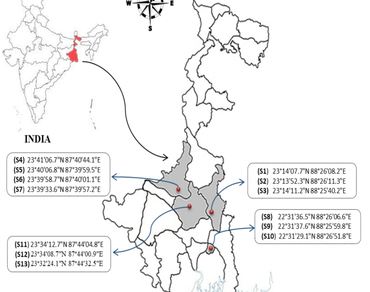
Microalgae play an important role in nutrient cycling and primary productivity in wetland ecosystems and are increasingly recognised for their potential in sustainable biotechnological applications. However, detailed understanding of relationships between microalgal diversity and environmental parameters in tropical Indian wetlands remains limited. In this study, we examined the diversity and distribution of microalgae across thirteen wetlands in West Bengal to explore species–environment relationships and identify potential indicator taxa. A total of 60 taxa were recorded, with Chlorophyceae (50%) as the dominant group, followed by Euglenophyceae (15%), Bacillariophyceae (12%), and Cyanophyceae (12%). Canonical Correspondence Analysis (CCA) was used to examine relationships between community composition and selected physicochemical variables. The analysis explained 29.2% of the total variance in species data and was not statistically significant, indicating that additional environmental factors may influence community patterns. The ordination suggested that Euglena polymorpha was associated with nutrient gradients, while Navicula lanceolata, Chlorella sp., and Desmodesmus sp. aligned with electrical conductivity and dissolved oxygen, whereas Scenedesmus and Pediastrum exhibited broader ecological tolerance. The occurrence of taxa such as Euglena, Phacus, Scenedesmus, Pediastrum, Navicula, and Nitzschia, interpreted using the Palmer Pollution Index, suggests their potential association with nutrient-enriched or organically influenced conditions, although these are considered indicative rather than definitive. Additionally, six microalgal strains were isolated, providing preliminary scope for further investigation. Overall, this study provides baseline information on microalgal diversity and their relationships with environmental variables in tropical wetlands. As the study was conducted during a single pre-monsoon period, further multi-seasonal investigations are required to better understand temporal dynamics and validate the observed patterns.
References
American Public Health Association, American Water Works Association, Water Environment Federation (1992) Standard methods for the examination of water and wastewater, 18th edn. American Public Health Association, Washington, DC
Arumugham S, Joseph SJP, Gopinath P, Nooruddin T, Subramani N (2023) Diversity and ecology of freshwater diatoms as pollution indicators from the freshwater Ponds of Kanyakumari district. Tamilnadu Energy Nexus 9:100164
Baishya A, Chowdhury A, Chakrabarty R, Sengupta S, Das A, Panda A, Bhadoriya UPS, Mandal D (2023) Spatiotemporal analysis and trend detection of groundwater levels using gis techniques in Nadia District of West Bengal, India. J Geol Soc India 99(6):868–874
Banerjee S, Pal R (2017) Morphotaxonomic study of blue green algae from pristine areas of West Bengal with special reference to SEM studies of different morphotypes and four new reports. Phytomorphology 67(3):67–83
Basu T, Mondal BK (2023) Climate-resilient agropolitan approach towards sustainable regional development of Barddhaman District of West Bengal. In: Chatterjee U, Shaw R, Kumar S, Raj AD, Das S (eds) Climate crisis: adaptive approaches and sustainability. Springer Nature Switzerland, Cham, pp 369–403
Begum N, Narayana J, Sayeswara HA (2010) Phytoplankton diversity and pollution indicators of Bathi pond near Davangere-A seasonal study. Environ Conserv J 11(3):75–80
Biswas S, Ghosh S (2022) Estimation of land surface temperature in response to land use/land cover transformation in Kolkata city and its suburban area, India. Int J Urban Sci 26(4):604–631. https://doi.org/10.1080/12265934.2021.1997633
Borgohain D, Tanti B (2014) Diversity of freshwater diatoms from few silica rich habitats of Assam, India. J Res Biology 4(1):1162–1173
Brraich O, Kaur R (2015) Phytoplankton community structure and species diversity of Nangal Wetland, Punjab, India. Int Res J Biol Sci 4(3):76–83
Chattopadhyay RK, Bandyopadhyay K (2015) A preliminary study of the worked bone industry in the middle and lower Ganga valleys: from the Mesolithic to the early historic periods. Studies in South Asian Heritage: Essays in Memory of M Harunur Rashid 225–284
Chellappa NT, Borba JM, Rocha O (2008) Phytoplankton community and physical-chemical characteristics of water in the public reservoir of Cruzeta, RN, Brazil. Brazilian J Biology 68:477–494
Das B, Chakraborty R (2016) Climate change scenario of West Bengal, India: a geo-environmental assessment. Indian Cartogr 36:425–441
Das D, Pathak A, Pal S (2018) Diversity of phytoplankton in some domestic wastewater-fed urban fish pond ecosystems of the Chota Nagpur Plateau in Bankura, India. Appl Water Sci 8(3):84. https://doi.org/10.1007/s13201-018-0726-6
Dasgupta S, Gosain AK, Rao S, Roy S, Sarraf M (2013) A megacity in a changing climate: the case of Kolkata. Clim Change 116:747–766
Davison IR (1991) Environmental effects on algal photosynthesis: temperature. J Phycol 27(1):2–8. https://doi.org/10.1111/j.0022-3646.1991.00002.x
Desikachary TV (1959) Cyanophyta. Indian Council of Agricultural Research, New Delhi
Dey AK, Ghosh AR (2023) Assessment of water quality parameters of an abandoned opencast coal pit (ocp) of asansol-raniganj coalfield (arcf), Paschim Bardhaman, West Bengal, India. Khulna University Studies, pp 69–77
Dimopoulou M, Kolonas A, Stagos D, Gortzi O (2025) A review of the sustainability, chemical composition, bioactive compounds, antioxidant and antidiabetic activity, neuroprotective properties, and health benefits of microalgae. Biomass 5(1):11
Garai S, Mondal A, Dey I, Bose R, Pal R (2025) Decoding the influence of water quality and seasonal shifts on phytoplankton communities in Eastern Indian Freshwater Waterbodies. Limnol Freshw Biology:284–297
Ghosh S, Bhattacharya K (2012) Multivariate erosion risk assessment of lateritic badlands of Birbhum (West Bengal, India): A case study. J Earth Syst Sci 121:1441–1454
Gubelit YI (2022) Opportunistic macroalgae as a component in assessment of eutrophication. Diversity 14(12):1112
Guiry MD (2023) AlgaeBase. World-wide electronic publication. http://www algaebase org
Halder P, Debnath M, Ray S (2019) Occurrence and diversity of microalgae in phytoplankton collected from freshwater community ponds of Hooghly District, West Bengal, India. Plant Sci Today 6(1):8–16. https://doi.org/10.14719/pst.2019.6.1.426
Hammer Ø, Harper DA, Ryan PDothers (2001) PAST: Paleontological statistics software package for education and data analysis. Palaeontologia electronica 4(1):9
Islam A, Das BC, Mahammad S, Hoque MM, Pham QB, Sarkar B, Islam ARMT, Pal SC, Quesada-Román A, Mohinuddin S (2024) Assessing river water quality for ecological risk in the context of a decaying river in India. Environ Sci Pollut Res :1–17
Kadam AD, Kishore G, Mishra DK, Arunachalam K (2020) Microalgal diversity as an indicator of the state of the environment of water bodies of Doon valley in Western Himalaya, India. Ecol Ind 112:106077
Khan A, Chatterjee S, Bisai D (2015) On the long-term variability of temperature trends and changes in surface air temperature in Kolkata Weather Observatory, West Bengal, India. Meteorol Hydrology Water Manage Res Oper Appl 3(2):9–16
Kim YJ (2013) Taxonomic and ecological study of the families Hydrodictyaceae and Coelastraceae, order Chlorococcales, and Class Chlorophyceae in Korea. J Ecol Environ 36(4):421–437
Kumar K, Mishra SK, Choi G-G, Yang J-W (2015) CO2 sequestration through algal biomass production. In: Das D (ed) Algal biorefinery: an integrated approach. Springer International Publishing, Cham, pp 35–57
Lobus NV, Kulikovskiy MS (2023) The co-evolution aspects of the biogeochemical role of phytoplankton in aquatic ecosystems: A review. Biology 12(1):92
Manna T (2023) Rainfall probability and trend analysis for strategic crop planning with their impact on the existing cropping system in the new alluvial plains of West Bengal. J Crop Weed 19(1):220–228. https://doi.org/10.22271/09746315.2023.v19.i1.1683
Miranda J, Krishnakumar G (2015) Microalgal diversity in relation to the physicochemical parameters of some Industrial sites in Mangalore, South India. Environ Monit Assess 187(11):664. https://doi.org/10.1007/s10661-015-4871-1
Mukherjee B, Nivedita M, Mukherjee D (2010) Plankton diversity and dynamics in a polluted eutrophic lake, Ranchi. J Environ Biol 31(5):827
Narchonai G, Arutselvan C, LewisOscar F, Thajuddin N (2019) Deciphering the microalgal diversity and water quality assessment of two urban temple ponds in Pondicherry, India. Biocatal Agric Biotechnol 22:101427. https://doi.org/10.1016/j.bcab.2019.101427
Nather Khan ISA (1991) Effect of urban and industrial wastes on species diversity of the diatom community in a tropical river. Malaysia Hydrobiologia 224(3):175–184. https://doi.org/10.1007/BF00008467
Noll CA (2002) Determination of Nitrate in Boiler Water by Brucine Reagent. In: ACS Publications. https://pubs.acs.org/doi/pdf/10.1021/i560143a007. Accessed 11 Mar 2023
Ogidi OI, Angaye TCN, Carbom HE (2024) Microorganisms in the monitoring of terrestrial and aquatic ecosystems: applications, challenges, and future prospects. In: Izah SC, Ogwu MC, Hamidifar H (eds) Biomonitoring of pollutants in the global south. Springer Nature Singapore, Singapore, pp 639–665
Ozturk BY, Asikkutlu B, Akkoz C, Atici T (2019) Molecular and morphological characterization of several cyanobacteria and chlorophyta species isolated from Lakes in Turkey. TrJFAS 19(8):635–643
Palmer CM (1969) A composite rating of algae tolerating organic pollution. J Phycol 5(1):78–82. https://doi.org/10.1111/j.1529-8817.1969.tb02581.x
Philipose MT (1967) Chlorococcales. Indian Council of Agricultural Research
Prescott GW (1962) Algae of the western Great Lakes area
Rai SV, Rajashekhar M (2014) Effect of pH, salinity and temperature on the growth of six species of marine phytoplankton. J Algal Biomass Utilization 5(4):55–59
Ray A, Mondal D, Chakraborty N, Ganguly S (2023) Phytoplankton diversity in wastewater impacted Indian Ramsar site: a study from East Kolkata Wetland. Environ Monit Assess 195(8):938. https://doi.org/10.1007/s10661-023-11541-x
Ray JG, Santhakumaran P, Kookal S (2021) Phytoplankton communities of eutrophic freshwater bodies (Kerala, India) in relation to the physicochemical water quality parameters. Environ Dev Sustain 23:259–290
Roy AS, Pal R (2015) An investigation on morphotaxonomy and diversity of planktonic chlorophytes from fresh water eutrophic wetland of Indian Ramsar site. Phykos 45(2):29–42
Roy AS, Pal R (2016) Fresh water euglenophytes from East Kolkata wetlands-A Ramsar site. Phytomorphology 66:113–121
Rudra K (2018) Rivers of the Ganga-Brahmaputra-Meghna Delta. Springer International Publishing, Cham
Saha S, Mandal A, Sahoo D (2017) Study of physico-chemical parameters of three different urban pond water of Nadia district, West-Bengal, India. Int J Fisheries Aquat Stud 5(6):23–27
Satpati GG, Pal R (2017) Taxonomic diversity and SEM study of Euglenoids from brackish water ecosystems of Indian Sundarbans Biosphere Reserve. Phykos 47(1):105–122
Sharathchandra K, Sridhar KR (2022) Cyanobacterial diversity in eight lentic habitats of temples in Southwest India. Species 23(71):99–107
Sharma LK, Naik R (2024) Wetland Ecosystems. Conservation of Saline Wetland Ecosystems. Springer Nature Singapore, Singapore, pp 3–32
Shetty K, Gulimane K (2023) Application of microalgal diversity in assessing the water quality of freshwater ponds. Environ Monit Assess 195(5):595. https://doi.org/10.1007/s10661-023-11116-w
Sletten O, Bach CM (1961) Modified stannous chloride reagent for orthophosphate determination. J Am Water Works Assoc 53(8):1031–1033
Srinivas L, Seeta Y, Reddy PM (2018) Bacillariophyceae as ecological indicators of water quality in Manair Dam, Karimnagar, India. Int J Sci Res Sci Tech 4(2):468–474
Stark JR, Cardon ZG, Peredo EL (2020) Extraction of high-quality, high‐molecular‐weight DNA depends heavily on cell homogenization methods in green microalgae. Appl Plant Sci 8(3):e11333. https://doi.org/10.1002/aps3.11333
Subramanian KG, Dhanushkodi M, Satyapriyan A, Nagarajan M, Muthuvinayagam P, Nallathambi M, Prabu E, Rajendiran D, Muthusamy G (2023) An Intensive Study on Algal Diversity in the Ancient Man-Made Aquatic Ecosystem of Tiruvallur, South India: exploration for sustainable development. Mol Biotechnol. https://doi.org/10.1007/s12033-023-00817-9
Sultana S, Khan S, Shaika NA, Hena SM, Mahmud Y, Haque MM (2024) Ecology of freshwater harmful euglenophytes: a review. Heliyon 10(8):e29625. https://doi.org/10.1016/j.heliyon.2024.e29625
Ter Braak CJF, Smilauer P (2002) CANOCO reference manual and CanoDraw for windows user’s guide: software for canonical community ordination (version 4.5). https://www.canoco.com
Thapa R, Gupta S, Guin S, Kaur H (2017) Assessment of groundwater potential zones using multi-influencing factor (MIF) and GIS: a case study from Birbhum district, West Bengal. Appl Water Sci 7(7):4117–4131. https://doi.org/10.1007/s13201-017-0571-z
Tortell PD, DiTullio GR, Sigman DM, Morel FMM (2002) CO2 effects on taxonomic composition and nutrient utilization in an Equatorial Pacific phytoplankton assemblage. Mar Ecol Prog Ser 236:37–43. https://doi.org/10.3354/meps236037
Vanden Heuvel JP (2012) Nutrigenomics and nutrigenetics of ω3 polyunsaturated fatty acids. Prog Mol Biol Transl Sci 108:75–112
Viaroli P, Bartoli M, Giordani G, Naldi M, Orfanidis S, Zaldivar JM (2008) Community shifts, alternative stable states, biogeochemical controls and feedbacks in eutrophic coastal lagoons: a brief overview. Aquat Conserv: Mar Freshw Ecosyst 18(S1):S105–S117. https://doi.org/10.1002/aqc.956
Whittaker RH (1960) Vegetation of the Siskiyou mountains, Oregon and California. Ecol Monogr 30(3):279–338
Winkler LW (1888) The determination of dissolved oxygen in water. Berlin DeutChem Gas 21:2843–2855
Author Information
Department of Botany, Visva-Bharati (A Central University), Santiniketan, India