Vegetos

(An International Journal of Plant Research & Biotechnology)
(eISSN: 2229-4473)
Augmentation in growth and physiology of eggplant (Solanum melongena) by the utilization of chicken feather compost prepared using Bacillus cereus
*Article not assigned to an issue yet
Research Article | Published: 20 August, 2025
First Page: 0
Last Page: 0
Views: 446
Keywords: Chicken feather, Compost, n Solanum melongenan , n Bacillus cereusn
Abstract
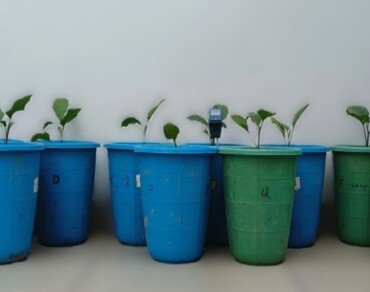
Chicken feather compost, rich in organic matter and essential nutrients, can significantly enhance crop growth and physiological performance. This study evaluates the impact of chicken feather compost on Solanum melongena (Pusa Brinjal Long) growth under varying compost levels (6 and 12%). The optimized composting conditions, identified using Response Surface Methodology (RSM), included 6.25% chicken feathers and 12% Bacillus cereus inoculum. Results showed significant improvements in plant height, leaf area, biomass, flower and fruit production, chlorophyll content, and physiological processes with compost treatments compared to the control. 12% compost treatment resulted in 23.2% taller plants at 40 DAT and 15.9% taller plants at 75 DAT compared to the control. Leaf area increased by 7.91%, while total chlorophyll content rose by 45.3% in 12% compost group relative to the control. Physiological measurements indicated 43% higher photosynthetic rate and 79.1% reduction in respiration rate in 12% compost group compared to the control, reflecting improved metabolic efficiency. Shoot fresh weight and dry weight were 7.65% and 47.3% higher in 12% compost group, while root fresh weight increased by 40% and root dry weight by 85.6%. Total fruit yield in 12% compost group was 627.4% higher than the control. These findings highlight the effectiveness of chicken feather compost as an organic amendment for enhancing plant growth, yield, and physiological performance. This research underscores the potential of repurposing poultry waste into nutrient-rich compost, promoting sustainable agricultural practices while addressing waste management challenges.
References
Abad M, Noguera P, Bures S (2001) National inventory of organic wastes for use as growing media for ornamental potted plant production: case study in Spain. Bioresour Technol 77(2):197–200. https://doi.org/10.1016/S0960-8524(00)00152-8
Adediran JA, Taiwo LB, Akande MO, Sobulo RA, Idowu OJ (2004) Application of organic and inorganic fertilizer for sustainable maize and cowpea yields in Nigeria. J Plant Nutr 27(7):1163–1181. https://doi.org/10.1081/PLN-120038542
Al Mamun S, Rahman MH, Ali M (2019) Organic amendment effects on soil properties, plant growth, and biomass. Agric Soil Manage 12(4):123–130. https://doi.org/10.1016/j.soilman.2019.10.007
Amalia L, Budiasih R, Ria E, Widodo R, Kuswati U (2020) Fermented compost and N-fertilizer for enhancing the growth and productivity of purple eggplant on vertisols. Open Agric 5(1):898–904. https://doi.org/10.1515/opag-2020-0084
Ashokkumar N, Muruganantham M, Dharani S (2020) Effect of organic amendments in Brinjal (Solanum melongena L). Int J Adv Res Biol Sci 7(2):143–148. https://doi.org/10.2219/ijarbs.2020.07.02.014
Cozzolino E, Salluzzo A, Piano Ld, Tallarita AV, Cenvinzo V, Cuciniello A, Cerbone A, Lombardi P, Caruso G (2023) Effects of the application of a plant-based compost on yield and quality of industrial tomato (Solanum lycopersicum L.) grown in different soils. Appl Sci 13(14):8401. https://doi.org/10.3390/app13148401
Fageria NK, Baligar VC, Jones CA (2006) Growth and mineral nutrition of field crops. CRC Press
Gondek M, Weindorf DC, Thiel C, Kleinheinz G (2020) Soluble salts in compost and their effects on soil and plants: a review. Compost Sci Util 28(2):59–75. https://doi.org/10.1080/1065657X.2020.1772906
Hargreaves JC, Adl MS, Warman PR, Rupasinghe HPV (2008) The effects of organic amendments on soil biological, chemical, and physical properties and the production of lettuce and cabbage in a home gardening system. Biores Technol 99(9):3801–3808. https://doi.org/10.1016/j.biortech.2007.07.043
Hassan ME, Ahmed A, Wang X (2023) Synergistic effects of compost and biochar on soil properties and crop productivity: A meta-analysis. Agronomy 13(5):789–805. https://doi.org/10.3390/agronomy13050789
Kaur P, Singh J, Dhillon NS (2021) Impact of nutrient management on chlorophyll content and photosynthesis in plants. J Plant Nutr 44(3):465–480. https://doi.org/10.1080/01904167.2020.1867834
Kim JH, Lee SW, Park KH (2021) Optimization of keratinase production from Bacillus cereus for effective feather composting. Biores Technol 320:124–136. https://doi.org/10.1016/j.biortech.2021.123587
Lazcano C, Arnold J, Tato A, Domínguez J (2008) Compost and vermicompost as soil amendments for organic agriculture. Biores Technol 99(7):3155–3159. https://doi.org/10.1016/j.biortech.2007.07.123
Lee CH, Tan SH, Lim WJ (2022) Enhancing the agronomic value of poultry feather compost: Advances in microbial inoculants. J Agric Sci Biotechnol 25(3):78–90. https://doi.org/10.1007/s11056-022-1048-3
Lin D, Chen Q, Zhang Y (2024) Effects of organic amendments on photosynthesis and plant growth in horticultural crops. J Plant Physiol 251:104–113. https://doi.org/10.1016/j.jplph.2024.104113
Marschner P (2012) Marschner’s mineral nutrition of higher plants. Academic Press
Martinez R, Kumar P, Singh A (2022) Impact of organic amendments on plant hormone synthesis and stress resistance in arid soils. Environ Sci Adv 15(4):112–125. https://doi.org/10.1038/esa.2022.34
Nguyen TT, Marschner P, McNeill A (2012) Impact of organic amendments on the phosphorus availability in an alkaline soil. Aust J Soil Res 50(7):485–493. https://doi.org/10.1071/SR12014
Pandey R, Sharma D, Pathak H (2019) Organic amendments and their role in chlorophyll synthesis and photosynthetic efficiency in crops. Soil Use Manage 35(2):215–226. https://doi.org/10.1111/sum.12451
Patel A, Yadav S, Mehta R (2021) Role of organic amendments in drought resilience and crop productivity. Agron Adv 18(2):54–72. https://doi.org/10.1016/j.agronadv.2021.03.005
Poorter H, Niklas KJ, Reich PB, Wright IJ (2012) Biomass allocation to roots and shoots: A meta-analysis. Funct Ecol 26(4):736–748. https://doi.org/10.1111/j.1365-2435.2012.02092.x
Rivera D, Garcia L, Munoz J (2022) Microbial-mediated keratin degradation: insights into sustainable composting practices. Waste Manag Res 40(1):23–39. https://doi.org/10.1177/0734242X21106698
Singh A, Verma S, Bhardwaj R (2020) Organic amendments enhance chlorophyll content and photosynthetic efficiency in crops. J Agric Sci 12(7):68–77. https://doi.org/10.5539/jas.v12n7p68
Singh T, Choudhary R, Sharma V (2023) Feather composting trends: addressing waste management and nutrient recycling. Compost Sci Util 31(1):14–26. https://doi.org/10.1080/1065657X.2023.105789
Soon SM, Tan WH, Lim CK (2023) Innovative microbial approaches for keratin degradation and compost production from poultry feathers. Waste Manage 154:12–25. https://doi.org/10.1016/j.wasman.2023.01.045
Tan HM, Lee JK, Ong WL (2023) Biotechnological advancements in keratinolytic bacteria for efficient compost production. Biotechnol Adv 41:107–115. https://doi.org/10.1016/j.biotechadv.2023.100058
Tian H, Zhou Z, Li X (2012) Role of organic amendments in improving root biomass and nutrient uptake. J Agric Res 54(5):890–896. https://doi.org/10.1016/j.agrres.2012.05.004
Tiquia SM, Tam NFY, Hodgkiss IJ (1996) Compost applications and plant growth performance. Compost Sci Util 4(3):20–34. https://doi.org/10.1080/1065657X.1996.10701892
Wang K, He Z, Li Y (2016) Effect of organic amendments on soil nutrient availability and crop growth: a review. Agric Res 5(4):225–232
Wei Z, Xi B, Zhao Y, Wang S (2017) Effect of compost application on soil organic matter and crop yield in a long-term field experiment. Soil Sci Plant Nutr 63(3):227–234. https://doi.org/10.1080/00380768.2017.1326723
Wright J, Kenner S, Lingwall B (2022) Utilization of compost as a soil amendment to increase soil health and to improve crop yields. Open J Soil Sci 12:216–224. https://doi.org/10.4236/ojss.2022.126009
Zhang X, Patel R, Brown J (2023) Advances in utilizing poultry feathers for sustainable agriculture: challenges and opportunities. J Agric Sci Technol 18(2):102–118. https://doi.org/10.1007/s10661-023-1012-9
Author Information
Department of Environmental Sciences, Maharshi Dayanand University, Rohtak , India