Vegetos

(An International Journal of Plant Research & Biotechnology)
(eISSN: 2229-4473)
Biofumigation efficacy of Brassica spp. against Alternaria brassicae: species, tissue type, dose, and in vivo suppression
*Article not assigned to an issue yet
Rao Yaragorla Hanumantha, Srivastava Mukesh, Singh Siddharth
Research Articles | Published: 19 September, 2026
First Page: 0
Last Page: 0
Views: 7
Keywords: Biofumigation, n Alternaria brassicaen , Glucosinolates, Isothiocyanates, n Brassica spp., Dose–response, Conidial germination, Pot experiment
Abstract
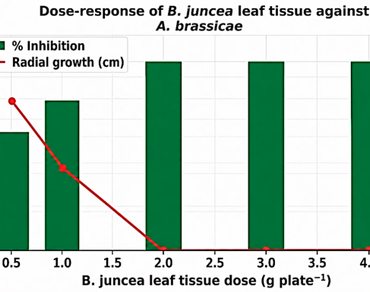
Alternaria blight, caused by Alternaria brassicae (Berk.) Sacc., inflicts yield losses of 15–71% in mustard (Brassica juncea L.) across India. Biofumigation exploits volatile isothiocyanates (ITCs) released upon myrosinase-mediated hydrolysis of glucosinolates in disrupted Brassica tissues as an eco-friendly alternative to fungicides. Six experiments evaluated: sealing delay (immediate to 48 h) on antifungal efficacy (Experiments I–II, replicated independently); species- and tissue-type comparisons (B. juncea, B. nigra, B. oleracea; leaf, stem, seed meal) at 2.0 g plate?1 (Experiment III); dose–response (0.5–4.0 g plate?1; Experiment IV); conidial germination and germ-tube elongation inhibition (Experiment V); and an in vivo pot experiment with soil incorporation or surface mulch at 5 and 10 t ha?1 equivalents (Experiment VI). Immediate sealing achieved 100% inhibition of mycelial growth and zero conidial germination; both declined progressively with delayed containment. B. juncea leaf tissue outperformed all other species and tissues. The minimum effective dose for complete in vitro suppression was 2.0 g plate?1. In vivo, B. juncea leaf soil incorporation at 10 t ha?1 reduced disease incidence by 89.97% and PDI by 85.96%, approaching mancozeb efficacy, while significantly restoring plant height, leaf number, chlorophyll content and dry biomass. These findings establish a quantitative, multi-scale framework for optimising Brassica residue biofumigation against A. brassicae in mustard cropping systems.
References
Abdel-Massih RM, Debs E, Othman L, Attieh J, Cabrerizo FM (2023) Glucosinolates, a natural chemical arsenal: more to tell than the myrosinase story. Front Microbiol 14:1130208. https://doi.org/10.3389/fmicb.2023.1130208
Atharvaveda (ca. 1000 BCE). Atharvaveda Samhita (R. T. H. Griffith, Trans., 1895). Munshiram Manoharlal Publishers, New Delhi.
Aung SLL, Liu F-Y, Gou Y-N, Nwe ZM, Yu Z-H, Deng J-X (2024) Morphological and phylogenetic analyses reveal two new Alternaria species from plants in the family Cucurbitaceae in China. MycoKeys 107:125–139. https://doi.org/10.3897/mycokeys.107.124814
Baghel MM, Singh R (2024) Impact of weather variables on the severity of Alternaria brassicae blight in Indian mustard. Indian J Ecol 51(4):905–911
Chauhan JS, Verma KP (2022) Eco-friendly management strategies for Alternaria brassicae blight of mustard. Indian Phytopathol 75(1):45–56
Government of India (2024) Agricultural statistics at a glance 2024. Ministry of Agriculture and Farmers Welfare, New Delhi
Kaushik P, Kaushik P (2025) Ecological and societal diversity in the epic Padmaavat. Today and Tomorrow’s Printers & Publishers, New Delhi, pp 1–348
Kirkegaard JA, Gardner PA, Desmarchelier JM and Angus JF (1993). Biofumigation using Brassica species to control pests and diseases. Proceedings of the 9th Australian Research Assembly on Brassicas, pp. 77–82.
Kirkegaard JA, Sarwar M (1998) Biofumigation potential of brassicas. I. Variation in glucosinolate profiles of diverse field-grown brassicas. Plant Soil 201:71–89. https://doi.org/10.1023/A:1004364713152
Kumar D, Maurya N, Bharati YK, Kumar A, Kumar K, Srivastava K, Chand G, Kushwaha C, Singh SK, Mishra RK, Kumar A (2014) Alternaria brassicae blight of oilseed Brassicas: a comprehensive review. Afr J Microbiol Res 8(30):2816–2829. https://doi.org/10.5897/AJMR2013.6434
Meena S, Godika S, Ghasolia RP, Sumitra NN, Kardam VK (2022) Management of Alternaria brassicae blight of mustard through plant extracts and fungicides. Pharma Innovation 11(1):58–67
Morra MJ, Kirkegaard JA (2002) Isothiocyanate release from soil-incorporated Brassica tissues. Soil Biol Biochem 34(11):1683–1690. https://doi.org/10.1016/S0038-0717(02)00153-0
Pandey R, Singh K, Yadav P (2021) Effect of biofumigation using mustard residues on suppression of Alternaria brassicae under laboratory conditions. Journal of Plant Disease Sciences 16(2):134–140
Pandey MK, Ahmad MM, Siddiqui S, Kumar A, Singh SK, Rai D (2024) Survey on disease incidence of Alternaria brassicae blight of mustard in Eastern and Central Uttar Pradesh. Int J Plant Environ 10(1):69–75
Plaszkó T, Sz?cs Z, Vasas G, Gonda S (2021) Effects of glucosinolate-derived isothiocyanates on fungi: mechanisms and applications. J Fungi 7(7):539. https://doi.org/10.3390/jof7070539
Rosa EAS, Heaney RK, Fenwick GR, Portas CAM (1997) Glucosinolates in crop plants. Hortic Rev 19:99–215. https://doi.org/10.1002/9780470650622.ch3
Sarwar M, Kirkegaard JA, Wong PTW, Desmarchelier JM (1998) Biofumigation potential of brassicas. III. Toxicity of isothiocyanates to fungal pathogens. Plant Soil 201:103–112. https://doi.org/10.1023/A:1004381129991
Saxena P, Kumar A, Singh R (2023) Evaluation of biofumigation efficiency using mustard cake amendments against Alternaria brassicae. Crop Prot 169:106250
Zhang M, Li YC, Bi Y, Wang TL, Dong YP, Yang Q, Zhang T (2020) 2-Phenylethyl isothiocyanate exerts antifungal activity against Alternaria alternata. Toxins (Basel) 12:124. https://doi.org/10.3390/toxins12020124
Author Information
Department of Plant Pathology, Chandra Shekhar Azad University of Agriculture and Technology, Kanpur, India