Vegetos

(An International Journal of Plant Research & Biotechnology)
(eISSN: 2229-4473)
Characterization of methanotrophs: phylogenetic, motif, and structural insights into Methylococcus capsulatus MS01 and Methylobacter luteus MS02 from environmental sediment
*Article not assigned to an issue yet
Logeshwaran M., Sheba V. Miriam, Nandakumar R., Prathiviraj R., Jayaprakashvel M., Prasath B. Balaji
Short Communication | Published: 17 August, 2026
First Page: 0
Last Page: 0
Views: 73
Keywords: Methanotrophs, 16S rRNA sequencing, RNA secondary structure, Motif enrichment
Abstract
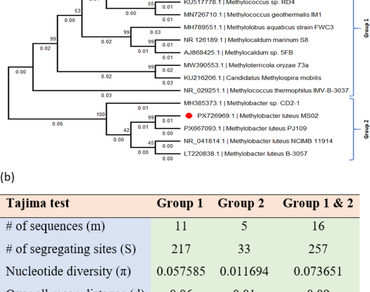
Methanotrophic bacteria are instrumental in limiting methane emissions from terrestrial sediments. However, there is a lack of representation of cultivated sediment-derived isolates from Indian agroecosystems in molecular and evolutionary studies. Herein, we report the isolation and taxonomic characterization of two aerobic methanotrophic bacteria, Methylococcus capsulatus MS01 (NCBI accession: PX726968.1) and Methylobacter luteus MS02 (NCBI accession: PX726969.1) from paddy field sediments in Tamil Nadu, India. The characterization involved 16S rRNA gene phylogeny, motif enrichment analysis, and RNA secondary structure prediction. Phylogenetic reconstruction indicated that MS01 and MS02 were closely associated with M. capsulatus CIa and M. luteus PJ109, respectively, supported by high bootstrap values (100%) and low pairwise genetic distances (0.009 and 0.007). Evolutionary neutrality test using Tajima’s D suggested both groups followed near, neutral evolutionary patterns. Motif analysis revealed three conserved sequence motifs shared by the isolates and their closest phylogenetic relatives. Furthermore, RNA secondary structure prediction using mFold showed similar minimum free energy values between the target and reference strains, suggesting structural conservation at the species-level. These findings confirm the taxonomic affiliation and evolutionary stability of the isolated methanotrophs and provide molecular insights into cultured sediment-derived methanotrophs from Indian paddy ecosystems.
References
Akinsemolu AA, Onyeaka HN (2024) Can Methylococcus capsulatus revolutionize methane capture and utilization for sustainable energy production? SynBio 2(3):311–328. https://doi.org/10.3390/synbio2030019
Altschul SF, Gish W, Miller W, Myers EW, Lipman DJ (1990) Basic local alignment search tool. J Mol Biol 215(3):403–410. https://doi.org/10.1016/S0022-2836(05)80360-2
Altshuler I, Raymond-Bouchard I, Magnuson E et al (2022) Unique high Arctic methane metabolizing community revealed through in situ 13CH4-DNA-SIP enrichment in concert with genome binning. Sci Rep 12:1160. https://doi.org/10.1038/s41598-021-04486-z
Bailey TL, Johnson J, Grant CE, Noble WS (2015) The MEME suite. Nucleic Acids Res 43(W1):W39-49. https://doi.org/10.1093/nar/gkv416
Braverman JM, Hudson RR, Kaplan NL, Langley CH, Stephan W (1995) The hitchhiking effect on the site frequency spectrum of DNA polymorphisms. Genetics 140(2):783–796. https://doi.org/10.1093/genetics/140.2.783
Chen KH, Feng J, Bodelier PLE et al (2024) Metabolic coupling between soil aerobic methanotrophs and denitrifiers in rice paddy fields. Nat Commun 15:3471. https://doi.org/10.1038/s41467-024-47827-y
Cheng C, He Q, Zhang J, Chen B, Pavlostathis SG (2022) Is the role of aerobic methanotrophs underestimated in methane oxidation under hypoxic conditions? Sci Total Environ 833:155244. https://doi.org/10.1016/j.scitotenv.2022.155244
Conrad R (2009) The global methane cycle: recent advances in understanding the microbial processes involved. Environ Microbiol Rep 1:285–292. https://doi.org/10.1111/j.1758-2229.2009.00038.x
Culpepper MA, Rosenzweig AC (2014) Structure and protein–protein interactions of methanol dehydrogenase from Methylococcus capsulatus (Bath). Biochemistry 53(39):6211–6219. https://doi.org/10.1021/bi500850j
Esson KC, Lin X, Kumaresan D, Chanton JP, Murrell JC, Kostka JE (2016) Alpha- and gammaproteobacterial methanotrophs codominate the active methane-oxidizing communities in an acidic boreal peat bog. Appl Environ Microbiol 82(8):2363–2371. https://doi.org/10.1128/AEM.03640-15
Guerrero-Cruz S, Vaksmaa A, Horn MA, Niemann H, Pijuan M, Ho A (2021) Methanotrophs: discoveries, environmental relevance, and a perspective on current and future applications. Front Microbiol 12:678057. https://doi.org/10.3389/fmicb.2021.678057
Hall TA (1999) BioEdit: a user-friendly biological sequence alignment editor and analysis program for Windows 95/98/NT. Nucleic Acids Symp Ser 41:95–98
He L, Groom JD, Wilson EH, Fernandez J, Konopka MC, Beck DAC, Lidstrom ME (2023) A methanotrophic bacterium to enable methane removal for climate mitigation. Proc Natl Acad Sci USA 120(35):e2310046120. https://doi.org/10.1073/pnas.2310046120
He Y, Yang Y, Huang H, Yang W, Ren B, Hu Q, Jin J, Wen S, Cheng H, Shen L (2024) Spatio-temporal variations in activity of aerobic methane oxidation and community structure of methanotrophs in sediment of Wuxijiang river. Environ Pollut 363(Pt 2):125200. https://doi.org/10.1016/j.envpol.2024.125200
Katoh K, Standley DM (2013) MAFFT multiple sequence alignment software version 7: improvements in performance and usability. Mol Biol Evol 30(4):772–780. https://doi.org/10.1093/molbev/mst010
Khider MLK, Brautaset T, Irla M (2021) Methane monooxygenases: central enzymes in methanotrophy with promising biotechnological applications. World J Microbiol Biotechnol 37(4):72. https://doi.org/10.1007/s11274-021-03038-x
Kimura M (1980) A simple method for estimating evolutionary rate of base substitutions through comparative studies of nucleotide sequences. J Mol Evol 16:111–120
Kumar S, Stecher G, Li M, Knyaz C, Tamura K (2018) MEGA X: molecular evolutionary genetics analysis across computing platforms. Mol Biol Evol 35(6):1547–1549. https://doi.org/10.1093/molbev/msy096
Lakshmikanth AR, Rangesh K, Chellapandi P, Prathiviraj R, Anand M (2023) Inter and intra-specific relationship between goat fishes Upeneus vittatus (Forsskal, 1775) and Upeneus tragula based on their mtCOI gene from Palk Bay and Gulf of Mannar Coast (Mandapam, Tamil Nadu) of India. Gene Rep 30:101713. https://doi.org/10.1016/j.genrep.2022.101713
Manivel G, Mathews Lurth Raj D, Prathiviraj R, Senthilraja P (2020) Distribution of phylogenetic proximity upon species-rich marine Ascomycetes with reference to Pichavaram mangrove soil sediment of southern India. Gene Rep 21:100878. https://doi.org/10.1016/j.genrep.2020.100878
Manovina M, Thamarai Selvi B, Prathiviraj R, Selvin J (2022) Potential probiotic properties and molecular identification of lactic acid bacteria isolated from fermented millet porridge or ragi koozh and jalebi batter. Anim Gene 26:200134. https://doi.org/10.1016/j.angen.2022.200134
Murugan R, Prathiviraj R, Mothay D, Chellapandi P (2020) Evolution-guided optimization for selecting site-directed mutagenesis sites of Agrobacterium tumefaciens Uronate dehydrogenase. Asian J Microbiol Biotechnol Environ Sci 22(1):140–148
Nei M, Kumar S (2000) Molecular evolution and phylogenetics. Oxford University Press, pp 352. ISBN-13: 978-0195135855.
Nguyen NL, Yu WJ, Gwak JH, Kim SJ, Park SJ, Herbold CW, Kim JG, Jung MY, Rhee SK (2018) Genomic insights into the acid adaptation of novel methanotrophs enriched from acidic forest soils. Front Microbiol 9:1982. https://doi.org/10.3389/fmicb.2018.01982
Prathaban M, Prathiviraj R, Mythili R, Sharmila Devi N, Sobanaa M, Selvin J, Varadharaju C (2024) Integrated bioprocess for carbon dioxide sequestration and methanol production. Bioresour Technol 404:130847. https://doi.org/10.1016/j.biortech.2024.130847
Prathiviraj R, Chellapandi P (2020) Evolutionary genetic analysis of unassigned peptidase clan-associated microbial virulence and pathogenesis. Biologia 75:2083–2092. https://doi.org/10.2478/s11756-020-00529-4
Rahalkar MC, Khatri K, Pandit P, Bahulikar RA, Mohite JA (2021) Cultivation of important methanotrophs from Indian rice fields. Front Microbiol 12:669244. https://doi.org/10.3389/fmicb.2021.669244
Rognes T, Flouri T, Nichols B, Quince C, Mahé F (2016) VSEARCH: a versatile open source tool for metagenomics. PeerJ 4:e2584. https://doi.org/10.7717/peerj.2584
Saitou N, Nei M (1987) The neighbor-joining method: a new method for reconstructing phylogenetic trees. Mol Biol Evol 4(4):406–425. https://doi.org/10.1093/oxfordjournals.molbev.a040454
Schmitz RA, Peeters SH, Versantvoort W, Picone N, Pol A, Jetten MSM, Op den Camp HJM (2021) Verrucomicrobial methanotrophs: ecophysiology of metabolically versatile acidophiles. FEMS Microbiol Rev 45(5):fuab007. https://doi.org/10.1093/femsre/fuab007
Semrau JD, DiSpirito AA, Gu W, Yoon S (2018) Metals and methanotrophy. Appl Environ Microbiol 84:e02289-17. https://doi.org/10.1128/AEM.02289-17
Sheba VM, Srinivas MA, Aditya P, Kumar CP, Begum TN (2024a) Activity and identification of culturable methanotrophs from mangrove sediments, South East Coast of India. J Pure Appl Microbiol 18(3):1799–1806. https://doi.org/10.22207/JPAM.18.3.28
Sheba V, Jayaprakash J, Nisha PG, Balaji Prasath B, Debora S, Nargis Begum T (2024b) Influence of seasons and environmental variables on methane dynamics in the Muthukuda mangrove sediments of Tamil Nadu. J Environ Biol 45:438–445
Sivan O, Shusta SS, Valentine DL (2016) Methanogens rapidly transition from methane production to iron reduction. Geobiology 14(2):190–203
Sobanaa M, Prathiviraj R, Selvin J, Prathaban M (2024) A comprehensive review on methane’s dual role: effects in climate change and potential as a carbon–neutral energy source. Environ Sci Pollut Res 31:10379–10394. https://doi.org/10.1007/s11356-023-30601-w
Tajima F (1989) Statistical methods to test for nucleotide mutation hypothesis by DNA polymorphism. Genetics 123:585–595
Ward ND et al (2020) Pathways for methane emissions and oxidation that influence the net carbon balance of a subtropical cypress swamp. Front Earth Sci. https://doi.org/10.3389/feart.2020.573357
Zuker M (2003) Mfold web server for nucleic acid folding and hybridization prediction. Nucleic Acids Res 31(13):3406–3415. https://doi.org/10.1093/nar/gkg595
St?pniewska Z, Ku?niar A (2014) Cultivation and detection of endophytic aerobic methanotrophs isolated from Sphagnum species as a perspective for environmental biotechnology. AMB Express 4:58. https://doi.org/10.1186/s13568-014-0058-3
Whittenbury R, Phillips KC, Wilkinson JF (1970) Enrichment, isolation and some properties of methane-utilizing bacteria. J Gen Microbiol. 61(2):205–218. https://doi.org/10.1099/00221287-61-2-205
Author Information
Department of Biotechnology, Microbiology and Bioinformatics, National College, Trichy, India