Vegetos

(An International Journal of Plant Research & Biotechnology)
(eISSN: 2229-4473)
Chemical composition and herbicidal activity of essential oil from flowering shoots of Mesosphaerum suaveolens (L.) Kuntze against five weeds
*Article not assigned to an issue yet
Research Article | Published: 11 September, 2025
First Page: 0
Last Page: 0
Views: 369
Keywords: Essential oil, n Mesosphaerum suaveolensn , Germination, Inhibitory effect, Weed-suppressing activity, Green pesticides
Abstract
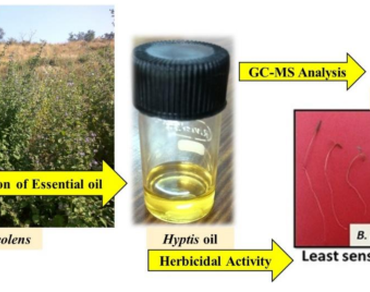
Essential oils are considered “green pesticides” for controlling weeds due to their eco-friendly nature and phytotoxic potential. The Lamiaceae family, known for being highly aromatic and rich in essential oils, is a popular choice for exploring herbicidal potential. In this study, we analyzed the chemical constituents of the essential oil extracted from flowering shoots of Mesosphaerum suaveolens, and evaluated its herbicidal potential against some weeds (i.e., Parthenium hysterophorus, Bidens pilosa, Amaranthus viridis, Phalaris minor, and Cyperus rotundus). The hydro-distilled essential oil obtained from the flowering shoots of M. suaveolens was analysed by Gas Chromatography-Mass Spectrometry (GC-MS). The GC-MS analysis showed that the oil contains a mixture of monoterpenes (52%), sesquiterpenes (32.7%), and diterpenes (11.7%). The main chemical constituents found were sabinene (17.2%), β-caryophyllene (14.4%), and limonene (7.8%). Laboratory bioassay studies demonstrated that the M. suaveolens oil treatment (0.5 to 2.5 mg mL− 1) significantly reduced the seed germination percentage, seedling length, and biomass of all the selected weeds dose-dependently. Among the tested weeds, the essential oil treatment (at 1.5 mg mL− 1) showed maximum complete inhibitory effect on germination of P. hysterophorus indicating it is the most sensitive weed. In contrast, at the same concentration, there was minimal effect on B. pilosa, making it the most resistant species tested. The study concluded that the chemical constituents in M. suaveolens oil possess weed-suppressing activity and could be used as an eco-friendly alternative for weed management practices.
Graphical abstract

References
Abd-ElGawad AM, Elshamy AI, El‐Nasser El Gendy A, Al‐Rowaily SL, Assaeed AM (2019) Preponderance of oxygenated sesquiterpenes and diterpenes in the volatile oil constituents of Lactuca serriola L. revealed antioxidant and allelopathic activity. Chem Biodivers 16:e1900278
Angelini LG, Carpanese G, Cioni PL, Morelli I, Macchia M, Flamini G (2003) Essential oils from mediterranean lamiaceae as weed germination inhibitors. J Agric Food Chem 51:6158–6164
Asekun OT, Ekundayo O (2000) Essential oil constituents of Hyptis suaveolens (L.) Poit.(bush tea) leaves from Nigeria. J Essent Oil Res 12:227–230
Azevedo NR, Campos IF, Ferreira HD, Portes TA, Santos SC, Seraphin JC, Paula JR, Ferri PH (2001) Chemical variability in the essential oil of Hyptis suaveolens. Phytochemistry 57(5):733–736
Batish DR, Singh HP, Kaur M, Kohli RK, Singh S (2012) Chemical characterization and phytotoxicity of volatile essential oil from leaves of Anisomeles indica (Lamiaceae). Biochem Syst Ecol 41:104–109
Batish DR, Singh HP, Setia N, Kohli RK, Kaur S, Yadav SS (2007) Alternative control of littleseed canary grass using eucalypt oil. Agron Sustain Dev 27:171–177
Bezerra JW, Santos MD, Meiado MV, Linhares KV, Boligon AA, Leandro CD, Silva MA (2018) Allelopathy of aromatic species on the germination of Cereus Jamacaru DC. Subsp. Jamacaru (Cactaceae). J Agr Sci 10(11):337–348
Casella F, Vurro M, Valerio F, Perrino EV, Mezzapesa GN, Boari A (2023) Phytotoxic effects of essential oils from six lamiaceae species. Agronomy 13(1):257
Chhokar RS, Sharma RK, Pundir AK, Singh RK (2007) Evaluation of herbicides for control of Rumex dentatus, Convolvulus arvensis and Malva parviflora. Indian J Weed Sci 39:214–218
Chhokar RS, Singh S, Sharma RK (2008) Herbicides for control of isoproturon-resistant littleseed Canarygrass (Phalaris minor) in wheat. Crop Prot 27(3–5):719–726
Dayan FE, Duke SO (2014) Natural compounds as next-generation herbicides. Plant Physiol 166:1090–1105
De Mastro G, El Mahdi J, Ruta C (2021) Bioherbicidal potential of the essential oils from mediterranean lamiaceae for weed control in organic farming. Plants 10:818
de Oliveira MS, de Souza Vilhena KD, da Silva MP, Kumar R, dos Santos ED, Ferreira OO, de Aguiar Andrade EH (2025) Terpenes and terpenoids as a sustainable alternative for weed control. In: Natural Pesticides and Allelochemicals CRC, pp 281–298
Duke SO, Dayan FE (2015) Discovery of new herbicide modes of action with natural phytotoxins. In discovery and synthesis of crop protection products. Am ChemSoc Symp Ser 1204:79–92
Eshilokun AO, Kasali AA, Giwa-Ajeniya AO (2005) Chemical composition of essential oils of two Hyptis suaveolens (L.) poit leaves from Nigeria. Flavour Fragr J 20:528–530
Fagodia SK, Singh HP, Batish DR, Kohli RK (2017) Phytotoxicity and cytotoxicity of Citrus aurantiifolia essential oil and its major constituents: limonene and citral. Ind Crops Prod 108:708–715
Ferraz CA, Pastorinho MR, Palmeira-de-Oliveira A, Sousa AC (2022) Ecotoxicity of plant extracts and essential oils: a review. Environ Pollut 292:118319
Gupta I, Singh R, Muthusamy S, Sharma M, Grewal K, Singh HP, Batish DR (2023) Plant essential oils as biopesticides: applications, mechanisms, innovations, and constraints. Plants 12(16):2916
Ibrahim MA, Oksanen EJ, Holopainen JK (2004) Effects of limonene on the growth and physiology of cabbage (Brassica Oleracea L) and carrot (Daucus Carota L) plants. J Sci Food Agric 84:1319–1326
Islam F, Wang J, Farooq MA, Khan MS, Xu L, Zhu J, Zhao M, Muños S, Li QX, Zhou W (2018) Potential impact of the herbicide 2, 4-dichlorophenoxyacetic acid on human and ecosystems. Environ Int 111:332–351
Isman MB (2000) Plant essential oils for pest and disease management. Plant Physiol 19:603–608
Issa M, Chandel S, Singh HP, Batish DR, Kohli RK, Yadav SS, Kumari A (2020) Appraisal of phytotoxic, cytotoxic and genotoxic potential of essential oil of a medicinal plant Vitex Negundo. Ind Crops Prod 145:112083
Kordali S, Cakir A, Sutay S (2007) Inhibitory effects of monoterpenes on seed germination and seedling growth. Z Für Naturforschung C 62:207–214
Li H, Madden JL, Potts BM (1995) Variation in volatile leaf oils of the Tasmanian Eucalyptus species—1. Subgenus Monocalyptus Biochem Syst Ecol 23:299–318
Luz TR, Leite JA, de Mesquita LS, Bezerra SA, Silveira DP, de Mesquita JW, Gomes RE, Vilanova CM, de Sousa Ribeiro MN, do Amaral FM, Coutinho DF (2020) Seasonal variation in the chemical composition and biological activity of the essential oil of Mesosphaerum suaveolens (L.) Kuntze. Ind Crop Prod 153:112600
Mallavarapu GR, Ramesh S, Kaul PN, Bhattacharya AK, Rajeswara Rao BR (1993) The essential oil of Hyptis suaveolens (L.) poit. J Essent Oil Res 5:321–323
Mancini E, Apostolides Arnold N, De Feo V, Formisano C, Rigano D, Piozzi F, Senatore F (2009) Phytotoxic effects of essential oils of Nepeta curviflora boiss. and Nepeta Nuda L. Subsp. albiflora growing wild in Lebanon. J Plant Interact 4:253–259
Mohanty SS, Jena HM (2019) A systemic assessment of the environmental impacts and remediation strategies for chloroacetanilide herbicides. J Water Process Eng 31:100860
Moola AK, Ayyadurai T, Balasubramani S, Vignesh R, Mohan PK, Sathish S, Diana RK (2023) Chemical composition and larvicidal activity against Aedes aegypti larvae from Hyptis suaveolens (L.) poit essential oil. Pestic Res J 3:100018
Moreira AC, Lima ED, Wanderley PA, Carmo ES, Souza EL (2010) Chemical composition and antifungal activity of Hyptis suaveolens (L.) poit. Leaves essential oil against Aspergillus species. Braz J Microbiol 41:28–33
Nantitanon W, Chowwanapoonpohn S, Okonogi S (2007) Antioxidant and antimicrobial activities of Hyptis suaveolens essential oil. Sci Pharm 75:35–54
Nishida N, Tamotsu S, Nagata N, Saito C, Sakai A (2005) Allelopathic effects of volatile monoterpenoids produced by Salvia leucophylla: inhibition of cell proliferation and DNA synthesis in the root apical meristem of Brassica Campestris seedlings. J Chem Ecol 31:1187–1203
Oliveira MJ, Campos IF, Oliveira CB, Santos MR, Souza PS, Santos SC, Seraphin JC, Ferri PH (2005) Influence of growth phase on the essential oil composition of Hyptis suaveolens. Biochem Syst Ecol 33:275–285
Peerzada N (1997) Chemical composition of the essential oil of Hyptis suaveolens. Molecules 2(11):165–168
Rana VS, Juyal JP, Blazquez MA (2004) Volatile constituents of Hyptis Swaveolens flowering twig oil. Int J Aromather 14:198–201
Shao H, Zhang Y, Nan P, Huang X, Zhang C (2013) Chemical composition and phytotoxic activity of the volatile oil of invasive Xanthium italicum Moretti from Xinjiang, China. J Arid Land 5:324–330
Sharma A, Batish DR, Singh HP, Jaryan V, Kohli RK (2017) The impact of invasive Hyptis suaveolens on the floristic composition of the Periurban ecosystems of chandigarh, Northwestern India. Flora 233:156–162
Sharma A, Singh HP, Batish DR, Kohli RK (2019) Chemical profiling, cytotoxicity and phytotoxicity of foliar volatiles of Hyptis suaveolens. Ecotoxicol Environ Saf 171:863–870
Sharma N, Tripathi A (2008) Integrated management of postharvest fusarium rot of gladiolus corms using hot water, UV-C and Hyptis suaveolens (L.) poit essential oil. Postharvest Biol Technol 47:246–254
Singh HP, Batish DR, Kaur S, Kohli RK, Arora K (2006) Phytotoxicity of the volatile monoterpene citronellal against some weeds. Z Für Naturforschung C 61(5–6):334–340
Singh HP, Mittal S, Kaur S, Batish DR, Kohli RK (2009) Characterization and antioxidant activity of essential oils from fresh and decaying leaves of Eucalyptus Tereticornis. J Agric Food Chem 57:6962–6966
Singh R, Yadav DB, Yadav A, Punia SS (2021) Characterization of herbicide use and factors responsible for herbicide resistance in Phalaris minor in wheat in Haryana, India. Crop Prot 144:105581
Tonzibo ZF, Florence AB, Bédi G, Chalchat JC (2009) Chemical composition of essential oil of Hyptis suaveolensis (L) poit. From Côte d’ivoire. Eur J Sci Res 38:565–571
Valente J, Zuzarte M, Gonçalves MJ, Lopes MC, Cavaleiro C, Salgueiro L, Cruz MT (2013) Antifungal, antioxidant and anti-inflammatory activities of Oenanthe crocata L. essential oil. Food Chem Toxicol 62:349–354
Vaughn SF, Spencer GF (1996) Synthesis and herbicidal activity of modified monoterpenes structurally similar to cinmethylin. Weed Sci 44(1):7–11
Verma SK, Singh SB, Meena RN, Prasad SK, Meena RS (2015) A review of weed management in india: the need of new directions for sustainable agriculture. Bioscan 10253:63
Wang D, Saleh NB, Byro A, Zepp R, Sahle-Demessie E, Luxton TP, Ho KT, Burgess RM, Flury M, White JC, Su C (2022) Nano-enabled pesticides for sustainable agriculture and global food security. Nat Nanotechnol 17(4):347–360
Werrie PY, Durenne B, Delaplace P, Fauconnier ML (2020) Phytotoxicity of essential oils: opportunities and constraints for the development of biopesticides. A review. Foods 9(9):1291
WFO (2025) Mesosphaerum suaveolens (L.) Kuntze. Published on the Internet; http://www.worldfloraonline.org/taxon/wfo-0000242254. Accessed on: 27 March 2025
Author Information
Department of Botany, Panjab University, Chandigarh, India