Vegetos

(An International Journal of Plant Research & Biotechnology)
(eISSN: 2229-4473)
Chemical elements in Capsicum annuum L. fruits grown with mixed substrate of Red Ferralitic Soil and dry weight of invasive aquatic plants
Hernández-Fernández Leslie, Lorenzo José Carlos, Acosta Yanier, Turcios Ariel E., Papenbrock Jutta, de Zayas Roberto González
Short Communications | Published: 26 May, 2026
First Page: 1639
Last Page: 1646
Views: 90
Keywords: Pepper, vegetables, heavy metals, n P. stratiotesn , n P. crassipesn
Abstract
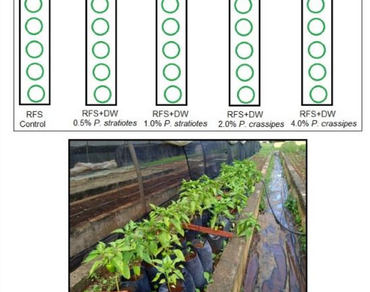
Capsicum annuum L. comprises several cultivars, including True Heart, whose fruit quality is influenced by the organic matter incorporated into the substrate. This study evaluated the fruits of C. annuum (True Heart cultivar) grown in Red Ferralitic Soil from Ciego de Ávila, Cuba, amended with organic matter derived from the invasive aquatic plants Pistia stratiotes L. and Pontederia crassipes Mart. Twenty-five experimental units were established: five with a simple substrate (Red Ferralitic Soil), five units each with mixed substrates containing 0.5% and 1.0% dry weight of P. stratiotes, and five units each with mixed substrates containing 2.0% and 4.0% dry weight of P. crassipes. Morphological traits (fruit number, length, diameter, mass, and pericarp thickness) and concentrations of 25 chemical elements were measured in the first 54 fruits. Except for fruit length, all morphological traits exhibited higher values in fruits from plants grown in mixed substrates. A total of 22 chemical elements were identified, with K, Na, P, and Ca being the most abundant. Considering the concentrations of Cd and Pb in the fresh mass of the fruits, the mixed substrates with dry weight of P. stratiotes and P. crassipes appear suitable for the cultivation of Capsicum annuum (True Heart cultivar). These findings support the safe use of invasive aquatic plant dry weight as a substrate amendment, while highlighting the need for further studies in other cultivars, soil types, and extended cultivation periods to validate its broader applicability.
References
Álvarez F, Pino MT (2018) Aspectos generales del manejo agronómico del pimiento en Chile. En MT Pino (Ed.) Pimientos para la industria de alimentos e ingredientes. INIA 360: 41–58
Barboza GE, De Bem Bianchetti L (2005) Three new species of Capsicum (Solanaceae) and a key to the wild species from Brazil. Syst Bot 30:863–871
Barrera J, Cruz M, Melgarejo LM (2010) Nutrición mineral. En: Hernández S, Barrera J, Solarte M E, Suárez D, Melgarejo L M, Romero M (eds) Experimentos en Fisiología Vegetal. Bogotá, Universidad Nacional de Colombia, pp 79–106
Barrios O, Fuentes V, Cristóbal R, Shagardosky T, Fundora Z, Castiñeiras L, Moreno V, Fernández L, García M, Hernández F (2005) Diversidad morfológica del género Capsicum conservada en huertos caseros de Cuba. Agrotec Cuba, Número especial, pp 48–65
Benavides DV (2012) Determinación de variaciones de pH rizosférico y contenido de fósforo en tejidos de Lupinus mutabilis L. en dos andisoles, Pasto, Nariño. Trabajo de grado de Ingeniería Agroforestal. Universidad de Nariño. Colombia, 27 pp
Berdonces JL (1996) Toxicidad de metales y oligoelementos y de aditivos alimentarios. Natura Medicatrix. Rev Méd Est Dif Medic Alt, (45): 20–25
Caldeira MVW et al (2000) Crescimento de mudas de Eucalyptus saligna Smith em função de diferentes doses de vermicomposto. Rev For Curitiba 28:19–30
Del Valle-Echevarria AR, Kantar MB, Branca J, Moore S, Frederiksen MK, Hagen L, Hussain T, Baumler DJ (2019) Aeroponic cloning of Capsicum spp. Hort 5(2):30
Depestre T (2009) Guía técnica para la producción del cultivo de pimiento. Instituto de Investigaciones Hortícolas Liliana Dimitrova, La Habana, p 18
Durán P (2010) Transferencia de metales de suelo a planta en áreas mineras: Ejemplos de los Andes peruanos y de la Cordillera Prelitoral Catalana. Universidad de Barcelona, Barcelona, España, p 259
Esmeraldas VAC, Rodriguez JLR, Buñay TCG, Murillo RAL (2021) Experiencias productivas con pimiento (Capsicum anuumm L.) con abonos orgánicos en el subtrópico del Ecuador. Cien Lat Rev Cient Multidiscip 5(4):4311–4321. https://doi.org/10.37811/cl_rcm.v5i4.622
European Union (2003) Legislación de la Unión Europea de Contaminantes Químicos en Productos Alimentarios. 11 pp
European Union (2019) Diario Oficial de la Unión Europea. Reglamento (UE) 2019/1009 del parlamento europeo y del consejo. 5 de junio de 2019. 114 pp
Gamboa-Angulo J, Ruíz-Sánchez E, Alvarado-López C, GutiérrezMiceli F, Ruíz-Valdiviezo VM, Medina-Dzul K (2020) Efecto de biofertilizantes microbianos en las características agronómicas de la planta y calidad del fruto del chile xcat´ik (Capsicum annuum L). Terra Latinoam 38:817–826. https://doi.org/10.28940/terra.v38i4.716
García MC, Taboada G, López S, López G, Mora A, Tlapal B (2011) Calidad de plántulas de chile ‘poblano’ en la Sierra Nevada de Puebla, México. Rev Fitotec Mex 34:115–121
González-Domínguez J, de León-Ortiz ME, Machado-Contreras I, Pineda-Ruiz EB, Viñas-Quintero Y (2019) Respuesta de caña de azúcar a la aplicación de fertilizantes minerales en Ciego de Ávila. Rev Ing Agríc 9:16–22. https://revistas.unah.edu.cu/index.php/IAgric/article/view/1138
Hernández-Fernández L, Acosta Y, González de Zayas R, García-Moya A, Lorenzo JC (2024) Invasive aquatic plants as a mixed substrate with Red Ferralitic soil in vegetable seedbeds. Agron Colomb 42:1–11. https://doi.org/10.15446/agron.colomb.v42n2.115670
Hernández-Fernández L, Lorenzo Feijoo JC, Acosta Fernández Y, González de Zayas R, Turcios AE, Naidoo S, Papenbrock J, García-Moya A (2025b) Concentration of chemical elements in dry mass of Pontederia crassipes Mart. for use as organic fertilizer in small-scale crops. Hidrobiológica 35(3):197–203
Hernández-Fernández L, Lorenzo Feijoo JC, Acosta Fernández Y, Martínez Rodríguez J, Gonzálezde Zayas R (2025a) Elementos químicos en masa seca de Pistia stratiotes L., Ciego de Ávila. Cuba Univ Cienc 14(2):e8810. https://doi.org/10.5281/zenodo
Hernández-Fernández L, Méndez IE, Gerardo-Vázquez J, González de Zayas R, Lorenzo JC (2023) Aquatic plants in the freshwater artificial lagoons in Ciego de Ávila, Cuba. Intropica 18(1). https://doi.org/10.21676/23897864475318
Hernández-Jiménez A, Pérez-Jiménez JM, Bosch-Infante D, Castro-Speck N (2015) Clasificación de los suelos de Cuba 2015. Editorial INCA. https://ediciones.inca.edu.cu/files/libros/clasificacionsueloscuba_%202015.pdf
Ibiza VP, Blanca J, Cañizares J, Nuez F (2012) Taxonomy and genetic diversity of domesticated Capsicum species in the Andean region. Genet Resour Crop Evol 59:1077–1088. https://doi.org/10.1007/s10722-011-9744-z
Jones C, Jacobsen J (2005) Plant nutrition and soil fertility. Nut Manag Mod 2:1–11
Knapik JG et al (2005) Crescimento inicial de Mimosa scabrella Benth., Schinus terebinthifolius Raddi e Allophylus edulis. St. Hil.) Radl. sob diferentes regimes de adubação, vol 51. Boletim de Pesquisa Florestal, Colombo, PR, pp 33–44
Liu Y, Hu C, Li B, Ding D, Zhao Z, Fan T, Li Z (2021) Subsurface drip irrigation reduces cadmium accumulation of pepper (Capsicum annuum L.) plants in upland soil. Sci Total Environ 755:142650. https://doi.org/10.1016/j.scitotenv.2020.142650
Londoño-Franco LF, Londoño-Muñoz PT, Muñoz-García FG (2016) Los riesgos de los metales pesados en la salud humana y animal. Biotec Sect Agrop Agroind 14(2):145–153. https://doi.org/10.18684/BSAA(14)145-153
NC 493 (2015) Contaminantes metálicos en alimentos - regulaciones sanitarias. 9 pp
Paun N, Zgavarogea R, Niculescu VC, Nasture AM, Voicea, Popescu DI (2025) From soil to plate: lithium and other trace metals uptake in vegetables under. Variable Soil Conditions Toxics 13(11):956. https://doi.org/10.3390/toxics13110956
Pérez GA, Garrido Fernández J, Lozano-Ruiz M, Montero de Espinosa V, Mínguez Mosquera MI (2001) Influencia del secado lento a baja temperatura en el contenido carotenoide de dos variedades de pimiento (Capsicum annuum L.). Balance biosintético y/o degradativo en función de las condiciones de procesado. Grasas Aceites 52(5):311–316
Pérez GA, Morgado M (2024) Algunos aspectos de la agricultura urbana en Ciego de Ávila. Univ Cienc 13(1):47–57. https://doi.org/10.5281/zenodo.10511377
Pino J, Fuentes V, Barrios O (2011) Volatile constituents of Cachucha peppers (Capsicum chinense Jacq.) grown in Cuba. Food Chem 125:860–864. https://doi.org/10.1016/j.foodchem.2010.08.073
Prabawardani S, Taberima S, Fatoni S, Mawikere NL, Fenetiruma OA, Lyons G (2024) The use of Pistia stratiotes compost as an ameliorant for chili growth and yields in the reclamation fresh tailing area of Timika. Papua J Degrade Min Land Manage 11:5329–5338. https://doi.org/10.15243/jdmlm.2024.112.5329
Prasad AA, Sachan HK, Krishna D (2025) Nutrient composition of Capsicum annuum L. fruits under integrated organic and inorganic fertiliser regimes. Vegetos 1–7. https://doi.org/10.1007/s42535-025-01317-8
Reyes M (ed) (2016) Control de Tizón en Tomate Industrial Mediante un Sistema de Alerta Temprana. Villa Alegre, Chile. Instituto de Investigaciones Agropecuarias. Boletín INIA. 338; 71p
Rodríguez-Alfaro M, Muñiz-Ugarte O, Araújo-do Nascimento CW, Montero-Álvarez A, Calero-Martín B, Martínez-Rodríguez F (2022) Rangos permisibles de Cadmio y Plomo en abonos orgánicos utilizados en la producción de alimentos. Cult trop 43(1):12
Vielma JR, Picón-Borregales D, Vergara M, Eligio P, Gutiérrez- Peña L (2017) El boro, un elemento benéfico que ayuda a prevenir la osteoporosis en el humano: una revisión de literatura José Ramón Vielma, David Picón-Borregales, María Alicia Vergara, Pablo Eligio Carrero, Luis Vicente Gutiérrez-Peña. Avan Biomedic 6(3):216–233. https://www.redalyc.org/
Wldjajanto DW, Honmura T, MIiyauchi N (2003) Possible utilization of water hyacinth (Eichhornia crassipes (Mart.) Solms), an aquatic weed, as green manure in vegetables cropping systems. Jpn J Trop Agr 47:27–33
Author Information
Centro de Bioplantas, Universidad de Ciego de Ávila, Ciego de Ávila City, Cuba