Vegetos

(An International Journal of Plant Research & Biotechnology)
(eISSN: 2229-4473)
Comparative analysis of withanolide accumulation in leaves and calli of Withania somnifera (L.) Dunal grown in different soil provenances
*Article not assigned to an issue yet
Research Article | Published: 20 May, 2026
First Page: 0
Last Page: 0
Views: 79
Keywords: Withanolides, Withaferin, Secondary metabolites, n Withania somniferan
Abstract
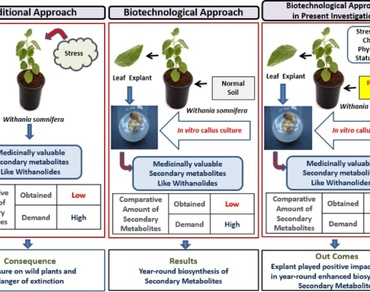
Withania somnifera (L.) Dunal (Indian ginseng); a valuable plant of Ayurvedic Medical System is helpful in treating diverse health issues. It possesses a number of medicinally important secondary metabolites such as withanolides, which are probably synthesized under stress conditions. However, its restricted distribution among plants and limited yield in W. somnifera itself, coupled with declining availability due to urbanization, unsustainable harvesting and habitat loss, pose significant challenges. These constraints highlight the urgent need to explore alternative strategies for producing such medicinally valuable metabolites in higher quantities. The current investigation was carried to upscale in vivo and in vitro synthesis of withanolides. For this purpose, a range of soil provenances, including the polluted site, were used to grow seedlings (1-month old) of Withania in pots as well as in the field. The calli were produced on basal MS medium comprising various combinations of BAP and NAA. Leaf explant from pot plants containing soil of selected provenances were used to find out the effect of soil provenances and hormonal combinations on the biosynthesis of withanolides in calli. Total alkaloids were extracted from different plant parts and calli and estimated for withanolides and withaferin-A using HPLC. Interestingly, total withanolide contents were recorded to be the highest in the callus raised from BEE (Before Effluent Entry) leaf explant on MS medium comprising BAP (1.0 mg/L) and NAA 0.5 mg/L) and sub-cultured on MS medium with BAP (2.0 mg/L) and NAA (0.1 mg/L) as compared to all other calli including those raised by the use of leaf explant from IGS (Irrigated Garden Soil) and DSS (Ditch Site Soil) cultivated pot plants. Additionally, amount of withanolides in the calli grown from DSS and BEE leaf explants on BAP (1.0 mg/L) with NAA (0.5 mg/L) and sub-cultured on BAP (2.0 mg/L) with NAA (0.1 mg/L) was found to be 153% and 1050% higher, respectively, as compared to corresponding in vivo leaves. The current investigation clearly indicates that the physiological condition of plants growing in selected/treated or polluted soil promotes in vitro withanolides production and accumulation in the callus of Withania somnifera (L.) Dunal.
References
Adil M, Abbasi BH, Ul Haq I (2019) Red light controlled callus morphogenetic patterns and secondary metabolites production in Withania somnifera L. Biotechnol Rep 24:e00380. https://doi.org/10.1016/j.btre.2019e00380
Ahmad Z, Shaheen A, Wasi A, Rehman SU, Tahseen S, Ramakrishnan M, Upadhyay A, Ganie IB, Shahzad A, Ding Y (2023) Biotechnological intervention and withanolide production in Withania coagulans. Agronomy 13:1997. https://doi.org/10.3390/agronomy13081997
Ahmad Z, Shareen GIB, Firdaus F, Ramakrishnan M, Shahzad A, Ding Y (2024) Enhancing withanolide production in the Withania species: advances in in vitro culture and synthetic biology approaches. Plants 13(15):2171. https://doi.org/10.3390/plants13152171
Ali NH, Rehman S, Naqvi M, Reshi MR, Gulati K, Ray A (2023) Withania somnifera extract ameliorates airway inflammation and oxidative stress in ovalbumin-induced bronchial asthma in rats. S Afr J Bot 155:310–317. https://doi.org/10.1016/j.sajb.2023.02.003
Autade RH, Fargade SA, Savant AR, Gangurde SS, Choudhary RS, Dighe SS (2016) Micropropagation of Ashwagandha (Withania somnifera). Biosci Biotech Res Commun 9(1):88–93. https://doi.org/10.21786/bbrc/19.1/13
Bhat WW, Lattoo SK, Razdan S, Dhar N, Rana S, Dhar RS et al (2012) Molecular cloning, bacterial expression and promoter analysis of squalene synthase from Withania somnifera (L.) Dunal. Gene 499:25–36. https://doi.org/10.1016/j.gene.2012.03.004
Chakraborty N, Banerjee B, Ghosh M, Pradhan P, Gupta NS, Acharya K, Banerjee M (2013) Influence of plant growth regulators on callus mediated regeneration and secondary metabolites synthesis in Withania somnifera (L.) Dunal. Physiol Mol Biol Plants 19(1):117–125. https://doi.org/10.1007/s12298-012-0146-2
Chandrashekar HK, Singh G, Kaniyassery A, Thorat SA, Nayak R, Murali TS, Muthusamy A (2023) Nanoparticle-mediated amelioration of drought stress in plants: a systematic review. 3 Biotech 13(10):336. https://doi.org/10.1007/s13205-023-03751-4
Ciddi V (2006) Withaferin A from cell cultures of Withania somnifera. Indian J Pharm Sci 68(4):490–492
Das A, Datta AK, Ghosh S, Bhattacharyya A (2009) Growth and cultivation of two varieties of Withania somnifera. J Trop Med Plants 10:225–230
Dhar N, Rana S, Bhat WW, Razdan S, Pandith SA, Khan S, Dutt P, Dhar RS, Vaishnavi S, Vishwakarma R, Lattoo SK (2013) Dynamics of withanolide biosynthesis in relation to temporal expression pattern of metabolic genes in Withania somnifera (L.) Dunal: a comparative study in two morpho-chemovariants. Mol Biol Rep 40:7007–7016. https://doi.org/10.1007/s11033-013-2820-z
Dhar N, Razdan S, Rana S, Bhat WW, Vishwakarma R, Lattoo SK (2015) A decade of molecular understanding of withanolide biosynthesis and in vitro studies in Withania somnifera (L.) Dunal: prospects and perspectives for pathway. Eng. Front Plant Sci 6:1031. https://doi.org/10.3389/fpls.2015.01031
Dutta R, Khalil R, Green R, Mohapatra SS, Mohapatra S (2019) Withania somnifera (Ashwagandha) and withaferin A: potential in integrative oncology. Int J Mol Sci 20:5310. https://doi.org/10.3390/ijms20215310
Espinosa-Leal CA, Puente-Garza CA, García-Lara S (2018) In vitro plant tissue culture: means for production of biological active compounds. Planta 248:1–18. https://doi.org/10.1007/s00425-018-2910-1
Gonçalves S, Romano A (2018) Production of plant secondary metabolites by using biotechnological tools. In: Vijayakumar R, Raja SSS (eds) Secondary metabolites: sources and applications. Intech Open, pp 81–99. https://doi.org/10.5772/intechopen.76414
Guo M, Lv H, Chen H, Dong S, Zhang J, Liu W, He L, Ma Y, Yu H, Chen S et al (2024) Strategies on biosynthesis and production of bioactive compounds in medicinal plants. Chin Herb Med 16:13–26. https://doi.org/10.1016/j.chmed.2023.01.007
Gupta AP, Verma RK, Misra HO, Gupta MM (1996) Quantitative determination of withaferin-A in different plant parts of Withania somnifera by TLC desitometry. J Med Aromat Plant Sci 18:788–790
Isah T, Umar S, Mujib A, Sharma MP, Rajasekharan P, Zafar N, Frukh A (2018) Secondary metabolism of pharmaceuticals in the plant in vitro cultures: strategies, approaches, and limitations to achieving higher yield. Plant Cell Tiss Organ Cult (PCTOC) 132(2):239–265. https://doi.org/10.1007/s11240-017-1332-2
Jain J, Narayanan V, Chaturvedi S, Pai S, Sunil S (2018) In vivo evaluation of Withania somnifera-based Indian traditional formulation (Amukkara Choornam), against Chikungunya virus-induced morbidity and arthralgia. J Evid Based Integr Med 23:1–7. https://doi.org/10.1177/2156587218757661
Jaleel CA, Manivannan P, Gomathinayagam M, Sridharan R, Panneerselvam R (2007) Responses of antioxidant potentials in Dioscorea rotundata Poir. following paclobutrazol drenching. C R Biol 330:798–805
Kaniyassery A, Thorat SA, Shanthi N, Tantry S, Sudhakar MP, Arunkumar K, Muthusamy A (2024) In vitro plant growth promoting effect of fucoidan fractions of Turbinaria decurrens for seed germination, organogenesis, and adventitious root formation in finger millet and eggplant. J Plant Growth Regul 43:283–298. https://doi.org/10.1007/s00344-023-11084-y
Kannan ND, Kulandaivelu G (2007) Novel method to isolate withaferin-A from Withania somnifera roots and its bioactivity. Allelopathy J 20(1):213–220
Kataria H, Wadhwa R, Kaul SC, Kaur G (2012) Water extract from the leaves of Withania somnifera protect RA differentiated C6 and IMR-32 cells against glutamate-induced excitotoxicity. PLoS ONE 7(5):1–13. https://doi.org/10.1371/journal.pone.0037080
Kaur K, Kaur K, Bhandawat A, Pati PK (2021) In vitro shoot multiplication using meta-Topolin and leaf-based regeneration of a withaferin A rich accession of Withania somnifera (L.) Dunal. Ind Crops Prod 171:113872. https://doi.org/10.1016/j.indcrop.2021.113872
Kuboyama T, Tohda C, Komatsu K (2005) Neuritic regeneration and synaptic reconstruction induced by withanolide A. Br J Pharmacol 144:961–971
Kumar V, Dhanjal JK, Kaul SC, Wadhwa R, Sundar D (2021) Withanone and caffeic acid phenethyl ester are predicted to interact with main protease (Mpro) of SARS-CoV-2 and inhibit its activity. J Biomol Struct Dyn. https://doi.org/10.1080/07391102.2020.1772108
Kurup PA (1956) Antibiotic principle of the leaves of Withania somnifera. Curr Sci 25:57–60
Leung JM, Yang CX, Sin DD (2020) COVID-19 and nicotine as a mediator of ACE-2. Eur Respir J 55(6):2001261. https://doi.org/10.1183/13993003.01261-2020
Mandlik Ingawale DS, Namdeo AG (2020) Pharmacological evaluation of Ashwagandha highlighting its healthcare claims, safety, and toxicity aspects. J Diet Suppl. https://doi.org/10.1080/19390211.2020.1741484
Mariappan P, Kiran KR, Swathy PS, Kaniyassery A, Thorat SA, Bhagyashree P, Thiruvengadam M, Muthusamy A (2022) Sacred groves and nakshatravan trees-a comparative analysis for their medicinal properties and volatile compounds for human health. S Afr J Bot 151:623–638. https://doi.org/10.1016/j.sajb.2022.08.029
Murashige T, Skoog F (1962) A revised medium for rapid growth and bioassays with tobacco tissue culture. Physiol Plant 15:437–497
Muthusamy A, Swathy PS, Tantry S, Thorat SA, Kaniyassery A, Kiran KR (2022) Large-scale production of in vitro plantlets of sweet flag (Acorus calamus L.) and quantitative analysis of α-and β-asarone contents using high pressure liquid chromatography. Vegetos 35(1):11. https://doi.org/10.1007/s42535-021-00287-x
Nagella P, Murthy HN (2010) Establishment of cell suspension cultures of Withania somnifera for the production of withanolide A. Bioresour Technol 101(17):6735–6739. https://doi.org/10.1016/j.biortech.2010.03.078
Ray AB, Gupta M (1994) Withasteroids, a growing group of naturally occurring steroidal lactones. Prog Chem Org Nat Prod 63:1–106
Sabir F, Mishra S, Sangwan RS, Jadaun JS, Sangwan NS (2013) Qualitative and quantitative variations in withanolides and expression of some pathway genes during different stages of morphogenesis in Withania somnifera Dunal. Protoplasma 250(2):539–549. https://doi.org/10.1007/s00709-012-0438-y
Saggam A, Limgaokar K, Borse S, Chavan-Gautam P, Dixit S, Tillu G, Patwardhan B (2021) Withania somnifera (L.) Dunal: opportunity for clinical repurposing in COVID-19 management. Front Pharmacol 12:623795. https://doi.org/10.3389/fphar.2021.623795
Sajc L, Grubisic D, Vunjak-Novakovic G (2000) Bioreactors for plant engineering: an overlook for further research. Biochem Eng J 4(2):89–99. https://doi.org/10.1016/S1369-703X(99)00035-2
Sajida AP (2022) Withania somnifera deploys immunomodulation and exerts anticancer effects on lung adenocarcinoma cells. S Afr J Bot 151(1):47–65. https://doi.org/10.1016/j.sajb.2022.09.031
Sangwan RS, Chaurasiya ND, Lal P, Misra LN, Uniyal GC, Tuli R, Sangwan NS (2007) Withanolide A biogenesis in shoot cultures of Ashwagandha (Withania somnifera Dunal). Chem Pharm Bull 55:1371–1375
Sangwan RS, Chaurasiya ND, Misra LN, Lal P, Uniyal GC, Sharma R et al (2004) Phytochemical variability in commercial herbal products and preparations of Withania somnifera (Ashwagandha). Curr Sci 86:461–465
Sangwan RS, Chaurasiya ND, Lal P, Misra L, Uniyal GC, Sangwan NS, Tuli R (2008) Withanolide A is inherently de novo biosynthesized in roots of the medicinal plant ashwagandha (Withania somnifera). Physiol Plant 133(2):278–287. https://doi.org/10.1111/j.1399-3054.2008.01076.x
Sathiyabama M, Parthasarathy R (2018) Withanolide production by fungal endophyte isolated from Withania somnifera. Nat Prod Res 32:1573–1577. https://doi.org/10.1080/14786419.2017.1389934
Sehgal N, Gupta A, Valli RK, Joshi SD, Mills JT, Hamel E, Khanna P, Jain SC, Thakur SS, Ravindranath V (2012) Withania somnifera reverses Alzheimer’s disease pathology by enhancing low-density lipoprotein receptor-related protein in liver. Proc Natl Acad Sci U S A 109(9):3510–3515. https://doi.org/10.1073/pnas.1112209109
Sharada M, Ahuja A, Suri K, Vij S, Khajuria R, Verma V, Kumar A (2007) Withanolide production by in vitro cultures of Withania somnifera and its association with differentiation. Biol Plant 51(1):161–164. https://doi.org/10.1007/s10535-007-0031-y
Singh P, Guleri R, Singh V, Kaur G, Kataria H, Singh B et al (2015) Biotechnological interventions in Withania somnifera (L.) Dunal. Biotechnol Genet Eng Rev 31(1–2):1–20. https://doi.org/10.1080/02648725.2015.1020467
Singh K, Bhori M, Kasu YA, Bhat G, Marar T (2018) Antioxidants as precision weapons in war against cancer chemotherapy induced toxicity—exploring the armoury of obscurity. Saudi Pharm J 26:177–190. https://doi.org/10.1016/j.jsps.2017.12.013
Sivanandhan G, Mariashibu TS, Arun M, Rajesh M, Kasthurirengan S, Selvaraj N, Ganapathi A (2011) The effect of polyamines on the efficiency of multiplication and rooting of Withania somnifera (L.) Dunal and content of some withanolides in obtained plants. Acta Physiol Plant 33(6):2279. https://doi.org/10.1007/s11738-011-0768-y
Sivanandhan G, Arun M, Mayavan S et al (2012) Chitosan enhances withanolides production in adventitious root cultures of Withania somnifera (L.) Dunal. Ind Crops Prod 37(1):124–129. https://doi.org/10.1016/j.indcrop.2011.11.022
Sivanandhan G, Arun M, Mayavan S, Rajesh M, Jeyaraj M, Dev GK et al (2012b) Optimization of elicitation conditions with methyl jasmonate and salicylic acid to improve the productivity of withanolides in the adventitious root culture of Withania somnifera (L.) Dunal. Appl Biochem Biotechnol 168:681–696. https://doi.org/10.1007/s12010-012-9809-2
Sivanandhan G, Rajesh M, Arun M et al (2013) Effect of culture conditions, cytokinins, methyl jasmonate and salicylic acid on the biomass accumulation and production of withanolides in multiple shoot culture of Withania somnifera (L.) Dunal using liquid culture. Acta Physiol Plant 35:715–728. https://doi.org/10.1007/s11738-012-1112-x
Sivanandhan G, Selvaraj N, Ganapathi A, Lim YP (2020) Up-regulation of Squalene synthase in hairy root culture of Withania somnifera (L.) Dunal yields higher quantities of withanolides. Ind Crops Prod. https://doi.org/10.1016/j.indcrop.2020.112706
Straughn AR, Kakar SS (2020) Withaferin A: a potential therapeutic agent against COVID-19 infection. J Ovarian Res 13(1):79. https://doi.org/10.7324/JAPS.2021.110402
Supe U, Fanisha D, Roymon MG (2006) In vitro plant regeneration of Withania somnifera. Plant Cell Tissue Organ Cult 16(2):11–115
Suryakumar G, Rathor R, Agrawal A, Singh SN, Kumar B (2019) Optimizing performance under high-altitude stressful conditions using herbal extracts and nutraceuticals. Nutraceuticals Nat Prod Pharmaceu. https://doi.org/10.1016/B978-0-12-816450-1.00005-2
Tandon N, Yadav SS (2020) Safety and clinical effectiveness of Withania somnifera (Linn.) dunal root in human ailments. J Ethnopharmacol 255:112768. https://doi.org/10.1016/j.jep.2020.112768
Tewari D, Chander V, Dhyani A, Sahu S, Gupta P, Patni P, Kalick LS, Bishayee A (2022) Withania somnifera (L.) Dunal: phytochemistry, structure-activity relationship, and anticancer potential. Phytomedicine. https://doi.org/10.1016/j.phymed.2022.153949
Thorat SA, Kaniyassery A, Poojari P, Rangel M, Tantry S, Kiran KR, Joshi MB, Rai PS, Botha AM, Muthusamy A (2022) Differential gene expression and withanolides biosynthesis during in vitro and ex vitro growth of Withania somnifera (L.) Dunal. Front Plant Sci. https://doi.org/10.3389/fpls.2022.917770
Thorat SA, Srivaishnavi M, Kaniyassery A, Padikkal S, Rai PS, Botha AM, Muthusamy A (2023) Physiological and biochemical traits positively modulate tissue-specific withanolides and untargeted metabolites in Withania somnifera (L.) Dunal under salinity stress. Plant Physiol Biochem 203:108011. https://doi.org/10.1016/j.plaphy.2023.108011
Thorat SA, Srivaishnavi M, Kaniyassery A, Chandrashekar HK, Mahato KK, Muthusamy A (2024) He-Ne laser pre-exposure alleviates salinity stress through physio-biochemical regulation and enhanced withanolide production in Withania somnifera (L.) Dunal. Ind Crops Prod 216:118776. https://doi.org/10.1016/j.indcrop.2024.118776
Tiwari R, Latheef SK, Ahmed I, Iqbal HMN, Bule MH, Dhama K, Samad HA, Karthik K, Alagawany M, El-Hack MEA, Yatoo MI, Farag MR (2018) Herbal immunomodulators—a remedial panacea for designing and developing effective drugs and medicines: current scenario and future prospects. Curr Drug Metab 19(3):264–301. https://doi.org/10.2174/1389200219666180129125436
Tripathi MK, Singh P, Sharma S, Singh TP, Ethayathulla AS, Kaur P (2020) Identification of bioactive molecule from Withania somnifera (Ashwagandha) as SARS-CoV-2 main protease inhibitor. J Biomol Struct Dyn. https://doi.org/10.1080/07391102.2020.1790425
Author Information
Department of Botany, Vardhaman College, Bijnor, India