Vegetos

(An International Journal of Plant Research & Biotechnology)
(eISSN: 2229-4473)
Comparative phytochemical profiling, antioxidant, and antibacterial activities of jute (Corchorus spp.), kenaf (Hibiscus cannabinus), and mesta (Hibiscus sabdariffa) using different extraction systems
*Article not assigned to an issue yet
Research Articles | Published: 22 July, 2026
First Page: 0
Last Page: 0
Views: 126
Keywords: n Corchorus spp., n Hibiscusn , Phytochemicals, GC-MS, Multidrug-resistant (MDR)
Abstract
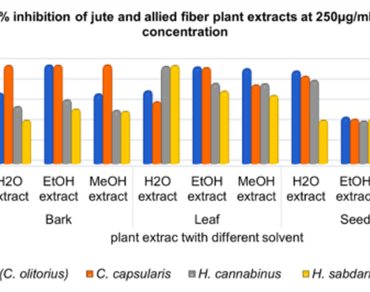
The increasing prevalence of multidrug-resistant (MDR) pathogens and oxidative stress-related disorders has intensified the search for plant-derived bioactive compounds. Four officially released Bangladesh Jute Research Institute varieties—BJRI Tossa Pat-8 (Corchorus olitorius), CVL-1 (C. capsularis), HC-95 (Hibiscus cannabinus) and BJRI Mesta-2 (H. sabdariffa)—were evaluated using distilled water, 80% ethanol and 90% methanol extraction systems. Yield, preliminary phytochemical screening, total phenolic content (TPC), total flavonoid content (TFC), DPPH radical-scavenging activity, and antibacterial activity were evaluated. Extracts showing antibacterial activity were further subjected to minimum inhibitory concentration (MIC), minimum bactericidal concentration (MBC), and targeted GC–MS analyses. Yield showed a species × plant-part × extraction-system interaction [F(12,72) = 14.33, p < 0.001]. HC-95 leaf extracted with 80% ethanol had the highest TPC/TFC (213.35 ± 0.33 mg GAE/g and 135.59 ± 0.09 mg QE/g dried extract). Several extracts produced >90% DPPH inhibition and zones up to 20 mm. CVL-1 seed and BJRI Mesta-2 leaf ethanol extracts were bactericidal at 125 µg/mL against Acinetobacter baumannii and Pseudomonas aeruginosa, respectively. GC–MS tentatively annotated fatty-acid methyl esters and 2,4-di-tert-butylphenol. This integrated comparison identifies priority variety–tissue–extraction combinations for value-added antioxidant and antibacterial research.
References
Adhikary K, Sarkar R, Chatterjee P et al (2024) The homeostatic phyto-defense mechanism for reactive oxygen species under environmental stress conditions: a review. Res J Pharm Technol 17:3505–3513. https://doi.org/10.52711/0974-360X.2024.00548
Adhikary K, Barman S, Banerjee P, Mondal P, Dam B, Misra A et al (2025) Characterization and antimicrobial activity of essential oils extracted from lemongrass (Cymbopogon flexuosus) using microwave-assisted hydrodistillation. Z Naturforsch C J Biosci 80:201–211. https://doi.org/10.1515/znc-2024-0095
Ayuni D, Neri L, Pittia P, Sirikantaramas S, Devahastin S, Borompichaichartkul C (2024) Impact of extraction methods on bioactive compounds and antioxidant activities of Thai jasmine rice leaf extracts. Int J Food Sci Technol 59:7865–7874. https://doi.org/10.1111/ijfs.17062
Bisso RBN, Nkwelle RNE, Tchuenguem Tchuenteu R, Dzoyem JP (2022) Phytochemical screening, antioxidant, and antimicrobial activities of seven underinvestigated medicinal plants against microbial pathogens. Adv Pharmacol Pharm Sci 2022:1998808. https://doi.org/10.1155/2022/1998808
Biswas A, Dey S, Huang S et al (2022) A comprehensive review of C. capsularis and C. olitorius: A source of nutrition, essential phytoconstituents and pharmacological activities. Antioxid (Basel) 11:1358. https://doi.org/10.3390/antiox11071358
Boubker A, El Ouardi A, El Kamli T et al (2025) Phytochemical analysis, antioxidant and antibacterial activities, minerals element profiling, and identification of bioactive compounds by UPLC-HRMS Orbitrap in four aromatic and medicinal plants. Molecules 30:1279. https://doi.org/10.3390/molecules30061279
Chaachouay N (2025) Synergy, additive effects, and antagonism of drugs with plant bioactive compounds. Drugs Drug Candidates 4:4. https://doi.org/10.3390/ddc4010004
Chowdhury M, Chowdhury S, Bhattacherjee A, Roy C, Sarkar R, Adhikary K et al (2023) Natural antioxidants and nutraceuticals to fight against common human diseases: an overview. Eur Chem Bull 12:1505–1521
de Kraker MEA, Stewardson AJ, Harbarth S (2016) Will 10 million people die a year due to antimicrobial resistance by 2050? PLoS Med 13:e1002184. https://doi.org/10.1371/journal.pmed.1002184
Farahmandfar R, Esmaeilzadeh Kenari R, Asnaashari M et al (2019) Bioactive compounds, antioxidant and antimicrobial activities of Arum maculatum leaves extracts as affected by various solvents and extraction methods. Food Sci Nutr 7:465–475. https://doi.org/10.1002/fsn3.815
Farooq S, Shaheen G, Asif HM, Aslam MR, Zahid R, Rajpoot SR, Jabbar S, Zafar F (2022) Preliminary phytochemical analysis: in-vitro comparative evaluation of anti-arthritic and anti-inflammatory potential of some traditionally used medicinal plants. Dose Response 20:15593258211069720. https://doi.org/10.1177/15593258211069720
Fathi Hafshejani S, Lotfi S, Rezvannejad E et al (2023) Correlation between total phenolic and flavonoid contents and biological activities of 12 ethanolic extracts of Iranian propolis. Food Sci Nutr 11:4308–4325. https://doi.org/10.1002/fsn3.3356
Ji W, Chen F, Chen Z, Jiang H (2024) Research in advances in the bioactivity of plant polyphenols. Int J Food Sci Technol 59:8037–8044. https://doi.org/10.1111/ijfs.17494
Lim J, Kim K, Kwon DY et al (2024) Effects of solvents on phenolic and flavonoid extraction. Horticulturae 10:160. https://doi.org/10.3390/horticulturae10020160
Liu Z, Ren Z, Zhang J, Chuang CC, Kandaswamy E, Zhou T, Zuo L (2018) Role of ROS and nutritional antioxidants in human diseases. Front Physiol 9:477. https://doi.org/10.3389/fphys.2018.00477
Mansoor S, Ali Wani O, Lone JK et al (2022) Reactive oxygen species in plants: From source to sink. Antioxid (Basel) 11:225. https://doi.org/10.3390/antiox11020225
Metrouh-Amir H, Duarte CMM, Maiza F (2015) Solvent effect on total phenolic contents, antioxidant, and antibacterial activities of Matricaria pubescens. Ind Crops Prod 67:249–256. https://doi.org/10.1016/j.indcrop.2015.01.049
Mogana R, Adhikari A, Tzar MN, Ramliza R, Wiart C (2020) Antibacterial activities of the extracts, fractions and isolated compounds from Canarium patentinervium Miq. against bacterial clinical isolates. BMC Complement Med Ther 20:55. https://doi.org/10.1186/s12906-020-2837-5
O’Neill J (2014) Review on antimicrobial resistance: tackling a crisis for the health and wealth of nations. Review on Antimicrobial Resistance, London
Rahman T, Ahmed Z, Sarkar S (2022) Analysis of the antibacterial properties of jute leaf. Open Access Res J Life Sci 4:51–55. https://doi.org/10.53022/oarjls.2022.4.1.0059
Rasool A, Bhat KM, Sheikh AA, Jan A, Hassan S (2020) Medicinal plants: role, distribution and future. J Pharmacogn Phytochem 9:2111–2114
Shaikh JR, Patil MK (2020) Qualitative tests for preliminary phytochemical screening: an overview. Int J Chem Stud 8:603–608. https://doi.org/10.22271/chemi.2020.v8.i2i.8834
Sim YY, Nyam KL (2021) Hibiscus cannabinus L. (kenaf) studies: Nutritional composition, phytochemistry, pharmacology, and potential applications. Food Chem 344:128582. https://doi.org/10.1016/j.foodchem.2020.128582
Sumner LW, Amberg A, Barrett D et al (2007) Proposed minimum reporting standards for chemical analysis. Metabolomics 3:211–221. https://doi.org/10.1007/s11306-007-0082-2
Sweidan N, Abu Rayyan W, Mahmoud I, Ali L (2023) Phytochemical analysis, antioxidant, and antimicrobial activities of Jordanian Pomegranate peels. PLoS ONE 18:e0295129. https://doi.org/10.1371/journal.pone.0295129
Truong DH, Ta NTA, Pham TV, Huynh NV, Do Q (2021) Effects of solvent-solvent fractionation on the total terpenoid content and in vitro anti-inflammatory activity of Severinia buxifolia bark extract. Food Sci Nutr 9:1720–1735. https://doi.org/10.1002/fsn3.2149
Vaou N, Stavropoulou E, Voidarou C et al (2022) Interactions between medical plant-derived bioactive compounds: focus on antimicrobial combination effects. Antibiot (Basel) 11:1014. https://doi.org/10.3390/antibiotics11081014
Wasihun Y, Alekaw Habteweld H, Dires Ayenew K (2023) Antibacterial activity and phytochemical components of leaf extract of Calpurnia aurea. Sci Rep 13:9767. https://doi.org/10.1038/s41598-023-36837-3
Author Information
Department of Microbiology, University of Dhaka, Dhaka, Bangladesh