Vegetos

(An International Journal of Plant Research & Biotechnology)
(eISSN: 2229-4473)
Development of an efficient and reproducible multiple shoot regeneration system in contrasting blast-tolerant indica rice
*Article not assigned to an issue yet
Research Articles | Published: 29 August, 2026
First Page: 0
Last Page: 0
Views: 11
Keywords: Indica rice, In-vitro regeneration, Multiple shoots, Environmental stresses
Abstract
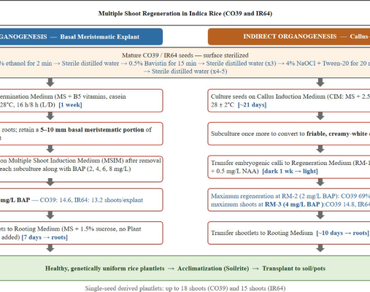
Regeneration of indica rice cultivars is challenging due to their recalcitrance. Moreover, transformation in indica rice is limited to a few genotypes due to low regeneration and transformation efficiencies. Therefore, establishing efficient and reproducible regeneration protocols is a prerequisite for successful transformation and rice improvement. In the present study, efficient multiple shoot regeneration of the indica rice cultivars CO39 and IR64 was achieved from explants derived from the shoot basal meristematic region (direct regeneration) and callus (indirect regeneration). In this devised method, Murashige and Skoog (MS) medium, along with other nutrient supplements and plant growth regulators, was used. Further, using basal meristematic region explants, the maximum multiple shoot (MS) formation occurred at 8 mg/L of 6-benzylaminopurine (BAP) in CO39 and IR64, respectively. Similarly, multiple shoots and plantlets were produced through callus regeneration in both rice cultivars, and maximum MS formation via callus induction occurred at 4 mg/L BAP and 0.5 mg/L 1-naphthaleneacetic acid. The in-vitro generated rice plantlets obtained from both direct and indirect regeneration were healthy and homogeneous. The uniform rice plantlets produced using this protocol are better able to withstand environmental stresses in the field and to study environmental interactions irrespective of genotypic variation.
References
Achary VMM, Reddy MK (2021) CRISPR-Cas9 mediated mutation in GRAIN WIDTH and WEIGHT2 (GW2) locus improves aleurone layer and grain nutritional quality in rice. Sci Rep 11(1):21941. https://doi.org/10.1038/s41598-021-00828-z
Ansari MD, Garai S, Kanaka KK, Sravani C, Kashyap T, Sahu TK, Choudhury AR, Bhadana VP, Rakshit S, Sinha RK, Bishi SK (2026) A classification-based machine learning strategy for nonlinear optimization of the antiparkinson drug L-DOPA and relevant catecholamine intermediates from Faba bean (Vicia faba L.) leaves. Chem Pap 25:1–6. https://doi.org/10.1007/s11696-026-05185-7
Behera L, Samal KC, Agrawal PK, Achary VM, Dash M, Mishra A, Rani M, Masika FB, Goud GS, Kesawat MS, Samantaray S (2026) An improved Agrobacterium-mediated transformation method for genome editing using CRISPR/Cas9 in elite indica rice (Oryza sativa L). BMC Genom. https://doi.org/10.1186/s12864-026-12800-0
Bin Rahman AR, Zhang J (2023) Trends in rice research: 2030 and beyond. Food Energy Secur 12(2):e390. https://doi.org/10.1002/fes3.390
Choudhary AK, Suri VK (2014) Integrated nutrient-management technology for direct-seeded upland rice (Oryza sativa) in Northwestern Himalayas. Commun Soil Sci Plant 45(6):777–784. https://doi.org/10.1080/00103624.2013.861914
Dey M, Bakshi S, Galiba G, Sahoo L, Panda SK (2012) Development of a genotype independent and transformation amenable regeneration system from shoot apex in rice (Oryza sativa spp. indica) using TDZ. 3 Biotech 2(3):233–240. https://doi.org/10.1007/s13205-012-0051-y
Ertiro BT, Labuschagne M, Olsen M, Das B, Prasanna BM, Gowda M (2020) Genetic dissection of nitrogen use efficiency in tropical maize through genome-wide association and genomic prediction. Front Plant Sci 11:474. https://doi.org/10.3389/fpls.2020.00474
Foley JA, Ramankutty N, Brauman KA, Cassidy ES, Gerber JS, Johnston M, Mueller ND, O’Connell C, Ray DK, West PC, Balzer C (2011) Solutions for a cultivated planet. Nature 478(7369):337–342. https://doi.org/10.1038/nature10452
Garai S, Rakshit D, Roy A, Paul RK, Das R (2026) Wavelet-based combinatorial machine learning techniques for forecasting particulate matter concentrations. J Data Sci Intell Syst 00:1–19. https://doi.org/10.47852/bonviewJDSIS62026021
Hubballi M, Pandey AK, Giriyappa R (2022) Genetic variation of infection degrees to blast disease among rice genotypes. J Phytopathol 170(2):107–123. https://doi.org/10.1080/00103624.2013.861914
Kaur J, Mahal SS (2015) Irrigation scheduling in direct seeded rice (Oryza sativa L.)—a review. Agric Rev 36(3):208–217. https://doi.org/10.5958/0976-0741.2015.00024.0
Lal SK, Mehta S, Raju D, Achary VM, Venkatapuram AK, Yadav SK, Parmar H, Pandey R, Panditi V, Sheri V, Singh AK (2023) Concurrent overexpression of rice GS1; 1 and GS2 genes to enhance the nitrogen use efficiency (NUE) in transgenic rice. 42(10):6699–6720. https://doi.org/10.1007/s00344-023-10988-z
Levene H (1960) Robust tests for equality of variances. In: Olkin I, Ghurye SG, Hoeffding W, Madow WG, Mann HB (eds) Contributions to probability and statistics. Stanford University Press, Stanford, pp 278-292.
Manna M, Rengasamy B, Reddy MK, Sinha AK (2025) Revisiting rice transformation for a fail-safe protocol and its application for various gene functional and molecular studies. J Plant Growth Regul 44(2):765–780. https://doi.org/10.1007/s00344-024-11486-6
Noor W, Lone R, Kamili AN, Husaini AM (2022) Callus induction and regeneration in high-altitude Himalayan rice genotype SR4 via seed explant. Biotechnol Rep 136:e00762. https://doi.org/10.1016/j.btre.2022.e00762
Raghavendra G, Kumaraswamy GK, Ramya B, Sandesh HS, Yogendra KN, Deepak N, Gowda PH (2010) Direct multiple shoot regeneration of indica rice (Oryza sativa) Var.‘Rasi’. Asian Asian Australas J Plant Sci Biotech 4(1):71–73
Rathour RK, Devi M, Dahiya P, Sharma N, Kaushik N, Kumari D, Kumar P, Baadhe RR, Walia A, Bhatt AK, Bhatia RK (2023) Recent trends, opportunities and challenges in sustainable management of rice straw waste biomass for green biorefinery. Energies 16(3):1429. https://doi.org/10.3390/en16031429
Raungnet J, Monthatong N, Janthabut T, Klayraung S, Pongjaroenkit S, Phuakjaiphaeo C, Jantasuriyarat C, Lanumteang K, Vuttipongchaikij S, Sakulsingharoj C (2026) CRISPR/Cas9-mediated editing of OsERF922 enhances blast resistance in the indica rice cultivar Kasalath. J Crop Sci Biotechnol 13:1–1. https://doi.org/10.1007/s12892-026-00351-5
Raza A, Khare T, Zhang X, Rahman MM, Hussain M, Gill SS, Chen ZH, Zhou M, Hu Z, Varshney RK (2025) Novel strategies for designing climate-smart crops to ensure sustainable agriculture and future food security. J Sustain Agric Environ 4(2):e70048. https://doi.org/10.1002/sae2.70048
Sahoo RK, Tuteja N (2012) Development of Agrobacterium-mediated transformation technology for mature seed-derived callus tissues of indica rice cultivar IR64. GM Crops Food 3(2):123–128. https://doi.org/10.4161/gmcr.20032
Sarkar MT, Islam SS (2025) In vitro plant regeneration of an indigenous aromatic rice (Oryza sativa L. var. Radhunipagal) through matured seed culture. Plant tissue cult Biotechnol 35(2):297–308. https://doi.org/10.3329/ptcb.v35i2.86598
Sarki YN, Keot AK, Marwein R, Singha DL, Gogoi DJ, Velmurugan N, Chikkaputtaiah C (2026) Genotype-specific optimization of in vitro regeneration and Agrobacterium-mediated transformation in indica rice with 35S: RUBY and CRISPR/LbCas12a system. Planta 263(6):137. https://doi.org/10.1007/s00425-026-05010-1
Shapiro SS, Wilk MB (1965) An analysis of variance test for normality (complete samples). Biometrika 1 52(3–4):591–611. https://doi.org/10.1093/biomet/52.3-4.591
Shirsat SP, Rout GR (2013) An efficient protocol on plant regeneration of upland indica rice (Oryza sativa vars. Ghanteshwari and Siddhanta. Agric Sci Digest 33(3):211–214
West PC, Gerber JS, Engstrom PM, Mueller ND, Brauman KA, Carlson KM, Cassidy ES, Johnston M, MacDonald GK, Ray DK, Siebert S (2014) Leverage points for improving global food security and the environment. Science 345(6194):325–328. https://doi.org/10.1126/science.1246067
Yadav B, Arya A, Yadav P, Kumar VS, Watts A, Chinnusamy V, Nagar S (2026) Efficient Agrobacterium-mediated genetic transformation for Indica black rice cvs. Chakhao Amubi and Chakhao Poireton. Plant Physiol Rep 16:1–9. https://doi.org/10.1007/s40502-026-00942-y
Yadav P, Santosh Kumar VV, Priya J, Yadav SK, Nagar S, Singh M, Chinnusamy V (2023) A versatile protocol for efficient transformation and regeneration in mega indica rice cultivar MTU1010: Optimization through hormonal variables. Methods Protoc 6(6):113. https://doi.org/10.3390/mps6060113
Yildiz M, Romanazzi G, Oguz MC (2025) Bio-based strategies for biotic and abiotic stress management in sustainable agriculture. Front Plant Sci 15:1536460. https://doi.org/10.3389/fpls.2024.1536460
Zhao M, Lin Y, Chen H (2020) Improving nutritional quality of rice for human health. Theor Appl Genet 133(5):1397–1413. https://doi.org/10.1007/s00122-019-03530-x
USDA (2025) Grain: World Markets and Trade. United States Department of Agriculture, Foreign Agricultural Service. www.fas.usda.gov. Accessed August 2026.
Author Information
School of Genome Engineering, ICAR-Indian Institute of Agricultural Biotechnology, Ranchi, India