Vegetos

(An International Journal of Plant Research & Biotechnology)
(eISSN: 2229-4473)
Diversity of bacterial communities colonizing field-grown chickpea distinctly differs across spatial compartments
*Article not assigned to an issue yet
Nysanth N. S., Jagannadham Jaisri, Iquebal Mir Asif, Annapurna K., Pooniya Vijay, Senthilkumar M., Kumar Dinesh, Jaiswal Sarika, Iquebal Mir Asif, Annapurna K.
Research Articles | Published: 19 September, 2026
First Page: 0
Last Page: 0
Views: 101
Keywords: Bacterial community assembly, Soil microbiome, Plant microbime, Chickpea, 16S rRNA amplicon sequencing
Abstract
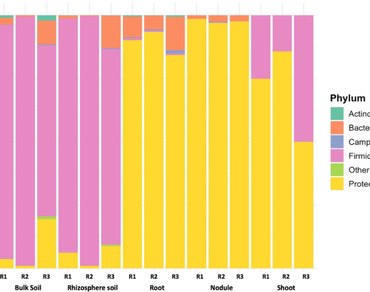
Soil- and plant-associated microbial communities play important roles in plant growth and health. Although chickpea–Mesorhizobium symbiosis has been widely studied, bacterial communities across different compartments of field-grown chickpea remain poorly understood. In this study, we investigated bacterial community dynamics in bulk soil, rhizosphere soil, root, nodule, and shoot tissues of chickpea at the 50% flowering stage using 16S rRNA V3–V4 amplicon sequencing on the Illumina platform. Distinct bacterial communities were observed among compartments. Firmicutes dominated bulk soil (86.2%) and rhizosphere soil (89.5%), whereas Proteobacteria predominated in roots (89.3%), nodules (97.7%), and shoots (70.2%). At the genus level, Paenibacillus was highly abundant in bulk and rhizosphere soils, while Mesorhizobium showed negligible abundance in soil but strong enrichment in nodules (87.5%), indicating selective recruitment during nodule formation. Bacillus was abundant in rhizosphere soil and shoots, whereas roots were enriched with Cellvibrio, Aeromonas and Pseudomonas. Shoots were predominantly colonized by Escherichia/Shigella along with Acinetobacter and Exiguobacterium. Soil samples showed larger and partially overlapping clusters, reflecting higher diversity while root and nodule samples formed distinct clusters with lower variability. The study demonstrates strong compartment-specific bacterial assembly and progressive microbial selection from soil to internal plant tissues. These findings may support development of next-generation microbial consortia for chickpea growth and sustainable crop improvement.
References
Alok D, Annapragada H, Singh S et al (2020) Symbiotic nitrogen fixation and endophytic bacterial community structure in Bt-transgenic chickpea (Cicer arietinum L.). Sci Rep 10(1):5453. https://doi.org/10.1038/s41598-020-62199-1
Anderson MJ (2001) A new method for non-parametric multivariate analysis of variance. Austral Ecol 26(1):32–46. https://doi.org/10.1111/j.1442-9993.2001.01070.pp.x
Aronesty E (2013) Comparison of sequencing utility programs. Open Bioinform J 7:1–8. https://doi.org/10.2174/1875036201307010001
Beattie GA, Bayliss KL, Jacobson DA et al (2024) From microbes to microbiomes: applications for plant health and sustainable agriculture. Phytopathology 114(8):1742–1752. https://doi.org/10.1094/PHYTO-02-24-0054-KC
Begum N, Khan QU, Liu LG et al (2023) Nutritional composition, health benefits and bio-active compounds of chickpea (Cicer arietinum L.). Front Nutr 10:1218468. https://doi.org/10.3389/fnut.2023.1218468
Bray JR, Curtis JT (1957) An ordination of the upland forest communities of southern Wisconsin. Ecol Monogr 27(4):325–349. https://doi.org/10.2307/1942268
Caporaso JG, Bittinger K, Bushman FD et al (2010a) Pynast: a flexible tool for aligning sequences to a template alignment. Bioinformatics 26(2):266–267. https://doi.org/10.1093/bioinformatics/btp636
Caporaso JG, Kuczynski J, Stombaugh J et al (2010b) QIIME allows analysis of high-throughput community sequencing data. Nat Methods 7(5):335–336. https://doi.org/10.1038/nmeth.f.303
Compant S, Clément C, Sessitsch A (2010) Plant growth-promoting bacteria in the rhizo- and endosphere of plants: their role, colonization, mechanisms involved and prospects for utilization. Soil Biol Biochem 42(5):669–678. https://doi.org/10.1016/j.soilbio.2009.11.024
Conesa A, Götz S, García-Gómez JM et al (2005) Blast2GO: a universal tool for annotation, visualization and analysis in functional genomics research. Bioinformatics 21(18):3674–4376. https://doi.org/10.1093/bioinformatics/bti610
Doyle JJ, Doyle JL (1987) A rapid DNA isolation procedure for small quantities of fresh leaf tissue. Phytochem Bull 19(1):11–15
Du J, Li Y, Yin Z, Wang H et al (2020) High-throughput customization of plant microbiomes for sustainable agriculture. Front Plant Sci 11:569742. https://doi.org/10.3389/fpls.2020.569742
Duret M, Wallner A, Buée M et al (2024) Rhizosphere microbiome assembly, drivers and functions in perennial ligneous plant health. Microbiol Res 287:127860. https://doi.org/10.1016/j.micres.2024.127860
Edgar RC, Flyvbjerg H (2015) Error filtering, pair assembly and error correction for next-generation sequencing reads. Bioinformatics 31(21):3476–3482. https://doi.org/10.1093/bioinformatics/btv401
Edgar RC (2010) Search and clustering orders of magnitude faster than BLAST. Bioinformatics 26(19):2460–2461. https://doi.org/10.1093/bioinformatics/btq461
Edwards J, Johnson C, Santos-Medellín C et al (2015) Structure, variation, and assembly of the root-associated microbiomes of rice. Proc Nat Acad Sci USA 112(8):E911–E920. https://doi.org/10.1073/pnas.1414592112
FAO FAOSTAT Statistical Database (2021) Food and Agriculture Organization of the United Nations. http://www.fao.org/faostat/en/
Feng J, Xu Y, Ma B et al (2019) Assembly of root-associated microbiomes of typical rice cultivars in response to lindane pollution. Environ Int 131:104975. https://doi.org/10.1016/j.envint.2019.104975
Fierer N, Bradford MA, Jackson RB (2007) Toward an ecological classification of soil bacteria. Ecology 88(6):1354–1364. https://doi.org/10.1890/05-1839
Fierer N (2017) Embracing the unknown: disentangling the complexities of the soil microbiome. Nat Rev Microbiol 15(10):579–590. https://doi.org/10.1038/nrmicro.2017.87
Fitzpatrick CR, Salas-González I, Conway JM et al (2020) The plant microbiome: from ecology to reductionism and beyond. Annu Rev Microbiol 74(1):81–100. https://doi.org/10.1146/annurev-micro-022620-014327
Flores-Rentería D, Rincón A, Valladares F et al (2016) Agricultural matrix affects differently the alpha and beta structural and functional diversity of soil microbial communities in a fragmented Mediterranean holm oak forest. Soil Biol Biochem 92:79–90. https://doi.org/10.1016/j.soilbio.2015.09.015
Gaiero JR, McCall CA, Thompson KA et al (2013) Inside the root microbiome: bacterial root endophytes and plant growth promotion. Am J Bot 100(9):1738–1750. https://doi.org/10.3732/ajb.1200572
Gopalakrishnan S, Srinivas V, Alekhya G et al (2015) The extent of grain yield and plant growth enhancement by plant growth-promoting broad-spectrum Streptomyces sp. in chickpea. Springerplus. https://doi.org/10.1186/s40064-015-0811-3
Gouda S, Kerry RG, Das G et al (2018) Revitalization of plant growth promoting rhizobacteria for sustainable development in agriculture. Microbiol Res 206:131–140. https://doi.org/10.1016/j.micres.2017.08.016
Greenlon A, Chang PL, Damtew ZM et al (2019) Global-level population genomics reveals differential efects of geography and phylogeny on horizontal gene transfer in soil bacteria. Proc Natl Acad Sci 116(30):15200–15209. https://doi.org/10.1073/pnas.1900056116
Gunnabo AH, van Heerwaarden J, Geurts RENE et al (2020) Symbiotic interactions between chickpea (Cicer arietinum L.) genotypes and Mesorhizobium strains. Symbiosis 82:235–248. https://doi.org/10.1007/s13199-020-00724-6
Haas BJ, Gevers D, Earl AM et al (2011) Chimeric 16S rRNA sequence formation and detection in Sanger and 454-pyrosequenced PCR amplicons. Genome Res 21(3):494–504
Hammer Ø, Harper DAT, Ryan PD (2001) PAST: Paleontological statistics software package for education and data analysis. Palaeontol Electron 4(1):9
Hu Q, Tan L, Gu S et al (2020) Network analysis infers the wilt pathogen invasion associated with non-detrimental bacteria. Npj Biofilms Microbiomes 6(1):8. https://doi.org/10.1038/s41522-020-0117-2
Jackson M (1973) Soil chemical analysis, vol 498. Prentice Hall of India (Pvt.) Ltd., New Delhi, pp 151–154
Jukanti AK, Gaur PM, Gowda CLL et al (2012) Nutritional quality and health benefits of chickpea (Cicer arietinum L.): a review. Br J Nutr 108(S1):S11–S26. https://doi.org/10.1017/S0007114512000797
Kers JG, Saccenti E (2022) The power of microbiome studies: some considerations on which alpha and beta metrics to use and how to report results. Front Microbiol 12:796025. https://doi.org/10.3389/fmicb.2021.796025
Laranjo M, Machado J, Young JPW et al (2004) High diversity of chickpea Mesorhizobium species isolated in a Portuguese agricultural region. FEMS Microbiol Ecol 48(1):101–107. https://doi.org/10.1016/j.femsec.2003.12.015
Laranjo M, Young JPW, Oliveira S (2012) Multilocus sequence analysis reveals multiple symbiovars within Mesorhizobium species. Syst Appl Microbiol 35(6):359–367. https://doi.org/10.1016/j.syapm.2012.06.002
Lundberg DS, Lebeis SL, Paredes SH et al (2012) Defining the core Arabidopsis thaliana root microbiome. Nature 488(7409):86–90. https://doi.org/10.1038/nature11237
Mohanram S, Kumar P (2019) Rhizosphere microbiome: revisiting the synergy of plant-microbe interactions. Ann Microbiol 69:307–320. https://doi.org/10.1007/s13213-019-01448-9
Nour SM, Fernandez MP, Normand P et al (1994) Rhizobium ciceri sp. nov, consisting of strains that nodulate chickpeas (Cicer arietinum L.). Int J Syst Bacteriol 44(3):511–522. https://doi.org/10.1099/00207713-44-3-511
Olsen SR, Cole CV, Watanabe FS et al (1954) Estimation of available phosphorus in soils by extraction with sodium bicarbonate. US Dept. Agric. Circ, Washington
Philippot L, Raaijmakers JM, Lemanceau P et al (2013) Going back to the roots: the microbial ecology of the rhizosphere. Nat Rev Microbiol 11(11):789–799. https://doi.org/10.1038/nrmicro3109
Poupin MJ, González B (2024) Embracing complexity in plant–microbiome systems. Environ Microbiol Rep 16(4):e70000. https://doi.org/10.1111/1758-2229.70000
Reinhold-Hurek B, Bünger W, Burbano CS et al (2015) Roots shaping their microbiome: global hotspotsfor microbial activity. Ann Rev Phytopathol 53(1):403–424. https://doi.org/10.1146/annurev-phyto-082712-102342
Santos-Medellín C, Edwards J, Liechty Z et al (2017) Drought stress results in a compartment-specific restructuring of the rice root-associated microbiomes. Mbio 8(4):10–128. https://doi.org/10.1128/mbio.00764-17
Santoyo G (2022) How plants recruit their microbiome? New insights into beneficial interactions. J Adv Res 40:45–58. https://doi.org/10.1016/j.jare.2021.11.020
Sasse J, Martinoia E, Northen T (2018) Feed your friends: do plant exudates shape the root microbiome? Trends Plant Sci 23(1):25–41. https://doi.org/10.1016/j.tplants.2017.09.003
Spearman C (1904) The proof and measurement of association between two things. Am J Psychol 15(1):72–101. https://doi.org/10.1037/11491-005
Subbiah BW, Asija GL (1956) A rapid procedure for the estimation of available nitrogen in soils. Curr Sci 25:259–260
Swarnalakshmi K, Pooniya V, Paul S et al (2017) Synergistic interaction of Piriformospora indica and microbial inoculants on symbiotic potential, plant nutrition and productivity of chickpea (Cicer arietinum). Indian J Agron 62(4):481–488. https://doi.org/10.59797/ija.v62i4.5555
Swarnalakshmi K, Rajkhowa S, Pooniya et al (2021) Endophytic bacteria improve mesorhizobial nodulation, plant growth and yield in chickpea (Cicer arietinum). Indian J Agric Sci 91(7):970–974. https://doi.org/10.56093/ijas.v91i7.115027
Swarnalakshmi K, Yadav V, Tyagi D et al (2020) Significance of plant growth promoting rhizobacteria in grain legumes: growth promotion and crop production. Plants 9(11):1596. https://doi.org/10.3390/plants9111596
Trivedi P, Leach JE, Tringe SG et al (2020) Plant–microbiome interactions: from community assembly to plant health. Nat Rev Microbiol 18(11):607–621. https://doi.org/10.1038/s41579-020-0412-1
Turner TR, James EK, Poole PS (2013) The plant microbiome. Genome Biol 14(209):1–10. https://doi.org/10.1186/gb-2013-14-6-209
Udvardi M, Poole PS (2013) Transport and metabolism in legume-rhizobia symbioses. Annu Rev Plant Biol 64(1):781–805. https://doi.org/10.1146/annurev-arplant-050312-120235
Van Der Heijden MG, Hartmann M (2016) Networking in the plant microbiome. PLoS Biol 14(2):e1002378. https://doi.org/10.1371/journal.pbio.1002378
Vandana UK, Rajkumari J, Singha LP et al (2021) The endophytic microbiome as a hotspot of synergistic interactions, with prospects of plant growth promotion. Biology (Basel) 10(2):101. https://doi.org/10.3390/biology10020101
Walkley A, Black IA (1934) An examination of the Degtjareff method for determining soil organic matter, and a proposed modification of the chromic acid titration method. Soil Sci 37(1):29–38. https://doi.org/10.1097/00010694-193401000-00003
Wang Q, Garrity GM, Tiedje JM et al (2007) Naive Bayesian classifier for rapid assignment of rRNA sequences into the new bacterial taxonomy. Appl Environ Microbiol 73(16):5261–5267. https://doi.org/10.1128/AEM.00062-07
Wei N, Ashman TL (2018) The effects of host species and sexual dimorphism differ among root, leaf and flower microbiomes of wild strawberries in situ. Sci Rep 8:5195. https://doi.org/10.1038/s41598-018-23518-9
Zhang GY, He JZ, Liu F et al (2014) Iron-manganese nodules harbor lower bacterial diversity and greater proportions of proteobacteria compared to bulk soils in four locations spanning from north to south China. Geomicrobiol J 31(7):562–577. https://doi.org/10.1080/01490451.2013.854428
Zhang J, Wang J, Zhu C et al (2024) Chickpea: its origin, distribution, nutrition, benefits, breeding, and symbiotic relationship with Mesorhizobium species. Plants (Basel) 13(3):429. https://doi.org/10.3390/plants13030429
Author Information
Division of Microbiology, ICAR-Indian Agricultural Research Institute (IARI), New Delhi, India