Vegetos

(An International Journal of Plant Research & Biotechnology)
(eISSN: 2229-4473)
Effect of tea leaf wastes on germination and seedling growth of Solanum lycopersicum L.
*Article not assigned to an issue yet
Bhattacharya Sanchita, Debnath Tulshi, Akhtar Nargis, Debnath Sanjit
Research Article | Published: 01 August, 2025
First Page: 0
Last Page: 0
Views: 450
Keywords: Aqueous extracts, Biomass, Germination, Germination indices, Tea leaf
Abstract
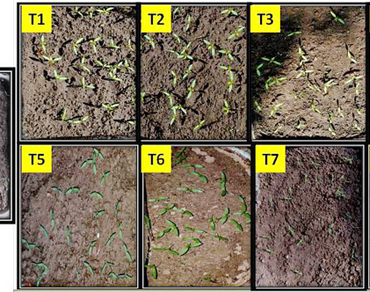
Intensive use of inorganic fertilizers has an adverse impact on the environment; as such, organic biostimulants are safer alternatives to promote sustainable agriculture. Large amounts of bio-waste produced every year may be managed and utilized as biostimulants for sustainable cultivation practices. This investigation aims to evaluate how aqueous tea leaf extract and dried tea leaf biomass affect the germination indices and seedling growth parameters of tomato plants. Seed priming and spraying of aqueous tea leaf extract results in increased germination rate and growth parameters as compared to the control set. Application of dried tea leaf biomass as soil amendments also exert a positive impact on germination indices and other growth parameters. Four aqueous extract-treated experimental sets (T1, T2, T3 and T4) and four dried tea leaf biomass treated sets (T5, T6, T7 and T8) along with the control set (TC) were used for the study. Experimental findings revealed that germination energy, germination index, and relative germination ratio increased up to the T3 set among aqueous extract treated sets, and among dried leaf biomass treated sets, the highest values were recorded in T5. Root and shoot length increased up to set T3, but in the dried leaf biomass treated set, it increased up to set T6. Thus, present research findings may be helpful to validate the potentiality of aqueous extract of tea leaf and dried tea leaf biomass as seed priming agents and fertilizing agents to enhance seedling growth and germinability of target plants.
References
Abbasi PA, Al-Dahmani J, Sahin F, Hoitinkand HAJ, Miller SA (2002) Effect of compost amendments on disease severity and yield of tomato in conventional and organic production systems. Plant Dis 86:156–161. https://doi.org/10.1094/PDIS.86.2.156
Ahmad R, Jilani G, Arshad M, Zahir ZA, Khalid A (2007) Bio-Conversion of organic wastes for their recycling in agriculture: an overview of perspectives and prospects. Ann Microbiol 57:471–479. https://doi.org/10.1007/BF03175343
Andresen M, Cedergreen N (2010) Plant growth is stimulated by Tea-seed extract: A new naturalGrowth Regulator? HortScience 45(12):1848–1853 https://www.doi.org/10.21273/HORTSCI.45.12.1848
Annabi M, Houot S, Francou C, Poitrenaud M, Bissonnais YL (2007) Soil aggregate stability improvement with urban composts of different maturities. Soil Sci Soc Am J 71(2):413–423
Anonymous (2022) https://economictimes.indiatimes.com/news/economy/agriculture/tea-planters-urge-the-tea-board-to-provide-guidelines-for-tea-waste-export/articleshow/70498311.cms
Ansari AA, Sukhraj K (2010) Effect of vermiwash and vermicompost on soil parameters and productivity of Okra (Abelmoschus esculentus) in Guyana. Afr J Agric Res 5(14):1794–1798
Arancon NQ, Owens JD, Converse C (2019) The effects of vermicompost tea on the growth and yield of lettuce and tomato in a non-circulating hydroponics system. J Plant Nutr 42:2447–2458
Arancon NQ, Pant A, Radovich T, Hue NV, Potter JK, Chad EC (2012) Seed germination and seedling growth of tomato and lettuce as affected by vermicompost water extracts (Teas). Hort Sci 47(12):1722–1728
Aslam Z, Ahmad A, Bellitürk K, Iqbal N et al (2018) Effects of vermicompost, vermi-tea and chemical fertilizer on morpho-physiological characteristics of tomato (Solanum lycopersicum) in Suleymanpasa district, Tekirdag of Turkey. Pure Appl Biol 9(3):1920–1931
Association of Official Seed Analysis (AOSA) (1983) Seed Vigor Testing Handbook, Handbook on Seed Testing, Contribution no. 32
Barker AV, Bryson GM (2006) Comparisons of composts with low or high nutrient status for growth of plants in containers. Comm Soil Sci Plant Anal 37:1303–1319. https://doi.org/10.1080/00103620600626460
Bewley JD, Black M (1985) Seeds: physiology of development and germination. Plenum, NewYork, NY, USA
Chiapusio G, S´anchez AM, Reigosa MJ, Gonz´alez L, Pellissier F (1997) Do germination indices adequately reflect allelochemical effects on the germination process? J Chem Ecol 23(11):2445–2453
Debnath B, Haldar D, Purkait MK (2021) Potential and sustainable utilization of tea waste: a review on present status and future trends. J Environ Chem Eng 9:106179. https://doi.org/10.1016/j.jece.2021.106179
Ellis RA, Roberts EH (1981) The quantification of ageing and survival in orthodox seeds. Seed Sci Technol 9:373–409
Eudoxie G, Martin M, IntechOpen (2019) London, UK
Gammoudi N, Nagaz K, Ferchichi A (2021) Potential use of spent coffee grounds and spent tea leaves extracts in priming treatment to promote in vitro early growth of salt-and drought stressed seedlings of Capsicum annuum L. Waste Biomass Valoriz 12(6):3341–3353
González-Hernández AI, Gómez-Sánchez MÁ, Pérez-Sánchez R, Morales-Corts MR (2023) Garden waste compost tea: A horticultural alternative to promote plant growth and root traits in tomato (Solanum lycopersicum L). Plants Horticulturae 9:1127. https://doi.org/10.3390/horticulturae9101127
Gupta S, Anand J, Sahil M, Rai N, Rawat S, Teshwar S (2020) Impact of green tea compost on soil quality and growth of plants. Ecol Environ Conserv 26:103–108
Gurav M, Sinalkar S (2013) Preparation of organic compost using waste tea powder. In National Conference on Biodiversity: Status and Challenges in Conservation-‘FAVEO: 97–99
Ibrahim EA (2016) Seed priming to alleviate salinity stress in germinating seeds. J Plant Physiol 192:38–46
International Seed Testing Association (ISTA) (1999) International rules for seed testing. Seed Sci Technol 27:333
Islam AKMA, Anuar N, Yaakob Z (2009) Effect of genotypes and pre-sowing treatments on seed germination behavior of Jatropha. Asian J Plant Sci 8(6):433–439
Kondo M, Kita K, Yokota HO (2004) Effects of tea leaf waste of green tea, oolong tea, and black tea addition on Sudangrass silage quality and in vitro gas production. J Sci Food Agric 84:721–727. https://doi.org/10.1002/jsfa.1718
Maiti R, Rajkurmar D, Jagan M, Pramanik K, Vidasagar P (2013) Effect of seed priming on seedling vigour and yield of tomato and Chilli. Int J Bio-Resour Stress Manag 4(2):119–125
Mavi K (2016) The effect of organic priming with marigold herbal tea on seeds quality in ‘aji’ pepper (Capsicum baccatum var pendulum Willd). J Agric Fac Mustafa Kemal Univ 21(1):31–39
Mekki A, Arous F, Aloui F, Sayadi S (2017) Treatment and valorization of agro-wastes as biofertilizers. Waste Biomass Valoriz 8(3):611–619
Morales-Corts MR, Pérez-Sánchez R, Ángeles M, Gómez-Sánchez (2018) Efficiency of garden waste compost teas on tomato growth and its suppressiveness against soilborne pathogens. Sci Agric 75(5):400–409
Ngan NM, Riddech N (2021) Use of spent mushroom substrate as an inoculant carrier and an organic fertilizer and their impacts on roselle growth (Hibiscus Sabdariffa L.) and soil quality. Waste Biomass Valoriz 12(7):3801–3811
Ramadan T, Amro A, Alazazi SMA (2018) Comparative allelopathic potential of ten field weeds against seed germination of three economic plants. BFAIJ 10(1):168–181
Rho BJ, Kil BS (1986) Influence of phytotoxin from Pinus rigida on the selected plants. J Nat Sci Wankwang Univ 5:19–27
Ruan S, Xue Q, Tylkowska K (2002) The influence of priming on germination of rice (Oryza sativa L.) seeds and seedling emergence and performance in flooded soil. Seed Sci Technol 30(1):61–67
Sarkar S, Majumder S, Ghosh A et al (2022) Metabolomic exploration of CTC tea manufacturing waste validates its potentiality as organic fertilizer. Turk J Food Agric Sci 4(2):41–48
Shaban H, Fazeli-Nasab B (2015) An overview of the benefits of compost tea on plant and soil structure. Adv Biores 6:154–158
Shivsubramanian K, Ganeshkumar M (2004) Influence of vermiwash on biological productivity of marigold. Madras Agric J 91(4):221–225
Singh H, Jassal RK, Kang JS et al (2015) Seed priming techniques in field crops– a review. Agric Rev 36(4):251–264
Suganthi A, Jayanandhan D (2015) Effect of tea compost on the growth of Vigna radiata (L.) R. Wilczek. Int J Appl Res 1(12):968–972
Tarashkar M, Matloobi M, Qureshi S, Rahimi A (2023) Assessing the growthstimulating effect of tea waste compost in urban agriculture while identifying the benefits of household waste carbon dioxide. Ecol Indic 151:110292
Wazir A, Gul Z, Hussain M (2018) Comparative study of various organic fertilizers effect on growth and yield of two economically important crops, potato and pea. Agric Sci 9:703–717
WHO, WFP, UNICEF (2022) The state of food security and nutrition in the world 2022. WHO, Geneva
Author Information
Department of Botany, Rabindranath Thakur Mahavidyalaya, Sipahijala District, India