Vegetos

(An International Journal of Plant Research & Biotechnology)
(eISSN: 2229-4473)
Ensifer meliloti strains: as multi-trait bioinoculants enhancing Cicer arietinum growth and sustainability
*Article not assigned to an issue yet
Bhatt Shivangi, Kaur Jasleen, Goswami Dweipayan, Saraf Meenu
Research Article | Published: 08 March, 2026
First Page: 0
Last Page: 0
Views: 509
Keywords: Plant growth-promoting rhizobacteria (PGPR), Bioinoculant, Symbiotic bacteria, Chickpea, n Ensifer melilotin , Sustainable agriculture
Abstract
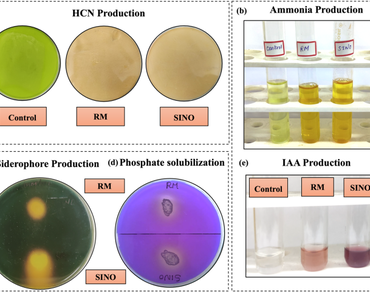
This study evaluates the multifaceted plant growth-promoting (PGP) capabilities of two distinct Ensifer meliloti strains: RM (MTCC 10499), isolated from the chickpea rhizosphere, and SINO (MTCC 11403), isolated from soybean nodules. Our selection of these strains is novel, driven by a notable gap in published research characterizing their PGP, quorum sensing (QS)-related, and biofilm-forming activities on Cicer arietinum. This study furthermore offers a unique comparative assessment of a native chickpea isolate against a soybean isolate for enhancing chickpea growth. While Ensifer meliloti is recognized for its traditional role in nitrogen fixation, the broader PGP traits of these particular strains, especially those potentially regulated by quorum sensing (QS), remain underexplored. We evaluated RM and SINO for key PGP traits including phosphate solubilization, siderophore production, ammonia and hydrogen cyanide synthesis, Indole-3-acetic acid (IAA) production, and biofilm formation. Both strains showed multiple beneficial attributes: RM exhibited significantly higher IAA production (57.8 µg/mL), while SINO displayed enhanced phosphate solubilization and siderophore activity. Pot studies further confirmed Condense to their efficacy, with both strains significantly improving chickpea growth parameters, including root length (up to 1.5-fold increase), shoot length (1.2–1.5-fold increase), and chlorophyll content (1.5–2-fold increase) compared to untreated controls. These findings highlight the novel potential of RM and SINO as distinct, multi-trait Ensifer meliloti bioinoculants, underscoring the value of assessing diverse, QS-related traits from strains with varied origins for developing next-generation solutions in sustainable chickpea production.
References
Ahmad F, Ahmad I, Khan MS (2008) Screening of free-living rhizospheric bacteria for their multiple plant growth promoting activities. Microbiol Res 163:173–181. https://doi.org/10.1016/j.micres.2006.04.001
Barnett MJ, Long SR (2018) Novel genes and regulators that influence production of cell surface exopolysaccharides in Sinorhizobium meliloti. J Bacteriol. https://doi.org/10.1128/JB.00501-17
Ben S, Philippe R, Fuhrmann JJ, Mrabet M (2022) Potential role of rhizobia to enhance chickpea—growth and yield in low fertility—soils of Tunisia. Antonie Van Leeuwenhoek 115:921–932. https://doi.org/10.1007/s10482-022-01745-5
Bhatt S, Goswami D, Saraf M (2023) Effect of quorum sensing and quorum quenching in plant microbe invasion. Adv Bioresearch 3:352–366. https://doi.org/10.15515/abr.0976-4585.S1.352366
Bhatt S, Goswami D, Saraf M (2025) Decoding quorum sensing: the language of bacteria for sustainable development. Microorg Sustain 28:23–46. https://doi.org/10.1007/978-981-96-3425-5_2
Bhattacharyya PN, Jha DK (2012) Plant growth-promoting rhizobacteria (PGPR): emergence in agriculture. World J Microbiol Biotechnol 28:1327–1350. https://doi.org/10.1007/s11274-011-0979-9
Ganesh J, Hewitt K, Devkota AR, Wilson T, Kaundal A (2024) IAA-producing plant growth promoting rhizobacteria from Ceanothus velutinus enhance cutting propagation efficiency and Arabidopsis biomass. Front Plant Sci 15:1–13. https://doi.org/10.3389/fpls.2024.1374877
Goswami D, Thakker JN, Dhandhukia PC (2016) Portraying mechanics of plant growth promoting rhizobacteria (PGPR): a review. Cogent Food Agric. https://doi.org/10.1080/23311932.2015.1127500
Hasan A, Tabassum B, Hashim M, Khan N (2024) Role of plant growth promoting rhizobacteria (PGPR) as a plant growth enhancer for sustainable agriculture: a review. Bacteria 3:59–75. https://doi.org/10.3390/bacteria3020005
Hinsinger P, Gobran GR, Gregory PJ, Wenzel WW (2005) Rhizosphere geometry and heterogeneity arising from root- mediated physical and chemical processes. New Phytol 168:293–303
Khairnar M, Hagir A, Parmar K, Sayyed RZ, James EK, Rahi P (2022) Phylogenetic diversity and plant growth-promoting activities of rhizobia nodulating fenugreek (Trigonella foenum-graecum Linn.) cultivated in different agroclimatic regions of India. FEMS Microbiol Ecol. https://doi.org/10.1093/femsec/fiac014
Kumar SC, Kumar M, Singh R, Kumar A (2025) Selection of competitive and effective rhizobial strain for enhanced chickpea production under Indo-Gangetic plains of India. Braz J Microbiol 56:2811–2825
Pérez-García LA, Sáenz-Mata J, Fortis-Hernández M, Navarro-Muñoz CE, Palacio-Rodríguez R, Preciado-Rangel P (2023) Plant-Growth-Promoting Rhizobacteria Improve Germination and Bioactive Compounds in Cucumber Seedlings. 1–10
Marschner P (2012) Rhizosphere Biology. In: Marschner's Mineral Nutrition of Higher Plants (Third Edition) 2012, pp 369–388
Nabati J, Nezami A, Yousefi A, Oskoueian E, Oskoueian A, Ahmadi-Lahijani MJ (2025) Biofertilizers containing plant growth promoting rhizobacteria enhance nutrient uptake and improve the growth and yield of chickpea plants in an arid environment. Sci Rep 15(1):1–13. https://doi.org/10.1038/s41598-025-93070-w. (1)
Ndeddy Aka RJ, Babalola OO (2016) Effect of bacterial inoculation of strains of Pseudomonas aeruginosa, Alcaligenes feacalis and bacillus subtilis on germination, growth and heavy metal (cd, cr, and ni) uptake of Brassica juncea. Int J Phytoremediation 18:200–209. https://doi.org/10.1080/15226514.2015.1073671
Pradhan S, Mackey HR, Al-Ansari TA, McKay G (2022) Biochar from food waste: a sustainable amendment to reduce water stress and improve the growth of chickpea plants. Biomass Convers Biorefinery 12:4549–4562. https://doi.org/10.1007/s13399-022-02575-1
Ramírez-Trujillo JA, Castillo-Texta MG, Ramírez-Yáñez M, Suárez-Rodríguez R (2025) Draft genome sequence data of the Ensifer sp. P24N7, a symbiotic bacteria isolated from nodules of Phaseolus vulgaris grown in mining tailings from Huautla, Morelos, Mexico. Data 10:1–7. https://doi.org/10.3390/data10030034
Rosier A, Bais HP (2022) Visualizing bacterial quorum sensing and quorum quenching interaction on Medicago roots, Research square 1–13. https://doi.org/10.21203/rs.3.rs-1742677/v1
Sharma S, Saraf M (2024) 2024 Vol. 67 | Št. 1. 67:20–34. https://doi.org/10.14720/abs.67.1
Sharma S, Gang S, Schumacher J, Buck M, Saraf M (2021) Genomic appraisal of Klebsiella PGPB isolated from soil to enhance the growth of barley. Genes Genomics 43:869–883. https://doi.org/10.1007/s13258-021-01099-8
Singh DP, Singh HB, Prabha R (2017) Plant-microbe interactions in agro-ecological perspectives. Plant-Microbe Interact Agro-Ecol Perspect 1:1–657. https://doi.org/10.1007/978-981-10-5813-4
Singh AA, Singh AK (2025) Role of bacterial quorum sensing in plant growth promotion. World J Microbiol Biotechnol 41:1–17. https://doi.org/10.1007/s11274-024-04232-3
Suliasih, Widawati S (2020) Isolation of indole acetic acid (IAA) producing Bacillus siamensis from peat and optimization of the culture conditions for maximum IAA production. In: IOP Conf Ser Earth Environ Sci, vol 572. https://doi.org/10.1088/1755-1315/572/1/012025
Li Y, Narayanan M, Shi X, Chen X, Li Z, Ma Y (2024) Biofilms formation in plant growth-promoting bacteria for alleviating agro-environmental stress. Sci Total Environ 907:167774
Bhatt S, Kaur J, Goswami D, Saraf M (2026) Identification of distinct N-acyl homoserine lactone profiles in non-hemolytic plant-associated symbiotic and non-symbiotic rhizobacteria. Arch Microbiol 208(1):1–17. https://doi.org/10.1007/s00203-025-04575-x
Author Information
Department of Microbiology and Biotechnology, Faculty of Sciences, University School of Sciences, Gujarat University, Ahmedabad, India