Vegetos

(An International Journal of Plant Research & Biotechnology)
(eISSN: 2229-4473)
Exogenous salicylic acid induces GluA and PR1a defense genes and enhances tomato tolerance to combined salinity and bacterial canker stress
*Article not assigned to an issue yet
Ahmad Jawad, Abbasi Hammad Ahmed, Atif Muhammad, Ullah Sana, Jalal Abdullah, Azam Zunaira, Bibi Hafsa
Research Articles | Published: 27 August, 2026
First Page: 0
Last Page: 0
Views: 5
Keywords: n Solanum lycopersicumn , Salicylic acid, n Clavibacter michiganensis subsp. michiganensisn , Salinity stress, PR1a, ?-1,3-glucanase A (GluA), Systemic acquired resistance, Gene expression
Abstract
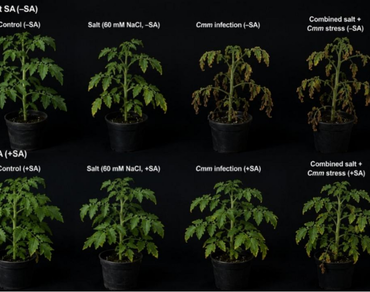
Tomato (Solanum lycopersicum L.) productivity is increasingly constrained by simultaneous abiotic and biotic stresses, particularly salinity and bacterial canker caused by Clavibacter michiganensis subsp. michiganensis (Cmm). This study evaluated the effects of exogenous salicylic acid (SA; 0.5 mM) on three tomato cultivars (Roma, Gala, and Rio Grande) exposed to salinity (60 mM NaCl), Cmm infection, and their combination. Growth, physiological traits, yield, and expression of the defense-related genes PR1a and GluA were assessed. Combined stress caused the greatest reductions in chlorophyll content, relative water content (RWC), vegetative growth, reproductive development, and yield. SA substantially alleviated these effects, increasing chlorophyll content and RWC under combined stress, improving plant height and branch production, and accelerating flowering and fruiting. Fruit size, number, and yield were also significantly improved by SA treatment. RT-qPCR analysis showed progressive induction of PR1a and GluA, with maximum expression at 3 days post-inoculation and the strongest response in SA-treated plants under combined stress. These findings indicate that exogenous SA enhances physiological performance while activating defense-associated pathways, supporting its potential for improving tomato resilience under concurrent abiotic and biotic stresses.
References
Aimé S, Alabouvette C, Steinberg C, Olivain C (2013) The endophytic strain Fusarium oxysporum Fo47: A good candidate for priming the defense responses in tomato roots. Mol Plant Microbe Interact 26:918–926. https://doi.org/10.1094/MPMI-12-12-0290-R
Ashraf M, Harris PJC (2013) Photosynthesis under stressful environments: An overview. Photosynthetica 51:163–190. https://doi.org/10.1007/s11099-013-0021-6
Balmer A, Pastor V, Gamir J, Flors V, Mauch-Mani B (2015) The ‘prime-ome’: Towards a holistic approach to priming. Trends Plant Sci 20:443–452. https://doi.org/10.1016/j.tplants.2015.04.002
Berens ML, Berry HM, Mine A, Argueso CT, Tsuda K (2017a) Evolution of hormone signaling networks in plant defense. Annu Rev Phytopathol 55:401–425. https://doi.org/10.1146/annurev-phyto-080516-035544
Chalupowicz L, Cohen-Kandli M, Dror O, Eichenlaub R, Gartemann K-H, Sessa G, Barash I, Manulis-Sasson S (2010) Sequential expression of bacterial virulence and plant defense genes during infection of tomato with Clavibacter michiganensis subsp. michiganensis. Phytopathology 100:252–261. https://doi.org/10.1094/PHYTO-100-3-0252
Chen N, Shao Q, Xiong Z (2023) Isolation and characterization of a pathogenesis-related protein 1 (SlPR1) gene with induced expression in tomato (Solanum lycopersicum) during Ralstonia solanacearum infection. Gene 855:147105. https://doi.org/10.1016/j.gene.2022.147105
Conrath U, Beckers GJM, Langenbach CJG, Jaskiewicz MR (2015) Priming for enhanced defense. Annu Rev Phytopathol 53:97–119. https://doi.org/10.1146/annurev-phyto-080614-120132
Ding P, Ding Y (2020) Stories of salicylic acid: A plant defense hormone. Trends Plant Sci 25:549–565. https://doi.org/10.1016/j.tplants.2020.01.004
Fu ZQ, Dong X (2013) Systemic acquired resistance: Turning local infection into global defense. Annu Rev Plant Biol 64:839–863. https://doi.org/10.1146/annurev-arplant-042811-105606
Gajewska E, Sk?odowska M (2008) Differential biochemical responses of wheat shoots and roots to nickel stress: Antioxidative reactions and proline accumulation. Plant Growth Regul 54:179–188. https://doi.org/10.1007/s10725-007-9240-9
Hassnain H, Basit A, Alam M, Ahmad I, Ullah I, Alam N, Ullah I, Khalid MA, Shair M, Ain NU (2020) Efficacy of chitosan on performance of tomato (Lycopersicon esculentum L.) plant under water stress condition. Pak J Agric Res 33:27–41. https://doi.org/10.17582/journal.pjar/2020/33.1.27.41
Hayat Q, Hayat S, Irfan M, Ahmad A (2010) Effect of exogenous salicylic acid under changing environment: A review. Environ Exp Bot 68:14–25. https://doi.org/10.1016/j.envexpbot.2009.08.005
Hwang IS, Oh E-J, Oh C-S (2020) Transcriptional changes of plant defense-related genes in response to Clavibacter infection in pepper and tomato. Plant Pathol J 36:450–458. https://doi.org/10.5423/PPJ.OA.07.2020.0124
Khan MIR, Fatma M, Per TS, Anjum NA, Khan NA (2015) Salicylic acid-induced abiotic stress tolerance and underlying mechanisms in plants. Front Plant Sci 6:462. https://doi.org/10.3389/fpls.2015.00462
Klessig DF, Choi HW, Dempsey DA (2018) Systemic acquired resistance and salicylic acid: Past, present, and future. Mol Plant Microbe Interact 31:871–888. https://doi.org/10.1094/MPMI-03-18-0067-CR
Lichtenthaler HK (1987) Chlorophylls and carotenoids: Pigments of photosynthetic biomembranes. Methods Enzymol 148:350–382. https://doi.org/10.1016/0076-6879(87)48036-1
Livak KJ, Schmittgen TD (2001) Analysis of relative gene expression data using real-time quantitative PCR and the 2 – ??CT method. Methods 25:402–408. https://doi.org/10.1006/meth.2001.1262
Mauch-Mani B, Baccelli I, Luna E, Flors V (2017) Defense priming: An adaptive part of induced resistance. Annu Rev Plant Biol 68:485–512. https://doi.org/10.1146/annurev-arplant-042916-041132
Mekonnen H, Kibret M, Assefa F (2022) Isolation and characterization of Ralstonia solanacearum causing wilt disease in tomato. Arch Phytopathol Plant Prot 55:2317–2333. https://doi.org/10.1080/03235408.2022.2164161
Miura K, Tada Y (2014) Regulation of water, salinity, and cold stress responses by salicylic acid. Front Plant Sci 5:4. https://doi.org/10.3389/fpls.2014.00004
Munns R, Gilliham M (2015) Salinity tolerance of crops – what is the cost? New Phytol 208:668–673. https://doi.org/10.1111/nph.13519
Munns R, Tester M (2008) Mechanisms of salinity tolerance. Annu Rev Plant Biol 59:651–681. https://doi.org/10.1146/annurev.arplant.59.032607.092911
Myung I-S, Kim DG, An SH, Lee Y-K, Kim WG (2008) First report of bacterial canker of tomato caused by Clavibacter michiganensis subsp. michiganensis in Korea. Plant Dis 92:1472. https://doi.org/10.1094/PDIS-92-10-1472A
Naeem M, Basit A, Ahmad I, Mohamed HI, Wasila H (2020) Effect of salicylic acid and salinity stress on the performance of tomato plants. Gesunde Pflanzen 72:393–402. https://doi.org/10.1007/s10343-020-00521-7
Naz N, Khan I, Gul B, Ayub G, Jan F, Jang N, Shuaib M (2019) Response of tomato (Lycopersicon esculentum Mill.) growth to different phosphorous levels and sowing dates. Acta Ecol Sin 39:30–35. https://doi.org/10.1016/j.chnaes.2018.06.004
Suzuki N, Rivero RM, Shulaev V, Blumwald E, Mittler R (2014) Abiotic and biotic stress combinations. New Phytol 203:32–43. https://doi.org/10.1111/nph.12797
Tripathi R, Vishunavat K, Tewari R, Kumar S, Minkina T, De Corato U, Keswani C (2022) Defense inducers mediated mitigation of bacterial canker in tomato through alteration in oxidative stress markers. Microorganisms 10:2160. https://doi.org/10.3390/microorganisms10112160
Van Loon LC, Rep M, Pieterse CMJ (2006) Significance of inducible defense-related proteins in infected plants. Annu Rev Phytopathol 44:135–162. https://doi.org/10.1146/annurev.phyto.44.070505.143425
Zandalinas SI, Fichman Y, Devireddy AR, Sengupta S, Azad RK, Mittler R (2020) Systemic signaling during abiotic stress combination in plants. Proc Natl Acad Sci USA 117:13810–13820. https://doi.org/10.1073/pnas.2005077117
Zhang Y, Xu S, Yang S, Chen Y (2015) Salicylic acid alleviates cadmium-induced inhibition of growth and photosynthesis through upregulating antioxidant defense system in two melon cultivars (Cucumis melo L). Protoplasma 252:911–924. https://doi.org/10.1007/s00709-014-0732-y
Zhou J-M, Zhang Y (2020) Plant immunity: Danger perception and signaling. Cell 181:978–989. https://doi.org/10.1016/j.cell.2020.04.028
Zhu J-K (2016) Abiotic stress signaling and responses in plants. Cell 167:313–324. https://doi.org/10.1016/j.cell.2016.08.029
Author Information
Institute of Biotechnology and Genetic Engineering, The University of Agriculture Peshawar, Peshawar, Pakistan