Vegetos

(An International Journal of Plant Research & Biotechnology)
(eISSN: 2229-4473)
Greenhouse Gas-reducing Purple Nonsulfur Bacteria Blastochloris sulfoviridis and Rhodobacter sphaeroides Improve Soil Properties, Nutrient Uptake, and Rice Yield Cultivated on Acid Sulfate Soil
*Article not assigned to an issue yet
Research Articles | Published: 19 September, 2026
First Page: 0
Last Page: 0
Views: 97
Keywords: Greenhouse gas-reducing purple nonsulfur bacteria, Methane, Nitrous oxide, Nutrient uptake, Paddy acid sulfate soil, Rice yield
Abstract
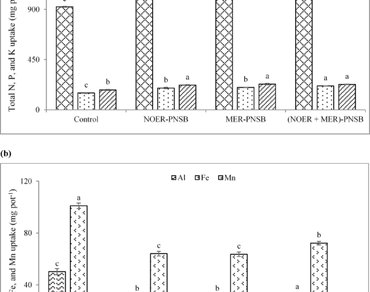
The objective of this study was to evaluate the effectiveness of purple nonsulfur bacteria (PNSB) previously characterized for nitrous oxide emission-reducing (NOER-PNSB) Rhodobacter sphaeroides SVG-8, SVG-10A, and WVG-3A, and methane emission-reducing (MER-PNSB) Blastochloris sulfoviridis WHA-9B, R. sphaeroides SPL-4A, and WHA-1A in improving soil properties, nutrient uptakes, and rice yield grown on acid sulfate soil. A completely randomized design pot experiment under greenhouse conditions included four treatments: (i) Control, (ii) NOER-PNSB addition, (iii) MER-PNSB addition, and (iv) (NOER?+?MER)-PNSB addition, with four replications. Addition of NOER-PNSB and MER-PNSB increased soil pH by 0.26–0.34 units, while increasing NH4+, soluble P, and exchangeable K contents by 27.7–45.8%, 36.9–69.3%, and 16.3–20.8%, respectively. The treatments also reduced soil Al3+, Fe2+, and Mn2+ concentrations by 38.0–50.9%, 25.1–29.3%, and 39.2–49.0%, respectively, compared with the control. Simultaneously, NOER-PNSB and MER-PNSB increased total N, P, and K uptake (23.3–29.2%, 29.8–42.5%, and 24.7–29.8%, respectively), reduced total Al, Fe, and Mn uptake (35.5–38.0%, 28.5–37.0%, and 36.2–43.8%, respectively), increased plant height (5.24–12.3%), and grain yield (13.4–22.5%) compared with the control. The combination of NOER-PNSB and MER-PNSB shows potential application in low-emission rice cultivation on acid sulfate soil due to improved soil quality and rice productivity.
References
Abubakar W, Uddin M, Kasim S, Zaibon S, Shamsuzzaman SM, Haque ANA, Reza A (2023) Biochar and silicon for sustainable agriculture in acid soil-nutrient dynamics and maize production: A review. Agric Rev 45(1):44–51. https://doi.org/10.18805/ag.RF-260
Altman DG (1991) Practical statistics for medical research. Chapman and Hall. https://search.ebscohost.com/login.aspx?direct=true&scope=site&db=nlebk&db=nlabk&AN=2140925. Accessed 23 February 2026
Asif MR, Ye B, Ye C (2025) Acid sulfate soils: formation, identification, environmental impacts, and sustainable remediation practices. Environ Monit Assess 197(4):484. https://doi.org/10.1007/s10661-025-13919-5
Ba LH, Hoan NX, Nam TV, Hung L (2022) The dynamic and effect of toxic in acid sulfate soil, on rice, in Mekong Delta, Viet Nam, caused by the artificial actions. J Soil Water Sci 6(1):223–228. https://doi.org/10.36959/624/448
Bayon-Vicente G, Toubeau L, Gilson M, Gégo G, Landgey N, Krings S, Leroy B (2025) Metabolic pathways to sustainability: Review of purple non-sulfur bacteria potential in agri-food waste valorization. Front Bioeng Biotechnol 13:1529032. https://doi.org/10.3389/fbioe.2025.1529032
CLRRI (Cuu Long Delta Rice Research Institute) (2022) Introduction to the characteristics of om rice varieties Winter-Spring crop 2021–2022. Vietnam Academy of Agricultural Sciences
Garcia Arredondo M, Fang Y, Jones M, Yabusaki S, Cardon Z, Keiluweit M (2023) Resolving dynamic mineral-organic interactions in the rhizosphere by combining in-situ microsensors with plant-soil reactive transport modeling. Soil Biol Biochem 184:109097. https://doi.org/10.1016/j.soilbio.2023.109097
Harada N, Nishiyama M, Matsumoto S (2001) Inhibition of methanogens increases photo-dependent nitrogenase activities in anoxic paddy soil amended with rice straw. FEMS Microbiol Ecol 35:231–238. https://doi.org/10.1111/j.1574-6941.2001.tb00808.x
Hayashi S, Iwamoto Y, Hirakawa Y, Mori K, Yamada N, Maki T, Yamamoto S, Miyasaka H (2022) Plant-growth-promoting effect by cell components of purple non-sulfur photosynthetic bacteria. Microorganisms 10(4):771. https://doi.org/10.3390/microorganisms10040771
Horneck DA, Sullivan DM, Owen J, Hart JM (2011) Soil test interpretation guide. Technical report EC1478. Oregon State University, Extension service
Houba VJG, Novozamsky I, Temminghof EJM (1997) Soil and plant analysis, Part 5. Department of soil science and plant nutrition. Wageningen Agricultural University, The Netherlands
Ibrahim MS, Ikhajiagbe B (2024) Effects of plant growth promoting bacteria (PGPB) Rhizo-inoculation on soil physico-chemical, bacterial community structure and root colonization of rice (Oryza sativa L. var. FARO 44) grown in ferruginous ultisol conditions. Sci World J 19(3):24044. https://doi.org/10.4314/swj.v19i3.38
IRRI (International Rice Research Institute) (1996) Standard evaluation system for rice. http://www.knowledgebank.irri.org/images/docs/rice-standard-evaluation-system.pdf. Accessed 1 August 2025
Khairullah I, Saleh M, Alwi M, Masganti (2021) Increasing productivity of rice through iron toxicity control in acid sulfate soils of tidal swampland. IOP Conf Ser: Earth Environ Sci 648:012151. https://doi.org/10.1088/1755-1315/648/1/012151
Khuong NQ, Nhat NM, Thu LTM, Thuc LV (2024) Influence of purple non-sulfur bacterial augmentation on soil nutrient dynamics and rice (Oryza sativa) growth in acidic saline-stressed environments. PeerJ 12:e16943. https://doi.org/10.7717/peerj.16943
Liu-Xu L, González-Hernández AI, Camañes G, Vicedo B, Scalschi L, Llorens E (2024) Harnessing green helpers: Nitrogen fixing bacteria and other beneficial microorganisms in plant–Microbe interactions for sustainable agriculture. Horticulturae 10(6):621. https://doi.org/10.3390/horticulturae10060621
Maeda I (2022) Potential of phototrophic purple nonsulfur bacteria to fix nitrogen in rice fields. Microorganisms 10(1):28. https://doi.org/10.3390/microorganisms10010028
Maciel-Rodríguez M, Moreno-Valencia FD, Plascencia-Espinosa M (2025) The role of plant growth-promoting bacteria in soil restoration: A strategy to promote agricultural sustainability. Microorganisms 13(8):1799. https://doi.org/10.3390/microorganisms13081799
Minh VQ, Hung TV, Vu PT (2024) Constraints of acid sulfate soils and practical use for the improvement of farming in the Mekong Delta, Vietnam: A review. Indian J Agric Res 58(3):369–379. https://doi.org/10.18805/IJARe.AF-834
Mmbaga N, Materu ST (2026) Soil acidification impacts on water dynamics and global paddy rice production challenges. Discov Water 6:14. https://doi.org/10.1007/s43832-025-00325-8
Ngoc NP, Qui NV, Hung NN (2023) Chemical processes and sustainability of rice-shrimp farming on saline acid sulfate soils in Mekong Delta. Heliyon 9(2):e13532. https://doi.org/10.1016/j.heliyon.2023.e13532
Nhanh PTN, Nhan TC, Bao MC, Quang LT, Thu LTM, Trong ND, Nguyen TTK, Toan NT, Xuan LNT, Xuan DT, Thao HV, Phuc NTH, Khuong NQ (2026) Selection of acid sulfate purple nonsulfur bacteria for mitigating methane emissions from paddy soils in the Mekong Delta, Vietnam. Int Microbiol (Under review).
Nyman A, Johnson A, Yu C, Sohlenius G, Becher M, Dopson M, Åström M (2023) A nationwide acid sulfate soil study—A rapid and cost-efficient approach for characterizing large-scale features. Sci Total Environ 869:161845. https://doi.org/10.1016/j.scitotenv.2023.161845
Ponnamperuma FN (1972) The chemistry of submerged soils. Adv Agron 24:29–96. https://doi.org/10.1016/S0065-2113(08)60633-1
Rashid N, Shaikh S, Onwusogh U, Siddique A, Mackey HR (2026) Micro-aerobic treatment using purple bacteria enriched cultures for the treatment of gas-to-liquid (GTL) wastewater and PHA production. Chemosphere 403:144929. https://doi.org/10.1016/j.chemosphere.2026.144929
Rohith AK, Joseph B, Gladis R (2024) Probing acid sulphate soils for sustainable rice production in Kuttanad: Challenges and solutions. Annu Res Rev Biol 39(12):46–56. https://doi.org/10.9734/arrb/2024/v39i122169
Sparks DL, Page AL, Helmke PA, Loeppert RH, Soltanpour PN, Tabatabai MA, Johnston CT, Sumner ME (1996) Methods of soil analysis. In: Madison WI (ed) Part 3-Chemical methods, SSSA Book Ser.5.3. SSSA, ASA. https://doi.org/10.2136/sssabookser5.3
Sulaeman Y, Maftuáh E, Noor M, Hairani A, Nurzakiah S, Mukhlis M, Anwar K, Fahmi A, Saleh M, Khairullah I, Rumanti IA, Alwi M, Noor A, Ningsih RD (2024) Coastal acid-sulfate soils of Kalimantan, Indonesia, for food security: Characteristics, management, and future directions. Resources 13(3):36. https://doi.org/10.3390/resources13030036
Sundar LS, Yen K-S, Chang Y-T, Chao Y-Y (2024) Utilization of Rhodopseudomonas palustris in crop rotation practice boosts rice productivity and soil nutrient dynamics. Agriculture 14(5):758. https://doi.org/10.3390/agriculture14050758
Trong ND, Trang TTT, Quang LT, Oanh TO, Nguyen PC, Nhan TC, Xuan LNT, Xuan DT, Khuong NQ (2025) Effects of Rhodopseudomonas palustris and Rhodopseudomonas pentothenatexigens on reducing chemical NPK fertilizer used for rice in acid sulfate soil under field conditions. Paddy Water Environ 23:491–510. https://doi.org/10.1007/s10333-025-01030-x
Varghese EM, Kour B, Ramya S, Krishna PD, Nazla KA (2024) Rice in acid sulphate soils: Role of microbial interactions in crop and soil health management. Appl Soil Ecol 196:105309. https://doi.org/10.1016/j.apsoil.2024.105309
Wu G, Wang X, Wei X, Zhang M, Chu J, Hou M, Lin L, Chen Y, Che Z, Li X, Zhang C, Song H (2026) Sustainable soil management in acidic paddy fields: Liming and biochar application reduce greenhouse gas emissions while enhancing rice yields. J Environ Manage 398:128461. https://doi.org/10.1016/j.jenvman.2025.128461
Wu Y, Zhao H, Xiao M, Liu H, He H, Peng L, Tao Q, Tang X, Zhang Y, Huang R, Li B, Wang C (2025) A plant growth-promoting bacterium supports cadmium detoxification of rice by inducing phenylpropanoid and flavonoid biosynthesis. J Hazard Mater 484:136795. https://doi.org/10.1016/j.jhazmat.2024.136795
Xuan LNT, Nhanh PTN, Dao NTX, Bao MC, Nhan TC, Khuong NQ (2026) Effects of Rhodobacter sphaeroides SVG-8, SVG-10A, and WVG-3A possessing nitrous oxide reductase on reducing nitrous oxide emissions and improving rice yield in acid sulfate soil under greenhouse conditions. Biocatal Agric Biotechnol. (Under review)
Yen KS, Sundar LS, Chao Y-Y (2022) Foliar application of Rhodopseudomonas palustris enhances the rice crop growth and yield under field conditions. Plants 11(19):2452. https://doi.org/10.3390/plants11192452
Author Information
Institute of Biotechnology and Food Technology, Can Tho University, Can Tho, Vietnam