Vegetos

(An International Journal of Plant Research & Biotechnology)
(eISSN: 2229-4473)
Impact of Bacillus velezensis OEE1 treatment against Verticillium wilt disease in expression level of chitinase, phospholipase and WRKY in olive trees
*Article not assigned to an issue yet
Cheffi Manel, Sellem Imen, Gharbi Yaakoub, Ennouri Karim, Mallouli Lotfi, Triki Mohamed Ali
Research Articles | Published: 27 August, 2026
First Page: 0
Last Page: 0
Views: 5
Keywords: Chitinase, Phospholipase D, WRKY, Transcription factors, qPCR
Abstract
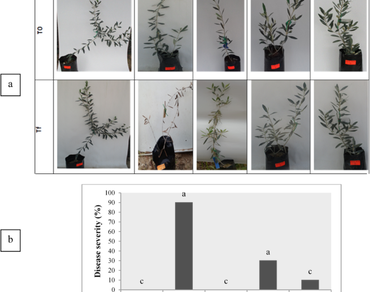
Olive is one of the most popular plants around the world which is threatened by Verticillium wilt disease (VWO), caused by Verticillium dahliae. In this study, olive trees cv Chemlali were artificially inoculated with V. dahliae to evaluate expression of related genes promoting defense to VWO disease after several treatments with Bacillus velezensis strain OEE1 under greenhouse conditions. Total RNA was extracted and the first-strand cDNA was then synthesized. Expression level of chitinase, phospholipase D (PLD) and WRKY transcription factors genes were investigated using quantitative polymerase chain reaction (qPCR). The transcriptional level of these genes was up expressed in B. velezensis treated plants. Analyses revealed that preventive and curative treatments against V. dahliae involve modulation of chitinase and WRKY genes expression. The highest level of expression was observed at 3 days post inoculation. This expression was confirmed by the phenotypic symptoms of VWO disease that appeared in inoculated and treated olive trees.
References
Adams DJ (2004) Fungal cell wall chitinases and glucanases. Microbiology (Reading). https://doi.org/10.1099/mic.0.26980-0
Cabanás CGL, Legarda G, Ruano-Rosa D, Pizarro-Tobías P, Valverde-Corredor A, Niqui JL, Triviño JC, Roca A, Mercado-Blanco J (2018) Indigenous Pseudomonas spp. strains from the olive (Olea europaea L.) rhizosphere as effective biocontrol agents against Verticillium dahliae: from the host roots to the bacterial genomes. Front Microbiol. https://doi.org/10.3389/fmicb.2018.00277
Cheffi M, Bouket AC, Alenezi FN, Luptakova L, Belka M, Vallat A, Rateb ME, Tounsi S, Triki MA, Belbahri L (2019) Olea europaea L. Root endophyte Bacillus velezensis oee1 counteracts oomycete and fungal harmful pathogens and harbours a large repertoire of secreted and volatile metabolites and beneficial functional genes. Microorganisms 7:1–29. https://doi.org/10.3390/microorganisms7090314
Cheffi Azabou M, Gharbi Y, Medhioub I, Ennouri K, Barham H, Tounsi S, Triki MA (2020) The endophytic strain Bacillus velezensis OEE1: an efficient biocontrol agent against Verticillium wilt of olive and a potential plant growth promoting bacteria. Biol Control 142:104168. https://doi.org/10.1016/j.biocontrol.2019.104168
Conn VM, Walker AR, Franco CMM (2008) Endophytic actinobacteria induce defense pathways in Arabidopsis thaliana. Mol Plant-Microbe Interact. https://doi.org/10.1094/MPMI-21-2-0208
Deketelaere S, Tyvaert L, França SC, Hofte M (2017) Desirable traits of a good biocontrol agent against Verticillium wilt. Front Microbiol. https://doi.org/10.3389/fmicb.2017.01186
Gharbi Y, Triki MA, Trabelsi R, Fendri I, Daayf F, Gdoura R (2015) Genetic structure of Verticillium dahliae isolates infecting olive trees in Tunisia using AFLP, pathogenicity and PCR markers. Plant Pathol. https://doi.org/10.1111/ppa.12323
Gharbi Y, Barkallah M, Bouazizi E, Cheffi M, Krid S, Triki MA, Gdoura R (2016) Development and validation of a new real-time assay for the quantification of Verticillium dahliae in the soil: a comparison with conventional soil plating. Mycol Prog. https://doi.org/10.1007/s11557-016-1196-6
Gond SK, Bergen MS, Torres MS, White JF (2015) Endophytic Bacillus spp. produce antifungal lipopeptides and induce host defence gene expression in maize. Microbiol Res 172:79–87. https://doi.org/10.1016/j.micres.2014.11.004
Hernandez MES, Davila R, de Algaba P, Lopez MB, Casas T (1998) Occurrence and etiology of death of young olive trees in southern Spain. Eur J Plant Pathol 104:347
Hyakumachi M, Nishimura M, Arakawa T, Asano S, Yoshida S, Tsushima S, Takahashi H (2013) Bacillus thuringiensis suppresses bacterial wilt disease caused by Ralstonia solanacearum with systemic induction of defense-related gene expression in tomato. Microbes Environ 28:128–134. https://doi.org/10.1264/jsme2.ME12162
Jiang CH, Huang ZY, Xie P, Gu C, Li K, Wang DC, Yu YY, Fan ZH, Wang CJ, Wang YP, Guo YH, Guo JH (2016) Transcription factors WRKY70 and WRKY11 served as regulators in rhizobacterium Bacillus cereus AR156-induced systemic resistance to Pseudomonas syringae pv. tomato DC3000 in Arabidopsis. J Exp Bot. https://doi.org/10.1093/jxb/erv445
Jiang CH, Liao MJ, Wang HK, Zheng MZ, Xu JJ, Guo JH (2018) Bacillus velezensis, a potential and efficient biocontrol agent in control of pepper gray mold caused by Botrytis cinerea. Biol Control 126:147–157. https://doi.org/10.1016/j.biocontrol.2018.07.017
Kim JS, Lee J, Lee CH, Woo SY, Kang H, Seo SG, Kim SH (2015) Activation of pathogenesis-related genes by the rhizobacterium, Bacillus sp. JS, which induces systemic resistance in tobacco plants. Plant Pathol J. https://doi.org/10.5423/PPJ.NT.11.2014.0122
Kloepper JW, Ryu CM, Zhang S (2004) Induced systemic resistance and promotion of plant growth by Bacillus spp. Phytopathology. https://doi.org/10.1094/PHYTO.2004.94.11.1259
Li J, Wang X (2019) Phospholipase D and phosphatidic acid in plant immunity. Plant Sci. https://doi.org/10.1016/j.plantsci.2018.05.021
Livak KJ, Schmittgen TD (2001) Analysis of relative gene expression data using real-time quantitative PCR and the 2-ΔΔCT method. Methods. https://doi.org/10.1006/meth.2001.1262
Schlöffel MA, Salzer A, Wan WL, van Wijk R, Corvo R, Del Šemanjski M, Symeonidi E, Slaby P, Kilian J, Ma?ek B, Munnik T, Gust AA (2020) The BIR2/BIR3-associated phospholipase DG1 negatively regulates plant immunity. Plant Physiol. https://doi.org/10.1104/pp.19.01292
Shibuya N, Minami E (2001) Oligosaccharide signalling for defence responses in plant. Physiol Mol Plant Pathol. https://doi.org/10.1006/pmpp.2001.0364
Tjamos SE, Flemetakis E, Paplomatas EJ, Katinakis P (2005) Induction of resistance to Verticillium dahliae in Arabidopsis thaliana by the biocontrol agent K-165 and pathogenesis-related proteins gene expression. Mol Plant-Microbe Interact. https://doi.org/10.1094/MPMI-18-0555
Van Loon LC, Rep M, Pieterse CMJ (2006) Significance of inducible defense-related proteins in infected plants. Annu Rev Phytopathol. https://doi.org/10.1146/annurev.phyto.44.070505.143425
Yang YL, Liu ZY, Cai L, Hyde KD, Yu ZN, McKenzie EHC (2009) Colletotrichum anthracnose of Amaryllidaceae. Fungal Divers 39(2):123
Author Information
Laboratory of Genetic Resources of Olive Tree: Characterization, Valorization and Phytosanitary Protection, Olive Tree Institute, University of Sfax, Sfax, Tunisia