Vegetos

(An International Journal of Plant Research & Biotechnology)
(eISSN: 2229-4473)
Impact of ethyl methane sulfonate on agronomic performance and chromosomal aberrations in Hordeum vulgare L
*Article not assigned to an issue yet
Arminian Ali, Ahmadi Maasoomeh, Fazeli-Nasab Bahman, Mastinu Andrea
Research Articles | Published: 14 July, 2026
First Page: 0
Last Page: 0
Views: 59
Keywords: Aberration, Chromosome, Cytogenetical, Mitotic index, Mutation, Mutagenesis
Abstract
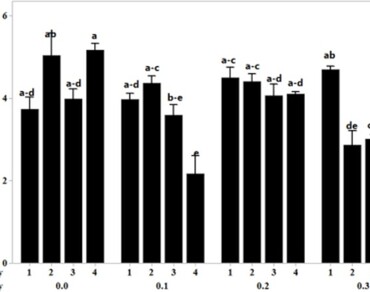
Ethyl methanesulfonate (EMS) is widely used in mutation breeding to generate genetic variability; however, its effects on agronomic performance and cytological stability require careful optimization. This study evaluated the impact of EMS on four barley (Hordeum vulgare L.) advanced breeding lines under greenhouse conditions. Seeds were treated with three EMS concentrations (0.1%, 0.2%, and 0.3%), along with untreated control, and assessed for agronomic and cytological traits. EMS treatment induced significant, dose-dependent changes in plant performance. Germination, seedling vigor, plant height, and 100-grain weight declined by approximately 20–50% with increasing EMS concentration. In contrast, total tiller number increased, although fertile tiller number did not increase proportionally, indicating a greater proportion of infertile tillers at higher EMS concentrations. Moderate EMS treatment (0.2%) improved grain number per spike while maintaining relatively stable grain weight, whereas higher concentration (0.3%) resulted in reduced plant performance and increased frequency of unfilled grains. Cytological analysis revealed a progressive increase in chromosomal aberrations, including chromosome stickiness, bridges, and laggards, with increasing EMS concentration. The chromosomal aberration index increased markedly (up to ~ 2-fold at 0.3% EMS), while the mitotic index declined, indicating enhanced genotoxic stress at higher doses. Overall, EMS proved to be an effective tool for inducing genetic variability in barley; however, its efficiency depends on dose optimization. Among the tested EMS concentrations, 0.2% EMS was associated with a comparatively favorable balance between agronomic performance and cytological stability. While higher EMS concentration (0.3%) increased chromosomal aberrations and reduced plant performance, the intermediate concentration maintained agronomic variability with comparatively lower cytogenetic disruption. These findings support the use of EMS-induced variability in barley breeding programs and contribute to sustainable crop improvement strategies aligned with global food security goals.
References
Alam MZ, Haider SA, Paul NK (2007) Yield and yield components of barley (Hordeum vulgare L.) in relation to sowing times. J Bio-Sciences 15:139–145. https://doi.org/10.3329/jbs.v15i0.2154
Alasti O, Zeinali E, Soltani A, Torabi B (2022) Exploring the current status of barley yield and production gap of Iran. Europ J Agr 139:126547. https://doi.org/10.1016/j.eja.2022.126547
Arisha MH, Liang B-K, Gong SNZ-H, Li D-W (2014) Kill curve analysis and response generation Capsicum annuum to ethyl methane sulfonate. Genet Mol Res 13(4):10049–10061. https://doi.org/10.4238/2014
Abbai R, Golan G, Longin CFH, Schnurbusch T (2024) Grain yield trade-offs in spike-branching wheat can be mitigated by elite alleles affecting sink capacity and post-anthesis source activity. J Exp Bot 75(1):88–102. https://doi.org/10.1093/jxb/erad373
Abdul-Baki AA, Anderson JD (1973) Vigor determination in soybean seed by multiple criteria. Crop Sci 13(6):630–633. https://doi.org/10.2135/cropsci1973.0011183X001300060013x
Beyramizadeh E, Arminian A, Fazeli A (2023) Evaluating the effect of gamma rays on Zamiifolia (Zamioculcas zamiifolia) plant in vitro and genetic diversity of the resulting genotypes using the ISSR marker. Sci Rep 13(1):8308. https://doi.org/10.1038/s41598-023-35618-2
Chen L, Duan L, Sun M, Yang Z, Li H, Hu K, Yang H, Liu L (2023) Current trends and insights on EMS mutagenesis application to studies on plant abiotic stress tolerance and development. Front. Plant Sci 13:1052569. https://doi.org/10.3389/fpls.2022.1052569
Fonseca R, Capel C, Nieto-Canseco R, Ortiz-Atienza A, Bretones S, López-Fábregas JD, Quevedo-Colmena AS, Lebrón R, Barragán-Lozano T, Villalobos-Ramírez V, Yuste-Lisbona FJ, Angosto T, Capel J, Lozano R (2022) A Tomato EMS-Mutagenized Population Provides New Valuable Resources for Gene Discovery and Breeding of Developmental Traits. Plants (Basel) 11(19):2453. https://doi.org/10.3390/plants11192453
Ghosh S, Ganga M, Soorianathasundaram K, Kumar A, Kapoor M (2020) Induction of mutation in Jasminum grandiflorum with gamma rays and EMS and identification of novel mutants using molecular markers and SEM imaging. Ind J Hort 77(4):695–703. https://doi.org/10.5958/0974-0112.2020.00101.2
Gilmour CS, Lukowitz W (2020) EMS mutagenesis of Arabidopsis seeds. Meth Mol Biol 2122:15–23
Gnanamurth S, Dhanavel D (2014) Effect of EMS on induced morphological mutants and chromosomal variation in Cowpea (Vigna unguiculata (L.) Walp). Int Lett Nat Sci 22:33–43. https://doi.org/10.18052/www.scipress.com/ilns.22.33
Khalil F, Naiyan X, Tayyab M, Pinghua C (2018) Screening of ems-induced drought-tolerant sugarcane mutants employing physiological, molecular and enzymatic approaches. Agronomy 8(226):1–13. https://doi.org/10.3390/AGRONOMY8100226
Kumar Rai P, Kumar G (2010) The genotoxic potential of two heavy metals in inbred lines of maize (Zea mays L.). Turk. J Biol 34:39–46. https://doi.org/10.3906/bot-0801-6
Kumlehn J, Stein N (2014) Biotechnological approaches to barley improvement. Springer-, Berlin, Heidelberg (Germany
Laskar RA, Chaudhary C, Khan S, Chandra A (2018) Induction of mutagenized tomato populations for investigation on agronomic traits and mutant phenotyping. J Saudi Soc Agr Sci 17:51–60. https://doi.org/10.1016/j.jssas.2016.01.002
Li H, Yu K, Zhang Z, Yu Y, Wan J, He H, Fan C (2024) Targeted mutagenesis of flavonoid biosynthesis pathway genes reveals functional divergence in seed coat colour, oil content and fatty acid composition in Brassica napus L. Plant Biotech J 22(2):445–459. https://doi.org/10.1111/pbi.14197
Nowak K, Wójcikowska B, Gajecka M, Elżbieciak A, Morończyk J et al (2024) The improvement of the in vitro plant regeneration in barley with the epigenetic modifier of histone acetylation, trichostatin A. J Appl Genet 65(1):13–30. https://doi.org/10.1007/s13353-023-00800-9
Salvi S, Druka A, Milner SG, Gruszka D (2014) Induced Genetic Variation, TILLING and NGS-Based Cloning. In: Kumlehn J, Stein N (eds) Biotechnological Approaches to Barley Improvement. Biotechnology in Agriculture and Forestry, vol 69. Springer, Berlin, Heidelberg. https://doi.org/10.1007/978-3-662-44406-1_15
Shirley BW, Hanley S, Goodman HM (1992) Effect of ionizing radiation on a plant genome: analysis of two Arabidopsis transparent test a mutations. Plant Cell 4:333–347. https://doi.org/10.1105/tpc.4.3.333
Shamshad A, Rashid M, Jankuloski L, Ashraf K, Sultan K, Alamri S, Siddiqui MH, Munir T, Zaman QU (2023) Effect of ethyl methanesulfonate mediated mutation for enhancing morpho-physio-biochemical and yield contributing traits of fragrant rice. PeerJ 11:e15821. https://doi.org/10.7717/peerj.15821
Till BJ, Cooper J, Tai TH, Colowit P, Greene EA, Henikoff S, Comai L (2007) Discovery of chemically induced mutations in rice by TILLING. BMC Plant Biol 11(7):19–30. https://doi.org/10.1186/1471-2229-7-19
Till BJ, Reynolds SH, Weil C, Springer N, Burtners C, Young K, Bowers E, Codomo CA, Enns LC, Odden AR, Greene EA, Comai L, Henikoff S (2004) Discovery of induced point mutations in maize genes by TILLING. BMC Plant Biol 4(12):28–36. https://doi.org/10.1186/1471-2229-4-12
Author Information
Agronomy and Plant Breeding Department, Agricultural Faculty, Ilam University, Ilam, Iran