Vegetos

(An International Journal of Plant Research & Biotechnology)
(eISSN: 2229-4473)
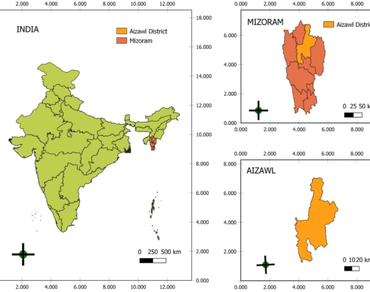
Impacts of invasive alien plant Tithonia diversifolia (Hemsl.) A. Gray on understory vegetation and soil in Aizawl, Mizoram, N.E. India
*Article not assigned to an issue yet
Research Articles | Published: 26 September, 2026
First Page: 0
Last Page: 0
Views: 25
Keywords: Biodiversity, Disturbance gradient, Indo Burma hotspot, Plant invasion, Phytosociology, Soil characteristics, n Tithonia diversifolian
Abstract
Urban forests in biodiversity hotspots have distinct disturbance regimes, ideal for studying plants invasion-driven environmental changes. In present study, effects of Tithonia diversifolia (Hemsl.) A. Gray (TD), an invasive alien plant from Asteraceae, was ecologically assessed in Aizawl, Mizoram, North-East India. The impacts of TD were evaluated on understory (i.e., herbs and shrubs) vegetation and soil physicochemical characteristics at two invaded sites i.e., disturbed and least-disturbed invaded habitats. The phytosociological parameters like ‘Importance Value Index’ (IVI) and diversity indices were calculated using standard methods to assess TD-induced alterations in floristic composition. The vegetation analysis showed that TD was dominant, co-existing with other co-dominant invasive and native plants. Results on species richness revealed a total of 40 species at the disturbed site, 57 species at the least-disturbed reference site, 23 shared species, and 74 species overall, with Sorenson’s similarity index (\(\:{\upbeta\:}\)) of 0.47 between the sites. Further, the IVI of TD was found to be highest at the disturbed (63.61), followed by least disturbed reference site (37.38) site. The vegetation analysis unequivocally unveils dominance of TD at infested sites. Unlike least-disturbed reference site, soil attributes at disturbed site like moisture content demonstrated positive significant correlation with available phosphorus (r?=?0.830). Further, Soil Organic Carbon (SOC) showed a highly significant positive correlation with Soil Organic Matter (SOM) (r?=?0.993). Also, the available nitrogen showed positive significant correlation with SOC (r?=?0.617) and SOM (r?=?0.666). Moreover, analysis of variance (ANOVA) was observed to be highly variable between sites and seasons (significance at p?
References
Agbede TM (2025) Influence of Tithonia diversifolia biochar on selected soil physicochemical properties, leaf nutrient concentrations and broccoli growth. Sci Rep 15(1):8084. https://doi.org/10.1038/s41598-025-91844-w
Bartz R, Kowarik I (2019) Assessing the environmental impacts of invasive alien plants: a review of assessment approaches. NeoBiota 43:69–99. https://doi.org/10.3897/neobiota.43.30122
Blumenthal DM, Jordan NR, Russelle MP (2003) Soil carbon addition controls weeds and facilitates prairie restoration. Ecol app 13:605–615. https://doi.org/10.1890/1051-0761(2003)013[0605: SCACWA]2.0.CO;2
Callaway RM, Ridenour WM (2004) Novel weapons: invasive success and the evolution of increased competitive ability. Front Ecol Environ 2(8):436–443. https://doi.org/10.1890/1540-9295(2004)002[0436: NWISAT]2.0.CO;2
CBD (1992) Convention On Biological Diversity. Preamble. United Nations
Gadgil M, Berkes F, Folke C (2021) Indigenous knowledge: From local to global. Ambio 50:967–969. https://doi.org/10.1007/s13280-020-01478-7
Hulme PE (2011) Addressing the threat to biodiversity from botanic gardens. Trends Ecol Evol 26(4):168–174. https://doi.org/10.1016/j.tree.2011.01.005
Kaur A, Sharma A, Kaur S, Siddiqui MH, Alamri S, Ahmad S, Kholi RK, Singh HP, Batish DR (2024) Role of plant functional traits in the invasion success: analysis of nine species of Asteraceae. BMC Plant Biol 24:784. https://doi.org/10.1186/s12870-024-05498-3
Kato-Noguchi H (2020) Involvement of allelopathy in the invasive potential of Tithonia diversifolia. Plants 9(6):766. https://doi.org/10.3390/plants9060766
Kjeldahl J (1883) A new method for the estimation of nitrogen in organic compounds. Z Anal Chemis 22:366. https://doi.org/10.1007/BF01338151
Mandal G, Joshi SP (2014) Analysis of vegetation dynamics and phytodiversity from three dry deciduous forests of Doon Valley, Western Himalaya, India. J Asia-Pac Biodivers 7(3):292–304. https://doi.org/10.1016/j.japb.2014.07.006
Misra R (1968) Ecology Workbook. Oxford and IBH Publishing Company, Calcutta, India, p 242
Dar MA, Ahmad M, Singh R, Kohli RK, Singh HP, Batish DR (2023) Invasive plants alter soil properties and nutrient dynamics: A case study of Anthemis cotula invasion in Kashmir Himalaya. Catena 226:107069. https://doi.org/10.1016/j.catena.2023.107069
Myers N, Russell M, Mittermeier C, da Fonseca G, Jennifer K (2000) Biodiversity Hotspots for Conservation Priorities. Nature 403:853–858. https://doi.org/10.1038/35002501
Olsen SR, Cole CV, Watanabe FS, Dean LA (1954) Circulation 939
Oludare A, Muoghalu JI (2014) Impact of Tithonia diversifolia (Hemsl.) A. Gray on the soil, species diversity and composition of vegetation in Ile-Ife (Southwestern Nigeria), Nigeria. Int J Biodivers Conserv 6(7):555–562. https://doi.org/10.5897/IJBC2013.0634
Pyšek P, Richardson DM (2006) The biogeography of naturalization in alien plants. J Biogeogr 33(12):2040–2050. https://doi.org/10.1111/j.1365-2699.2006.01578.x
Ramakrishnan PS (2007) Traditional forest knowledge and sustainable forestry: A north-east India perspective. Ecol Manag 249:91–99. https://doi.org/10.1016/j.foreco.2007.04.001
Rai PK, Lalramnghinglova H (2010) Threatened and less known ethnomedicinal plants of an Indo-Burma hotspot region: conservation implications. Environ Monit Assess 178:53–62. https://doi.org/10.1007/s10661-010-1670-6
Rai PK (2015) Paradigm of plant invasion: multifaceted review on sustainable Management. Environ Monit Assess 187:p759. https://doi.org/10.1007/s10661-015-4934-3
Rai PK, Lee SS, Bhardwaj N, Kim KH (2023) The environmental, socio-economic, and health effects of invasive alien plants: Review on Tithonia diversifolia (Hemsl.) A. Gray in Asteraceae. S Afr J Bot 162:461–480. https://doi.org/10.1016/j.sajb.2023.09.038
Rai PK, Singh JS (2025) Ecological Mechanisms and Weed Biology of World’s Worst Invasive Alien Plant Mikania micrantha: Policy Measures for Sustainable Management. Weed Biol Manag 25(3):e70004. https://doi.org/10.1111/wbm.70004
Rai PK, Singh JS (2021) Plant invasion in protected areas, the Indian Himalayan region and the North East India: Progress and prospects. Proc Indian Natl Sci Acad 87(1):19–35. https://doi.org/10.1007/s43538-021-00013-w
Rai PK, Singh JS (2020) Invasive alien plant species: Their impact on environment, ecosystem services and human health. Ecol Indic 111:106020. https://doi.org/10.1016/j.ecolind.2019.106020
Rai PK, Singh JS (2024) Ecological insights and environmental threats of invasive alien plant Chromolaena odorata: Prospects for sustainable management. Weed Biol Manag 24(1):15–37. https://doi.org/10.1111/wbm.12286
Rai PK, Vanlalruati (2026) Citizen science and traditional knowledge synergy for invasive Tithonia diversifolia (Hemsl.) A. Gray management in Mizoram, North East India: A landscape of Indo Burma biodiversity hotspot. Environ Manage Econ Policy 3:100019. https://doi.org/10.1016/j.jemecp.2026.100019
Sagar R, Raghubanshi AS, Singh JS (2003) Tree species composition, dispersion and diversity along a disturbance gradient in a dry tropical forest region of India. Ecol Manag 186(1–3):61–71. https://doi.org/10.1016/s0378-1127(03)00235-4
Sakachep ZK, Rai PK (2025) Effects of invasive alien plants on floristic diversity and soil physico-chemical characteristics in Hailakandi district, Assam, an Indo Burma hotspot region. Trop Ecol 66:303–320. https://doi.org/10.1007/s42965-025-00387-8
Sengupta R, Dash SS (2020) A comprehensive inventory and ecological assessment of alien plant invasion in Mizoram, India. Indonesian J Forestry Res 7(2):135–154. https://doi.org/10.59465/ijfr.2020.7.2.135-154
Shannon’s CE, Wiener W (1949) The mathematical theory of communication. University of Illinois Press, Urbana
Sharma A, Kaur A, Kohli RK, Singh HP, Batish DR (2023) Bidens pilosa (Asteraceae) invasion reshapes the pattern of plant communities and edaphic properties across the north-western Himalayan landscape. Ecol Inf 77:102281. https://doi.org/10.1016/j.ecoinf.2023.102281
Song X, Liu G, Li X, Chen Y, Wang J, Zhang CL, Ye XP, Zhu ZH (2025) Phylogenetically Close Alien Asteraceae Species With Minimal Niche Overlap Are More Likely to Invade. Plant Divers 47(5):804–813. https://doi.org/10.1016/j.pld.2025.02.005
Sorenson T (1948) A Method of Establishing Groups of Equal Amplitudes in Plant Sociology Based on Similarity of Species Content and Its Application to Analyses of the Vegetation on Danish Commons. Biol Skr 5:1–34
Sunarto S, Warsiti T, Sugiyarto S, Himawan W (2016) The diversity study of asteraceae family as effort to develop ecotourism in Mount Lawu. In 1st International Conference on Geography and Education (ICGE) (pp. 105–110). Atlantis Press
Syngkli RB, Lalremruati B, Rai PK (2025) Effects of three invasive alien plant species on soil attributes at different disturbance gradients in Aizawl, Mizoram, North East India. Vegetos. https://doi.org/10.1007/s42535-025-01377-w
Vanlalruati, Rai PK, Syngkli RB, Lalzarzovi ST (2025) Allelopathy of invasive Tithonia diversifolia (Hemsl) A. Gray on Pisum sativum L. and its linkage with canopy openness in a global biodiversity hotspot. Plant Sci Today. https://doi.org/10.14719/pst.8615
Walkley A, Black IA (1934) An examination of the Degtjareff method for determining soil organic matter, and a proposed modification of the chromic acid titration method. Soil Sci 37(1):29–38
Zhao X, Cui H et al (2026) The negative effects of invasive plants on ecosystem multifunctionality weaken with increase in temperature. Ecol Indic 188:115008
Author Information
Department of Environmental Science, School of Earth Sciences and Natural Resources Management, Mizoram University, Aizawl, Mizoram, India