Vegetos

(An International Journal of Plant Research & Biotechnology)
(eISSN: 2229-4473)
In-vitro evaluation of Trichoderma spp. and plant extracts for biological control of Indian Basil diseases
*Article not assigned to an issue yet
Mukherjee Soumik, Mukhopadhyay Ankur, Singh Siddharth, Oraon Susmita, Mondal Goutam
Research Article | Published: 03 December, 2025
First Page: 0
Last Page: 0
Views: 454
Keywords: Dual culture, Ocimum tenuiflorum, Plant extract, Poisoned-food, Trichoderma
Abstract
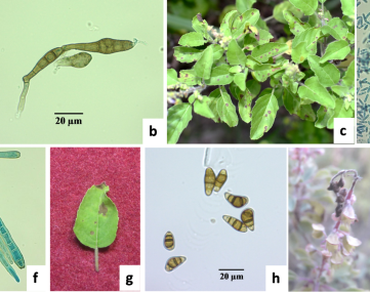
Fungal diseases are a major threat to medicinal crops such as Indian basil (Ocimum tenuiflorum), whose quality may be jeopardized by traditional chemical control methods; hence, eco-friendly biological control is being sought after. To address this, a study was conducted in West Bengal’s New Alluvial Zone, where five major diseases, viz., inflorescence blight (Fusarium spp.), three leaf spot diseases (Colletotrichum, Corynespora, and Curvularia spp.), and leaf blight (Alternaria spp.) were reported on Indian basil. In vitro tests were conducted to assess the effectiveness of five Trichoderma isolates (T1–T5) using dual culture assays and five plant extracts, viz., garlic (Allium sativum), turmeric (Curcuma longa), sarpagandha (Rauvolfia serpentina), neem (Azadirachta indica), and bael (Aegle marmelos) using poisoned-food tests. The percentage inhibition of radial mycelial growth of the pathogens was calculated to assess antifungal activity. Among Trichoderma treatments, T3 was most effective against Alternaria, achieving 47.7% radial mycelial growth inhibition, while T2 inhibited the growth of Colletotrichum (48.1%), Corynespora (49.6%), and Fusarium (37.3%). T4 was most effective against Curvularia (59.9% inhibition). Of the plant extracts, turmeric had the highest antifungal activity, with inhibition rates ranging from 38.3% to 87.2% across all pathogens. This indicates that selected Trichoderma isolates (T2, T3, and T4) and turmeric extract hold significant potential as eco-friendly disease management options for O. tenuiflorum, complementing sustainable agriculture and conserving the medicinal value of the crop.
References
Alemu A, Garedew W, Gebre A (2018) Essential oil yield and yield components of Basil (Ocimum Basilicum L.) as affected by genotype and intra-row spacing at Jimma, SW Ethiopia. Acta Agrobot 71(3)
Alwadai AS, Perveen K, Alwahaibi M (2022) The isolation and characterization of antagonist Trichoderma spp. From the soil of Abha, Saudi Arabia. Molecules 27(8):2525. https://doi.org/10.3390/molecules27082525
Arumugam K, Ramalingam P, Appu M (2013) Isolation of trichoderma viride and Pseudomonas fluorescens organism from soil and their treatment against rice pathogens. J Microbiol Biotechnol Res 3(6):77–81
Baiyee B, Pornsuriya C, Ito SI, Sunpapao A (2019) Trichoderma spirale T76-1 displays biocontrol activity against leaf spot on lettuce (Lactuca sativa L.) caused by Corynespora Cassiicola or Curvularia aeria. Biol Control 129:195–200. https://doi.org/10.1016/j.biocontrol.2018.10.018
Baker BP, Green TA, Loker AJ (2020) Biological control and integrated pest management in organic and conventional systems. Biol Control 140:104095. https://doi.org/10.1016/j.biocontrol.2019.104095
Chandra S, Dwivedi P, Arti KM, Shinde LP (2016) An industrial cultivation of Tulsi (Ocimum sanctum) for medicinal use and rural empowerment. J Med Plants Stud 4(6):213–218
Choudhury D, Seram S (2020) Screening of trichoderma and Pseudomonas isolates against Corynespora sp. and alternaria sp. in sarpagandha and thankuni under in vitro condition. Plant Archives 20(2):2505–2508
Cohen MM (2014) Tulsi- Ocimum sanctum: A herb for all reasons. J Ayurveda Integr Med 5(4):251. https://doi.org/10.4103/0975-9476.146554
Das SN, Sharma TC (2023) In vitro evaluation of some botanical extracts and fungicides against the mycelial growth of Colletotrichum capsici causing anthracnose disease of Chilli (Capsicum annuum L). J Mycopathol Res 61:381–384. https://doi.org/10.57023/JMycR.61.3.2023.381
de Lima FB, Félix C, Osório N, Alves A, Vitorino R, Domingues P et al (2017) Trichoderma Harzianum T1A constitutively secretes proteins involved in the biological control of Guignardia citricarpa. Biol Control 106:99–109. https://doi.org/10.1016/j.biocontrol.2017.01.003
Deresa EM, Diriba TF (2023) Phytochemicals as alternative fungicides for controlling plant diseases: A comprehensive review of their efficacy, commercial representatives, advantages, challenges for adoption, and possible solutions. Heliyon 9(3):e13810. https://doi.org/10.1016/j.heliyon.2023.e13810
Dugassa A, Alemu T, Woldehawariat Y (2021) In-vitro compatibility assay of Indigenous trichoderma and Pseudomonas species and their antagonistic activities against black root rot disease (Fusarium solani) of Faba bean (Vicia Faba L). BMC Microbiol 21(115). https://doi.org/10.1186/s12866-021-02181-7
Es-Soufi R, Tahiri H, Azaroual L, El Oualkadi A, Martin P, Badoc A, Lamarti A (2020) Biocontrol potential of Bacillus amyloliquefaciens Bc2 and Trichoderma Harzianum TR against strawberry anthracnose under laboratory and field conditions. Agric Sci 11(3):260–277. https://doi.org/10.4236/as.2020.113017
Grano-Maldonado MI, Ramos-Payan R, Rivera-Chaparro F, Aguilar-Medina M, Romero-Quintana JG, Rodríguez-Santiago A, Nieves-Soto M (2021) First molecular characterization of Colletotrichum sp. and Fusarium sp. isolated from Mangrove in Mexico and the antagonist effect of Trichoderma Harzianum as an effective biocontrol agent. Plant Pathol J 37:465–475. https://doi.org/10.5423/PPJ.OA.03.2021.0048
Hameed I, Irshad G, Naz F, Lala Ge, Mehmood A, Din RU, Ishaq M (2023) Investigating the effectiveness of ginger and turmeric extracts on common soil-borne pathogens affecting plants. Zoo Bot 1(2):43–51. https://doi.org/10.55627/zoobotanica.001.02.0603
Hiremath IG, Huilgol SN, Hegde YR, Basavaraja GT, Kullalli KG (2020) In vitro bio-efficacy of botanicals against Corynespora Cassiicola (Berk. And Curt.) Wei causing target leaf spot of soybean. J Pharmacogn Phytochem 9(5):1013–1016
Ibrahim NF, Yin WK, Saleh NH, Ahmad FT, Lob S (2020) Antifungal activity of extracts against Colletotrichum species in harvested Chili. Malays Appl Biol 49(4):241–246. https://doi.org/10.55230/mabjournal.v49i4.1627
Khalid KA (2006) Influence of water stress on growth, essential oil, and chemical composition of herbs (Ocimum sp). Int Agrophys 20:289–296
Kumar G, Gupta R, Sharan S, Roy P, Pandey DM (2019) Anticancer activity of plant leaves extract collected from a tribal region of India. 3 Biotech 9:1–16. https://doi.org/10.1007/s13205-019-1927-x
Liu B, Ji S, Zhang H, Wang Y, Liu Z (2020) Isolation of Trichoderma in the rhizosphere soil of Syringa oblata from Harbin and their biocontrol and growth promotion function. Microbiol Res 235:126445. https://doi.org/10.1016/j.micres.2020.126445
Manju MJ, Mushrif S, Santhosh HM, Patil RS, Shankarappa TH, Benagi VI, Idicula SP (2019) Evaluation of different fungi toxicants against Corynespora Cassiicola causing Corynespora leaf fall (CLF) disease of rubber (Hevea Brasiliensis Muell. Arg). Int J Curr Microbiol App Sci 8(2):1640–1647. https://doi.org/10.20546/ijcmas.2019.802.193
Marchiori CH (2023) Using biological control as a tool for sustainability. J Mod Agric Biotechnol 2(4):1–24. https://doi.org/10.53964/jmab.2023021
Martinez-Correa HA, Paula JT, Kayano AC, Queiroga CL, Magalhães PM, Costa FT, Cabral FA (2017) Composition and antimalarial activity of extracts of Curcuma longa L. obtained by a combination of extraction processes using supercritical CO2, ethanol and water as solvents. J Supercrit Fluids 119:122–129. https://doi.org/10.1016/j.supflu.2016.08.017
Matas-Baca MA, Urías García C, Pérez-Álvarez S, Flores-Córdova MA, Escobedo-Bonilla CM, Magallanes-Tapia MA, Sánchez Chávez E (2022) Morphological and molecular characterization of a new autochthonous Trichoderma Sp. isolate and its biocontrol efficacy against Alternaria Sp. Saudi J Biol Sci 29:2620–2625. https://doi.org/10.1016/j.sjbs.2021.12.052
Metz N, Hausladen H (2022) Trichoderma spp. As potential biological control agent against Alternaria Solani in potato. Biol Control 166:104820. https://doi.org/10.1016/j.biocontrol.2021.104820
More YD, Gade RM, Shitole AV (2017) In vitro antifungal activity of Aegle marmelos, Syzygium cumini and Pongamia pinnata extracts against Fusarium oxysporum f. sp. cicero. Indian J Pharm Sci 79(3):457–462
Mukherjee PK, Horwitz BA, Kenerley CM (2012) Secondary metabolism in Trichoderma–a genomic perspective. Microbiol 158(1):35–45. https://doi.org/10.1099/mic.0.053629-0
Mukhopadhyay A, Mukherjee S, Dutta S, Kanthal S, Mondal G (2025) Evaluating the bioactivity of Trichoderma asperellum against Colletotrichum Siamense and its growth-promoting effects on Aloe Vera (Aloe barbadensis Mill). Eur J Plant Pathol 172:275–289. https://doi.org/10.1007/s10658-025-03001-8
Naik SC, Narute TK, Narute TT, Khaire PB (2020) In vitro efficacy of plant extract (botanicals) against Alternaria Solani (early blight of tomato). J Pharmacogn Phytochem 9(5):614–617
Nofal AM, Abdelghany TM, Abd-EL-Hamed WF (2021) Significance of local Trichoderma isolates in controlling Pythium ultimum and Rhizoctonia solani on bean in Egypt. Egypt J Phytopathol 49(2):131–140. https://doi.org/10.21608/ejp.2021.110177.1051
Nurzyńska-Wier R, Borowski B, Dzida K (2011) Yield and chemical composition of Basil herb depending on cultivar and foliar feeding with nitrogen. Acta Scientarium Pol Hortorum Cultus 10:207–219
Nusaibah SA, Musa H (2019) Biological Control Agent of the Basal Stem Rot (BSR) Disease of Trichoderma: The most widely used fungicide 79
Pandey G, Madhuri S (2010) Pharmacological activities of Ocimum sanctum (Tulsi): a review. Int J Pharm Sci Rev Res 5(1):61–65
Rajani P, Rajasekaran C, Vasanthakumari MM, Olsson SB, Ravikanth G, Shaanker RU (2021) Inhibition of plant pathogenic fungi by endophytic Trichoderma spp. Through mycoparasitism and volatile organic compounds. Microbiol Res 242:126595. https://doi.org/10.1016/j.micres.2020.126595
Ramesh H, Valan MF (2021) Rethinking on using of traditional Indigenous medicinal plants for the management of Covid-19 in India- A review. Int J Ayur Pharma Res 9(7):53–63
Rao SS, Kumar MR, Madhusudhan P, Reddy BR (2021) Comparative efficacy of different plant extracts on mycelial growth of Curvularia Lunata (Wakker) Boedijn causing rice grain discoloration in vitro. J Pharm Innov 10(5):1151–1155
Rao YH, Devi PS, Vemavarapu VV, Chowdary KR (2020) In vitro evaluation of antagonistic potential of native Trichoderma spp., botanicals and fungicides against Curvularia spicifera causing Curvularia leaf spot of tomato in Manipur. Int J Curr Microbiol Appl Sci 9(10):1815–1823. https://doi.org/10.20546/ijcmas.2020.910.221
Ruangwong OU, Pornsuriya C, Pitija K, Sunpapao A (2021) Biocontrol mechanisms of Trichoderma Koningiopsis PSU3-2 against postharvest anthracnose of Chili pepper. J Fungi 7(4):276. https://doi.org/10.3390/jof7040276
Satapathy RR, Beura SK (2018) Management of Colletotrichum gloeosporioides (Penz.) causing cashew anthracnose through botanicals. Int J Curr Microbiol App Sci 7:3539–3543. https://doi.org/10.20546/ijcmas.2018.709.439
Shahrajabian MH, Sun W, Cheng Q (2020) Chemical components and Pharmacological benefits of Basil (Ocimum basilicum): a review. Int J Food Prop 23(1):1961–1970. https://doi.org/10.1080/10942912.2020.1828456
Sharma R, Magotra A, Manhas RS, Chaubey A (2017) Antagonistic potential of a psychrotrophic fungus: Trichoderma velutinum ACR-P1. Biol Control 115:12–17. https://doi.org/10.1016/j.biocontrol.2017.08.024
Sharma RL, Ahir RR, Yadav SL, Sharma P, Ghasolia RP (2021) Effect of nutrients and plant extracts on Alternaria blight of tomato caused by Alternaria alternata. J Plant Dis Prot 128:951–960. https://doi.org/10.1007/s41348-021-00485-4
Sunpapao A, Chairin T, Ito S (2018) The biocontrol by streptomyces and trichoderma of leaf spot disease caused by curvularia oryzae in oil palm seedlings. Biocontrol 123:36–42. https://doi.org/10.1016/j.biocontrol.2018.02.002
Susanna S, Sayuthi M, Salsabila L, Basri (2024) Test antagonism of several trichoderma species in suppressing the growth of alternaria sp. in vitro. IOP Conf Ser: Earth Environ Sci 1297:012066. https://doi.org/10.1088/1755-1315/1297/1/012066
Tiwari R, Shukla SK, Jaiswal VP, Sharma L, Joshi D, Chandra K et al (2021) Bio-control potential of Trichoderma spp., against Fusarium spp., the incitants of Pokkah boeng disease of sugarcane under in‐vitro conditions. Indian Phytopathol 74:691–701. https://doi.org/10.1007/s42360-021-00344-0
Verma S, Thakur A, Gautam HR (2022) Effect of botanicals against dieback and gummosis (Botryodiplodia theobromae Pat) of Mango. Int J Farm Sci 12(1):155–157. https://doi.org/10.5958/2250-0499.2022.00034.9
Williams LJ, Abdi H (2010) Fisher’s least significant difference (LSD) test. Encycl Res Des 218(4):840–853
Woo SL, Ruocco M, Vinale F, Nigro M, Marra R, Lombardi N et al (2014) Trichoderma-based products and their widespread use in agriculture. Open Mycol J 8(1):71–126
Zeilinger S, Gruber S, Bansal R, Mukherjee PK (2016) Secondary metabolism in Trichoderma–chemistry Meets genomics. Fungal Biol Rev 30(2):74–90. https://doi.org/10.1016/j.fbr.2016.05.001
Author Information
Department of Plant Pathology, Bidhan Chandra Krishi Viswavidyalaya, Mohanpur, India