Vegetos

(An International Journal of Plant Research & Biotechnology)
(eISSN: 2229-4473)
In vitro salinity priming modulates photosynthetic acclimation in Ananas comosus with limited growth recovery
*Article not assigned to an issue yet
Silva-Moraes Vitória K. O., Felipe Sérgio H. S., Alves Givago L., Albuquerque Irislene C., Pinheiro Jordanya F., Lima Aldilene S., Rivas Priscila M. S., Batista Diego S.
Research Article | Published: 15 June, 2026
First Page: 0
Last Page: 0
Views: 86
Keywords: Chlorophyll fluorescence, Gas exchange, In vitro culture, Salinity priming
Abstract
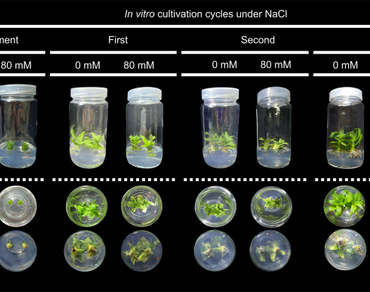
Salinity is a major abiotic constraint limiting pineapple (Ananas comosus) growth and productivity, and strategies that improve stress acclimation during early developmental stages may enhance plant performance under adverse conditions. This study evaluated whether in vitro salinity priming could modulate subsequent physiological and growth responses of pineapple seedlings exposed to severe ex vitro salt stress. Seedlings were subjected to salinity conditioning during the in vitro phase and subsequently acclimatized under greenhouse conditions, with or without exposure to 500 mM NaCl. Growth, gas exchange, chlorophyll fluorescence, and photosynthetic pigment content were assessed. Severe salinity reduced net CO2 assimilation, stomatal conductance, transpiration, and biomass accumulation in both primed and non-primed plants. However, primed seedlings showed partial physiological acclimation, including a less pronounced decline in apparent carboxylation efficiency and maintenance of pigment concentrations under salinity. Contrasting Ci/Ca responses suggested differences in the balance between stomatal and non-stomatal limitations depending on priming history. Despite these physiological adjustments, priming did not improve biomass accumulation and was associated with reduced plant size even under non-saline conditions. These findings indicate that in vitro salinity priming can alter subsequent physiological responses in pineapple, but under the severe salinity imposed here, these adjustments were insufficient to promote growth recovery, suggesting a decoupling between selected physiological traits and biomass performance.
References
Badavath H, Saski CA (2026) Plant adaptation to salinity: physiological pathways and prospects for crop improvement—a review. Genes 17:253. https://doi.org/10.3390/genes17030253
Carretero CL, Cantos M, García JL, Troncoso A (2007) In vitro–ex vitro salt (NaCl) tolerance of cassava (Manihot esculenta Crantz) plants. In Vitro Cell Dev Biol Plant 43:364–369. https://doi.org/10.1007/s11627-006-9022-5
Cruz CD (2016) Genes software—extended and integrated with the R, Matlab and Selegen. Acta Sci Agron 38(4):547. https://doi.org/10.4025/actasciagron.v38i3.32629
Da Silva D, Silva AKdS, Souza FVD, Fritsche Y, Stefenon VM (2025) Biotechnological potential of pineapple-Serendipita co-cultivation for salinity resilience in agriculture. Plant Cell Tiss Organ Cult 163:28. https://doi.org/10.1007/s11240-025-03241-w
He J, Ng OWJ, Qin L (2022) Salinity and salt-priming impact on growth, photosynthetic performance, and nutritional quality of edible Mesembryanthemum crystallinum L. Plants 11:332. https://doi.org/10.3390/plants11030332
Karalija E, Ibragić S, Dahija S, Šamec D (2025) Transgenerational memory of phenotypic traits in plants: epigenetic regulation of growth, hormonal balance, and stress adaptation. Curr Issues Mol Biol 47:404. https://doi.org/10.3390/cimb47060404
Melo YL, Gomes IA, Dantas CVS, Brito LKF, Oliveira MDM, Macêdo CEC (2011) Indicadores de estresse salino em abacaxizeiro cultivado na ausência e presença de fitorreguladores. Rev Bras Frutic 33:698–705. https://doi.org/10.1590/S0100-29452011005000104
Molassiotis A, Tanou G, Diamantidis G (2010) NO says more than ‘YES’to salt tolerance: salt priming and systemic nitric oxide signaling in plants. Plant Signal Behav 5:209–212. https://doi.org/10.4161/psb.5.3.10738
Murtaza G, Ahmed Z, Iqbal R, Deng G (2025) Biochar from agricultural waste as a strategic resource for promotion of crop growth and nutrient cycling of soil under drought and salinity stress conditions: a comprehensive review with context of climate change. J Plant Nutr 48:1832–1883. https://doi.org/10.1080/01904167.2025.2460769
Nasrallah AK, Atia MA, Abd El-Maksoud RM, Kord MA, Fouad AS (2022) Salt priming as a smart approach to mitigate salt stress in faba bean (Vicia faba L.). Plants Basel 11:1610. https://doi.org/10.3390/plants11121610
Nigam B, Rathore D, Chaudhary IJ (2026) Plant response mechanisms under soil salinity stress and its mitigation and management strategies: a review. J Plant Biochem Biotechnol 35:162–184. https://doi.org/10.1007/s13562-026-01043-5
Pinheiro JF, Felipe SHS, Albuquerque IC, Silva-Moraes VKdO, Alves GL, Soares MNB, Henschel JM, Marinho LTM, Santa-Catarina C, Batista DS et al (2025) Polyamine homeostasis and morphophysiological responses to salinity in Dizygostemon riparius: an endemic species from Brazilian ‘Cerrado’ biome. Biology 14:1494. https://doi.org/10.3390/biology14111494
Pissolato MD, Martins TS, Fajardo YCG (2024) Stress memory in crops: what we have learned so far. Theor Exp Plant Physiol 36:535–565. https://doi.org/10.1007/s40626-024-00315-6
Ranjan T, Pal AK, Mir H, Shamim M, Kumar RR, Kumar M, Prasad BD, Rajani K, Shiwani S, Nharika FP (2026) An efficient micropropagation protocol for Ananas comosus L. (Merr. Hybrid “MD2”) through somatic embryogenesis. J Plant Biochem Biotechnol 35:438–442. https://doi.org/10.1007/s13562-025-01028-w
Sahoo L, Swain B, Yadav D (2025) A review on different priming strategies to mitigate abiotic stress in plants. Discov Appl Sci 7:618. https://doi.org/10.1007/s42452-025-07009-x
Saleem MA, Khan A, Tu J, Huang W, Liu Y, Feng N, Zheng D, Xue Y (2025) Salinity stress in rice: multilayered approaches for sustainable tolerance. Int J Mol Sci. https://doi.org/10.3390/ijms26136025
Sghaier-Hammami B, Hammami SBM, Baazaoui N, Chaari S, Drira R, Drira N, Smida M, Jouira HB, Goussi R, Zribi F, Rapoport H, Shatti A, Bettaieb T, Jorrin Novo JV (2023) Differential effect of water salinity levels on gas exchange, chlorophyll fluorescence and antioxidant compounds in ex vitro date palm plants. Not Bot Horti Agrobot Cluj Napoca 51:13057. https://doi.org/10.15835/nbha51213057
Zandi P, Schnug E (2022) Reactive oxygen species, antioxidant responses and implications from a microbial modulation perspective. Biology Basel 11:155. https://doi.org/10.3390/biology11020155
Zhang H, Yu C, Zhang Q, Qiu Z, Zhang X, Hou Y, Zang J (2025) Salinity survival: molecular mechanisms and adaptive strategies in plants. Front Plant Sci 16:1527952. https://doi.org/10.3389/fpls.2025.1527952
Zhao C, Zhang H, Song C, Zhu JK, Shabala S (2020) Mechanisms of plant responses and adaptation to soil salinity. Innovation 1:1. https://doi.org/10.1016/j.xinn.2020.100017
Zhou Q, Priyadarshani SVGN, Qin R, Cheng H, Luo T, Wai MH, Mohammadi MA, Liu Y, Liu C, Cai H, Wang X, Liu Y, Qin Y, Wang L (2024) AcWRKY28 mediated activation of AcCPK genes confers salt tolerance in pineapple (Ananas comosus). Hortic Plant J 10:398–412. https://doi.org/10.1016/j.hpj.2023.05.002
Author Information
Graduate Program in Agricultural Sciences, State University of Maranhão, São Luís, Brazil