Vegetos

(An International Journal of Plant Research & Biotechnology)
(eISSN: 2229-4473)
Induction and assessment of genetic variability in Jasminum sambac cv. Ramanathapuram Gundumalli through colchicine treatment
*Article not assigned to an issue yet
S Vishnupandi, M Ganga, S Manonmani, N Manikanda Boopathi, P Swarnalatha, FD Prisca Seeli
Research Articles | Published: 14 July, 2026
First Page: 0
Last Page: 0
Views: 58
Keywords: n Jasminum sambacn , Colchicine, Variations, Heritability, PCA
Abstract
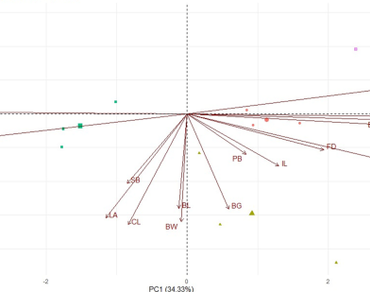
Jasminum sambac cv. Ramanathapuram Gundumalli is a commercially important sterile triploid cultivar with limited scope for improvement through conventional breeding. The present study evaluated the effect of colchicine treatments at four concentrations (0.25, 0.50, 0.75, and 1.00%) along with a control on 15 vegetative and floral traits. Colchicine treatment increased phenotypic variability across most traits, particularly those related to plant architecture, floral attributes and flower yield. Estimates of genotypic and phenotypic coefficients of variation, broad-sense heritability and genetic advance indicated considerable heritable variation for several economically important traits. High heritability coupled with appreciable genetic advance was observed for plant height, number of flowering cymes, open flower diameter and flower yield, suggesting good prospects for selection. Principal component analysis explained 60.27% of the total variation and showed clear separation among treatments, reflecting concentration-dependent differences in trait expression. Among the treatments, 0.50% colchicine was most effective in generating favourable variability and trait associations. The findings indicate that colchicine treatment can broaden the genetic base of this cultivar and support the selection of superior clonal lines for jasmine improvement. Future investigations involving cytological and molecular approaches are required to verify chromosome alterations and validate the genetic basis of the observed variations.
References
Allard RW (1999) Principles of plant breeding. John Wiley & Sons
Behera B, Patnaik SN (1975) Induced polyploidy in Amaranthus hypochondriacus L. and Amaranthus dubius Mart. ex Thell. Cytologia 40(1):157–168. https://doi.org/10.1508/cytologia.40.157
Burton GW (1952) Quantitative inheritance in grasses
Gantait S, Mandal N, Bhattacharyya S, Das PK (2011) Induction and identification of tetraploids using in vitro colchicine treatment of Gerbera jamesonii Bolus cv. Sciella. Plant Cell Tiss Organ Cult 106(3):485–493. https://doi.org/10.1007/s11240-011-9947-1
Ghosh S, Ganga M, Soorianathasundaram K (2018) Determination of radio sensitivity of jasmine (Jasminum spp.) to gamma rays. Electron J Plant Breed 9(3):956–965
Gopitha G, Rajamani K, Ganga M, Ravikesavan R, Gnanam R (2022) Potentiality of colchicine in induction of polyploids in Jasminum sambac (L.) Aiton cv. ramanathapuram Gundumalli. International Journal of Plant & Soil Science. 34(22):102–108
Green P, Miller D (2009) The genus Jasminum in cultivation
Horn W (2002) Breeding methods and breeding research. Breeding for ornamentals: classical and molecular approaches. Springer, pp 47–83
Johnson HW, Robinson H, Comstock R (1955) Estimates of genetic and environmental variability in soybeans
Manivannan N (2014) TNAUSTAT-Statistical package
Mirunalini S, Ganga M, Rajamani K, Meenakumari B, Suganthy M, Boopathi NM (2024) Phenotypic characterization and genetic variability of Muthu Mullai mutants of Jasminum auriculatum for induction of homeotic mutants. Indian J Agric Sci 94(7):761–766
Notsuka K, Tsuru T, Shiraishi M (2000) Induced polyploid grapes via in vitro chromosome doubling. J Jpn Soc Hortic Sci 69(5):543–551
Robinson H, Comstock RE, Harvey P (1949) Estimates of heritability and the degree of dominance in corn
Rose JB, Kubba J, Tobutt KR (2000) Chromosome doubling in sterile Syringa vulgaris × S. pinnatifolia hybrids by in vitro culture of nodal explants. Plant Cell Tissue Organ Cult 63(2):127–132. https://doi.org/10.1023/A:1006472101185
Saranraj N, Kannan M (2013) Evaluation of V2 M1 generation of Jasminum sambac cv. GUNDUMALLI (Ait.)
Saripalle M (2016) Jasmine cultivation in Tamil Nadu: market structure and pricing. World Dev Perspect 1:12–14
Sivasubramaniam S, Madhava Menon P (1973) Path analysis of yield components in rice
Soundarya SM, Ganga M, Iyanar K, Malarvizhi D (2026) Genetic analysis in pink and white flower mutants of royal jasmine (Jasminum grandiflorum L.). Plant Sci Today. https://doi.org/10.14719/pst.10713
Srivastava H, Devaiah K (1988) Correlation and path analysis in jasmine. Plant Breed 100(3):235–237
Sugiyama S-I (2005) Polyploidy and cellular mechanisms changing leaf size: comparison of diploid and autotetraploid populations in two species of Lolium. Ann Bot 96(5):931–938. https://doi.org/10.1093/aob/mci245
Vavilov NI (1949) The origin, variation, immunity and breeding of cultivated plants.
Vishnupandi S, Ganga M, Rajamani K, Manonmani S, Boopathi NM (2023) Effect of varying concentrations of colchicine on polyploid induction in Jasminum sambac (L.) Aiton. Electronic Journal of Plant Breeding 14(2)
Vishnupandi S, Ganga M, Rajamani K, Manonmani S, Boopathi NM (2024) Evaluation of oryzalin-induced putative polyploids of Jasminum sambac cv. Ramanathapuram Gundumalli. Journal of Horticultural Sciences 19(1)
Author Information
Department of Floriculture and Landscape Architecture, Tamil Nadu Agricultural University, Coimbatore, India