Vegetos

(An International Journal of Plant Research & Biotechnology)
(eISSN: 2229-4473)
Influence of picloram and BAP on callus cultures for vindoline synthesis in Catharanthus roseus
*Article not assigned to an issue yet
Gonzalez-Osorio Karen Jennifer, Aguilar-Uscanga María Guadalupe, Infanzón-Rodríguez María Inés, Gomez-Rodriguez Javier, Zavala-Ortiz Daniel Arturo
Short Communications | Published: 29 May, 2026
First Page: 0
Last Page: 0
Views: 84
Keywords: Vindoline, Vincristine, Vinblastine, Plant cell culture
Abstract
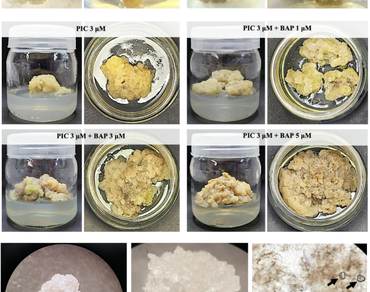
This work reports that picloram alone or combined with 6-benzylaminopurine (BAP), is associated with vindoline accumulation. Under controlled in vitro conditions, picloram (3 µM) induced rapid callogenesis, while its combination with BAP (3–5 µM) generated highly friable, metabolically active tissues with up to fourfold higher biomass than conventional auxins (2,4-D or NAA). Alkaloid analysis revealed a distinctive alkaloid profile: picloram treatments were associated with a metabolic profile in which a compound consistent with vindoline was the only alkaloid detected among the targeted compounds (11.25–30.44 mg kg−1) without detectable catharanthine, vinblastine, or vincristine. In contrast, 2,4-D and NAA treatments yielded only minimal catharanthine (1 mg kg−1) and likely suppressed secondary metabolism. This pattern is consistent with a possible shift in the alkaloid profile toward vindoline under picloram treatment, potentially involving regulatory processes, although this remains to be experimentally validated. Increasing BAP concentrations amplified this response, supporting the role of auxin–cytokinin balance in influencing secondary metabolism. These findings identify picloram–BAP as a promising hormonal combination for promoting both robust callus growth and targeted indole alkaloid biosynthesis, providing a basis for future studies on metabolic regulation and potential biotechnological exploitation.
References
Alam MM, Naeem M, Khan MMA, Uddin M (2017) Vincristine and vinblastine anticancer Catharanthus alkaloids: pharmacological applications and strategies for yield improvement. In: Naeem M, Aftab T, Khan MMA (eds) Catharanthus roseus. Springer International Publishing, Cham, pp 277–307
Azmi FN, Damanik RI (2024) Analysis of secondary metabolites through callus cell suspension culture of black cumin (Nigella sativa L.) with PGR combination on MS media. IOP Conf Ser Earth Environ Sci 1302:012043. https://doi.org/10.1088/1755-1315/1302/1/012043
Ban S, Ban Abdul JS (2020) Effect of plant growth regulators on secondary metabolites accumulation and antioxidant activity of Catharanthus roseus L. Int J Pharm Sci Res 11:241–245. https://doi.org/10.13040/IJPSR.0975-8232.11(1).241-45
Bhadra R, Vani S, Shanks JV (1993) Production of indole alkaloids by selected hairy root lines of Catharanthus roseus. Biotechnol Bioeng 41:581–592. https://doi.org/10.1002/bit.260410511
Colinas M, Pollier J, Vaneechoutte D et al (2021) Subfunctionalization of paralog transcription factors contributes to regulation of alkaloid pathway branch choice in Catharanthus roseus. Front Plant Sci 12:687406. https://doi.org/10.3389/fpls.2021.687406
De Luca V, Cutler AJ (1987) Subcellular localization of enzymes involved in indole alkaloid biosynthesis in Catharanthus roseus. Plant Physiol 85:1099–1102. https://doi.org/10.1104/pp.85.4.1099
Gnasekaran P, Rahman ZA, Chew BL et al (2023) Picloram enhanced the callus induction, growth kinetics, antioxidant potentials, and secondary metabolites production of Zingiber officinale var. rubrum callus cultures. Plant Cell Tissue Organ Cult 155:843–859. https://doi.org/10.1007/s11240-023-02603-6
Grzegorczyk-Karolak I, Kuźma Ł, Wysokińska H (2015) The effect of cytokinins on shoot proliferation, secondary metabolite production and antioxidant potential in shoot cultures of Scutellaria alpina. Plant Cell Tissue Organ Cult 122:699–708. https://doi.org/10.1007/s11240-015-0804-5
He L, Yang L, Tan R et al (2011) Enhancement of vindoline production in suspension culture of the Catharanthus roseus cell line C20hi by light and methyl jasmonate elicitation. Anal Sci 27:1243–1248. https://doi.org/10.2116/analsci.27.1243
Heijden R, Jacobs D, Snoeijer W et al (2004) The Catharanthus alkaloids: pharmacognosy and biotechnology. Curr Med Chem 11:607–628. https://doi.org/10.2174/0929867043455846
Hirata K, Horiuchi M, Ando T et al (1990) Vindoline and catharanthine production in multiple shoot cultures of Catharanthus roseus. J Ferment Bioeng 70:193–195. https://doi.org/10.1016/0922-338X(90)90186-Z
Ikeuchi M, Sugimoto K, Iwase A (2013) Plant callus: mechanisms of induction and repression. Plant Cell 25:3159–3173. https://doi.org/10.1105/tpc.113.116053
Li CY, Leopold AL, Sander GW et al (2013) The ORCA2 transcription factor plays a key role in regulation of the terpenoid indole alkaloid pathway. BMC Plant Biol 13:155. https://doi.org/10.1186/1471-2229-13-155
Liu J, Zhu J, Tang L et al (2014) Enhancement of vindoline and vinblastine production in suspension-cultured cells of Catharanthus roseus by artemisinic acid elicitation. World J Microbiol Biotechnol 30:175–180. https://doi.org/10.1007/s11274-013-1432-z
Magnotta M, Murata J, Chen J, De Luca V (2007) Expression of deacetylvindoline-4-O-acetyltransferase in Catharanthus roseus hairy roots. Phytochemistry 68:1922–1931. https://doi.org/10.1016/j.phytochem.2007.04.037
Miettinen K, Dong L, Navrot N et al (2014) The seco-iridoid pathway from Catharanthus roseus. Nat Commun 5:3606. https://doi.org/10.1038/ncomms4606
Miryousefzadeh S, Hosseini B, Hemmati S et al (2025) Fungal elicitation and precursor feeding: a novel approach to boost alkaloid yield in Catharanthus roseus cell suspension cultures. Research Square (preprint). https://doi.org/10.21203/rs.3.rs-6402841/v1
Murashige T, Skoog F (1962) A revised medium for rapid growth and bio assays with tobacco tissue cultures. Physiol Plant 15:473–497. https://doi.org/10.1111/j.1399-3054.1962.tb08052.x
Naaranlahti T, Lapinjoki S, Huhtikangas A et al (1989) Mass spectral evidence of the occurrence of vindoline in heterotrophic cultures of Catharanthus roseus cells. Planta Med 55:155–157. https://doi.org/10.1055/s-2006-961911
Pan Q, Mustafa NR, Tang K et al (2016) Monoterpenoid indole alkaloids biosynthesis and its regulation in Catharanthus roseus: a literature review from genes to metabolites. Phytochem Rev 15:221–250. https://doi.org/10.1007/s11101-015-9406-4
Phillips GC, Luteyn KJ (1983) Effects of picloram and other auxins on onion tissue cultures. J Am Soc Hortic Sci 108:948–953. https://doi.org/10.21273/JASHS.108.6.948
Ptak A, Tahchy A, Skrzypek E et al (2013) Influence of auxins on somatic embryogenesis and alkaloid accumulation in Leucojum aestivum callus. Open Life Sci 8:591–599. https://doi.org/10.2478/s11535-013-0160-y
Ramani S, Jayabaskaran C (2008) Enhanced catharanthine and vindoline production in suspension cultures of Catharanthus roseus by ultraviolet-B light. J Mol Signal 3:9. https://doi.org/10.1186/1750-2187-3-9
Rischer H, Orešič M, Seppänen-Laakso T et al (2006) Gene-to-metabolite networks for terpenoid indole alkaloid biosynthesis in Catharanthus roseus cells. Proc Natl Acad Sci USA 103:5614–5619. https://doi.org/10.1073/pnas.0601027103
Singh SK, Patra B, Paul P et al (2020) Revisiting the ORCA gene cluster that regulates terpenoid indole alkaloid biosynthesis in Catharanthus roseus. Plant Sci 293:110408. https://doi.org/10.1016/j.plantsci.2020.110408
Su Y-H, Liu Y-B, Zhang X-S (2011) Auxin–cytokinin interaction regulates meristem development. Mol Plant 4:616–625. https://doi.org/10.1093/mp/ssr007
Tyler RT, Kurz WGW, Panchuk BD (1986) Photoautotrophic cell suspension cultures of periwinkle (Catharanthus roseus (L.) G Don): transition from heterotrophic to photoautotrophic growth. Plant Cell Rep 5:195–198. https://doi.org/10.1007/BF00269117
Van Moerkercke A, Steensma P, Schweizer F et al (2015) The bHLH transcription factor BIS1 controls the iridoid branch of the monoterpenoid indole alkaloid pathway in Catharanthus roseus. Proc Natl Acad Sci USA 112:8130–8135. https://doi.org/10.1073/pnas.1504951112
Van Moerkercke A, Steensma P, Gariboldi I et al (2016) The basic helix–loop–helix transcription factor BIS2 is essential for monoterpenoid indole alkaloid production in the medicinal plant Catharanthus roseus. Plant J 88:3–12. https://doi.org/10.1111/tpj.13230
Vázquez-Flota F, De Luca V, Carrillo-Pech M et al (2002) Vindoline biosynthesis is transcriptionally locked in Catharanthus roseus cell suspension cultures. Mol Biotechnol. https://doi.org/10.1385/MB:22:1:001
Vazquez-Flota FA, De Luca V (1998) Developmental and light regulation of desacetoxyvindoline 4-hydroxylase in Catharanthus roseus (L.) G Don. Plant Physiol 117:1351–1361. https://doi.org/10.1104/pp.117.4.1351
Zavala-Ortiz DA, Infanzón-Rodríguez MI, Gomez-Rodriguez J et al (2024) Development of Catharanthus callus cell lines for indole-derived alkaloids production. S Afr J Bot 167:554–561. https://doi.org/10.1016/j.sajb.2024.03.003
Zavala-Ortiz DA, González-Osorio KJ, Palacios-Perez DL et al (2025) Plant cell organoids of Catharanthus roseus: a novel biotechnological platform for vinblastine and indole-derived alkaloids. Biotechnol Bioeng. https://doi.org/10.1002/bit.70053
Zhang K, Letham DS, John PCL (1996) Cytokinin controls the cell cycle at mitosis by stimulating the tyrosine dephosphorylation and activation of p34cdc2-like H1 histone kinase. Planta 200:2–12. https://doi.org/10.1007/BF00196642
Zhao J, Zhu W-H, Hu Q (2001) Effects of light and plant growth regulators on the biosynthesis of vindoline and other indole alkaloids in Catharanthus roseus callus cultures. Plant Growth Regul 33:43–49. https://doi.org/10.1023/A:1010722925013
Author Information
Laboratorio de Bioingeniería-UNIDA, Tecnológico Nacional de México/Instituto Tecnológico de Veracruz, Veracruz, Mexico