Vegetos

(An International Journal of Plant Research & Biotechnology)
(eISSN: 2229-4473)
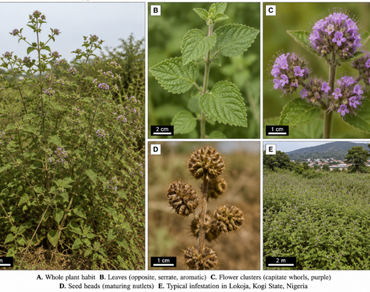
Invasive ecosystem engineering: Hyptis suaveolens drives dual crisis of biodiversity loss and nutrient monopolization in Nigerian savanna
*Article not assigned to an issue yet
Agboola O. O., Adelanwa E. B., Adekilekun S., Adelanwa M. A.
Research Articles | Published: 17 August, 2026
First Page: 0
Last Page: 0
Views: 3
Keywords: Nutrient, Invasion, Organic matter, Native species, Soil, Nigeria, Guinea savanna
Abstract
Hyptis suaveolens (L.) Poit. (bush mint) is a rapidly spreading annual herb that poses a significant ecological threat across tropical and subtropical regions. This study quantified the ecological impacts of H. suaveolens invasion on native plant biodiversity and key soil physicochemical properties within selected grassland and fallow agricultural landscapes in Lokoja, North-Central Nigeria. A comparative field assessment was conducted across six paired invaded and adjacent uninvaded plots (10 m?×?10 m each). Results revealed a marked decline in native diversity: the Shannon–Wiener Index dropped from 2.31 to 1.27 in invaded sites, and species richness was reduced by over 40%. Invader ground cover exceeded 75% in infested plots. Soil analysis showed significant nutrient depletion; nitrate (NO??) fell from 18.6 to 11.4 mg/kg (38.7% reduction) and available phosphorus (P) from 9.3 to 4.7 mg/kg (49.5% reduction) (p?p?=?0.001), pH (p?=?0.012), Magnesium (p?=?0.042), and Sodium (p?=?0.010) were also significantly altered. These findings confirm that H. suaveolens acts as a potent ecosystem engineer, reducing native biodiversity through competitive exclusion and likely allelopathy, while simultaneously degrading soil fertility by monopolizing key nutrients. Urgent management and restoration strategies are required to mitigate the long-term ecological consequences of this invasion in the region.
References
Afreen T, Srivastava P, Singh H, Singh JS (2018) Effect of invasion by Hyptis suaveolens on plant diversity and selected soil properties of a constructed tropical grassland. J Plant Ecol 11:751–763
Akobundu IO, Manyong VM, Carsky RJ (2019) Characteristics of Chromolaena odorata–infested sites and implications for integrated management in sub-Saharan Africa. Weed Res 39:409–421
Akomolafe OA, Nkemdy I (2020) Soil seed bank dynamics of two invasive alien plants in Nigeria: implications for ecosystem restoration. BMC Ecol Evol 24:22
Aluri JSR, Reddi CS (1989) Reproductive ecology of Hyptis suaveolens L. Poit. Proc Indian Natl Sci Acad B 55:333–338
Batty AL, Dixon KW, Kovacs Z, Sinagra E, Grant CD (2006) Long-term impact of severe phosphorous limitation on native Australian species. Plant Soil 285:97–109
Bhadoria PS (2011) Allelopathy: a review. J Sci Ind Res 70:1040–1048
Bradley BA, Laginhas BB, Whitlock R et al (2019) Disentangling the abundance–impact relationship for invasive species. Proc Natl Acad Sci USA 116:10009–10014
Castro-Díez P, Godoy O, Saldaña A, Richardson DM, Vilà M (2014) What explains variation in the impacts of exotic plant invasions on the nitrogen cycle? Ecol Lett 17:1–12
Daehler CC (2003) Performance comparisons of co-occurring native and alien invasive plants. Annu Rev Ecol Evol Syst 34:183–211
Dassonville N, Vanderhoeven S, Gruber W, Meerts P (2011) Invasion by Fallopia japonica increases topsoil mineral nutrient concentrations. Ecoscience 18:230–240
Ehrenfeld JG (2003) Effects of exotic plant invasions on soil nutrient cycling processes. Ecosystems 6:503–523
Ehrenfeld JG (2010) Ecosystem consequences of biological invasions. Annu Rev Ecol Evol Syst 41:59–80
Elton CS (1958) The ecology of invasions by animals and plants. Methuen, London
Gaertner M, Biggs R, Te Beest M et al (2014) Invasive plants as drivers of regime shifts: identifying high-priority invaders that alter feedback relationships. Divers Distrib 20:733–744
Geesing D, Felker P, Bingham RL (2000) Influence of mesquite on soil nitrogen and carbon development. J Arid Environ 46:157–180
GISD (2023) Species profile: hyptis suaveolens. Global Invasive Species Database
Godoy O, Castro-Díez P, Valladares F, Costa-Tenorio M (2010) Different effect of exotic and native plant litter on soil properties and microbial community. Ecosystems 13:501–514
Hejda M, Pyšek P, Jarošík V (2009) Impact of invasive plants on the species richness, diversity and composition of invaded communities. J Ecol 97:393–403
Hussain F, Khan MA, Shah SM (2011) Allelopathic potential of Lantana camara L. Pak J Bot 43:1929–1935
Inderjit CRM (2003) Experimental designs for the study of allelopathy. Plant Soil 256:1–11
IPBES (2023) Thematic assessment of invasive alien species and their control. Intergovernmental Science-policy platform on biodiversity and ecosystem services, Bonn
Kaur H, Inderjit KS (2012) Cellular and biochemical basis of allelopathy. Allelopathy J 29:1–20
Keeney DR, Nelson DW (1982) Inorganic forms of nitrogen. In: Page AL (ed) Methods of soil analysis, Part 2. Agronomy 9:643–698
Kent M (2012) Vegetation description and data analysis: a practical approach, 2nd ed. John Wiley & Sons
Kourtev PS, Ehrenfeld JG, Häggblom M (2002) Exotic plant species alter the microbial community structure and function in the soil. Ecology 83:3152–3166
Koutika LS, Vanderhoeven S, Chapuis-Lardy L, Dassonville N, Meerts P (2007) Assessment of changes in soil organic matter after invasion by exotic plant species. Biol Fertil Soils 44:331–341
Liao C, Peng R, Luo Y et al (2008) Altered ecosystem carbon and nitrogen cycles by plant invasion: a meta-analysis. New Phytol 177:706–714
Lorenzo P, Palomera-Pérez A, Reigosa MJ, González L (2010) Allelopathic interference of invasive Acacia dealbata on native species. Plant Ecol 209:1–12
Lowe S, Browne M, Boudjelas S, De Poorter M (2000) 100 of the world’s worst invasive alien species. ISSG/SSC/IUCN
Mack RN, Simberloff D, Lonsdale WM et al (2023) Biotic invasions: causes, epidemiology, global consequences, and control. Ecol Appl 30:e02148
Magurran AE (2004) Measuring biological diversity. Blackwell Publishing
Murphy J, Riley JP (1962) A modified single solution method for determination of phosphate. Anal Chim Acta 27:31–36
Okalebo JR, Gathua KW, Woomer PL (2020) Restoration of soil fertility in sub-Saharan Africa: an assessment of organic inputs to combat weed invasion. Afr J Agric Res 15:321–332
Peltzer DA, Wardle DA, Allison VJ et al (2010) Understanding ecosystem effects of alien plant invasions. Invasive Plant Sci Manag 3:429–442
Perkins LB, Nowak RS (2013) Soil conditioning and plant-soil feedbacks affect competitive relationships between native and invasive grasses. Plant Ecol 214:435–448
PIER (2016) Pacific island ecosystems at risk. Institute of Pacific Islands Forestry
Pyšek P, Jarošík V, Hulme PE et al (2012) A global assessment of invasive plant impacts. Glob Chang Biol 18:1725–1737
Pyšek P, Hulme PE, Simberloff D et al (2020) Scientists’ warning on invasive alien species. Biol Rev 95:1511–1534
Ramgunde V, Chaturvedi A (2016) Allelopathic perspectives of some plants for biocontrol of Hyptis suaveolens. Am J Res Commun 4:17–34
Sharma GP, Raizada P, Raghubanshi AS (2009) Hyptis suaveolens: an emerging invader of the tropics. J Plant Ecol 2:175–188
Simberloff D, Martin JL, Genovesi P et al (2013) Impacts of biological invasions: what’s what and the way forward. Trends Ecol Evol 28:58–66
Stefanowicz AM, Stanek M, Nobis M, Zubek S (2016) Species-specific effects of plant invasions on soil microbial communities. Biol Fertil Soils 52:841–852
Stohlgren TJ (2007) Measuring plant diversity: lessons from the field. Oxford University Press
Author Information
Department of Botany, Federal University Lokoja, Lokoja, Nigeria