Vegetos

(An International Journal of Plant Research & Biotechnology)
(eISSN: 2229-4473)
Molecular phylogeny of Tabernaemontana spp. (Apocynaceae): insights into correlations
*Article not assigned to an issue yet
Research Articles | Published: 17 August, 2026
First Page: 0
Last Page: 0
Views: 6
Keywords: Apocynaceae, ISSR, Phylogenetic tree, Polymorphism, n Tabernaemontanan
Abstract
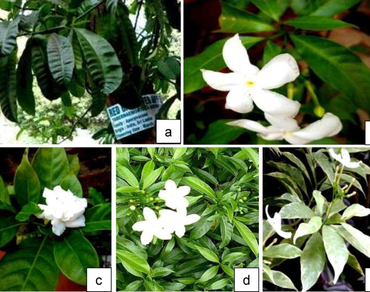
Tabernaemontana spp. belonging to the Apocynaceae family, consists of several common and horticultural varieties spanning across the tropical and sub-tropical zones. The genus has previously been taxonomically and pharmacologically explored with limited molecular characterization. Hence, this study focuses on unraveling the genetic diversity and phylogeny among some commonly found species (T. dichotoma, T. coronaria) and horticultural varieties of Tabernaemontana, {T. coronaria (var. variegata, var. dwarf and var. florepleno)} by deploying ISSR markers. Among the 180 bands generated, 92 showed polymorphism implying considerable genetic variation among the taxa. 23 to 38 fragments were amplified per primer indicating genetic variability in the abundance of microsatellites. Phylogenetic tree, constructed on the basis of ISSR banding patterns disclosed low levels of polymorphism among the horticultural varieties of Tabernaemontana. This reflects greater intraspecific genetic affinity among the taxa as compared to their interspecific counterpart. Therefore, the present work highlights the efficacy and virtue of ISSR markers in deducing both intra as well as interspecific relationships among the genus Tabernaemontana. The degree of polymorphism detected from this study creates a diversified genetic base suggesting phylogenetic adaptations among different species and varieties of this taxon. Our findings provide the first ISSR-based molecular evidence of genetic relatedness in Tabernaemontana sp., further opening up avenues for future conservational and molecular breeding practices.
References
Arnau G, Lallemand J, Bourgoin M (2003) Fast and reliable strawberry cultivar identification using inter-simple sequence repeat (ISSR) amplification. Euphytica 129:69–79. https://doi.org/10.1023/A:1021509206584
Bose TK, Chowdhury B, Sharma SP (2011) Tropical garden plants in colour. Horticulture and Allied Publishers, Calcutta, p 166
da Cunha Galvao LM, Lages-silvi E (2008) Randomly amplified poplymorphic DNA (RAPD): a useful tool for genomic characterization of different organisms. In: Walkr JM, Rapley R (eds) Molecular biomethods handbook. Hanumana Press, pp 133–147
Goulao L, Voldiviesso T, Santana C, Oliveira CM (2001) Comparison between phenolic characterization using RAPD and ISSR markers and phenotypic data of cultivated chestnut (Castanea sativa Mill.). Genet Resour Crop Evol 48:329–338. https://doi.org/10.1023/A:1012053731052
Hossain MM, Sharma M, Pathak P (2013) In vitro propagation of Dendrobium aphyllum (Orchidaceae)- seed germination to flowering. J Plant Biochem Biotechnol 22:157–167. https://doi.org/10.1007/s13562-012-0124-3
Jena SN, Vasundharan SK, Sahoo MK, Das A (2007) Assessment of genetic diversity in nine Indian species of Asparagus: insights from karyotype, in situ DNA content and RAPD markers. Bot Steciana 11:95–106. https://doi.org/10.2298/GENSR1902479G
Judd WS, Cambell CS, Kellogg EA, Stevens PF, Donoghue MJ (2002) Plant systematics: a phylogenetic approach. In: Systematic Biology 2nd edn. Sinauer Associates, Sunderland, MA, pp 517–518. https://doi.org/10.1080/10635150490445878
Khan MSA (2011) Gastroprotective effect of Tabernaemontana divaricata (Linn.) R. Br. flower methanolic extract in Wister rats. Br J Pharm Res 1:88–98. https://doi.org/10.9734/BJPR/2011/347
Khandka DK, Nejidat A, Golan-Goldrish A (1996) Polymorphism and DNA markers for Asparagus cultivars identified by random amplified polymorphic DNA. Euphytica 87:39–44. https://doi.org/10.1007/BF00022962
Mirali N, El-Khouri S, Rizq F (2007) Genetic diversity and relationships in some Vicia species as determined by SDS-PAGE of seed proteins. Biol Plant 51(4):660–666. https://doi.org/10.1007/s10535-007-0139-0
Mukhopadhyay S, Ray S (2013) Chromosome and marker-based genome analysis of different species of Asparagus. Cytologia 78:425–437. https://doi.org/10.1508/cytologia.78.425
Padmesh P, Reji JV, Jinish Dhar M, Seeni S (2006) Estimation of genetic diversity in varieties of Mucuna puriens using RAPD. Biol Plant 50:367–372. https://doi.org/10.1007/s10535-006-0051-z
Pharmawati M, Yan G, Finnegan PM (2005) Molecular variation and fingerprinting of Leucodendron cultivars (Proteaceae) by ISSR markers. Ann Bot 95:1163–1170. https://doi.org/10.1093/aob/mci127
Pratchayasakul W, Pongchaidecha A, Chattipakorn N, Chattipakorn S (2008) Ethnobotany & ethnopharmacology of Tabernaemontana divaricata. Indian J Med Res 127:317–335
Rahman MM, Habib MR, Hasan SMR, Ma S, Rana MS (2011) Antibacterial, cytotoxic and antioxidant potential of methanolic extract of Phyllanthus acidus L. Int J Drug Dev & Res 3(2):154–161
Raina SN, Rani V, Kojima T, Ogihara Y, Singh KP, Devarumath RM (2001) RAPD and ISSR fingerprints as useful genetic markers for analysis of genetic diversity, varietal identification and phylogenetic relationships in peanut (Arachis hypogea) cultivars and wild species. Genome 44:763–772
Ray S, Mukhopadhyay MJ, Mukhopadhyay S (2010) Phylogenetic relationship among six different species of Asparagus utilizing RAPD, isozyme and ISSR markers. Biores Bull 3:148–152
The Wealth of India: A dictionary of Indian Raw materials and Industrial Products (1962) CSIR, New Delhi, III pp 193
Author Information
Department of Botany, Dr. Kanailal Bhattacharyya College, Howrah, India