Vegetos

(An International Journal of Plant Research & Biotechnology)
(eISSN: 2229-4473)
Morphological characteristics and molecular identification of Chloranthus nervosus Collett & Hemsl. (Syn. Chloranthus flavus D.T. Liu & G. Chen) from Vietnam
*Article not assigned to an issue yet
Van Chen Tran, Quynh Tran Thi Thuy, Duy Huynh Thanh, Duc Duong Phan Nguyen, Bao Nguyen Quoc, Khai Hoang Dac, Dat Pham Thi Thanh
Research Articles | Published: 30 June, 2026
First Page: 0
Last Page: 0
Views: 31
Keywords: n Chloranthus nervosusn , n Chloranthus flavusn , DNA_Barcode, ITS, n rbcLn
Abstract
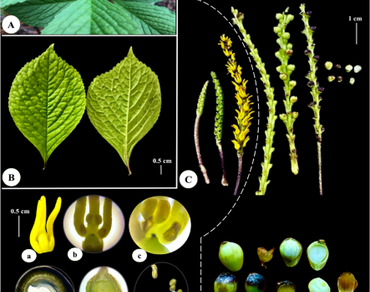
Chloranthus nervosus Collett & Hemsl. is a wild plantin the Chloranthaceae family. It is widely used in folk medicine to treat problems related to inflammation and pain. Currently, the macromorphology and molecular identification of C. nervosus collected in Vietnam are still limited in publicly accessible databases. Therefore, this study aimed to characterize the morphology and evaluate the ITS and rbcL sequences of C. nervosus collected from Vietnam. Macromorphological characterizations were noted and compared with previous studies. The total DNA of C. nervosus was used to amplify the ITS and rbcL regions by the CTAB method. Macromorphologically, C. nervosus differs from other Chloranthus species. Particularly, it’s distinguished by having a branched stem, blade leaf size (6–20 × 4–14 cm), long spike (5.5–10.0 cm), long stamens (5.0–12 mm), and long fruit (3–5 mm). The nuclear sequence of C. nervosus for ITS was 594 bp, while the final chloroplast sequence length for rbcL was 529 bp. The sequenced amplicons (97.6% and 100% similar to GenBank’s C. nervosus ITS and rbcL, respectively) demonstrated the ITS and rbcL markers’ ability to identify C. nervosus. Phylogenetic analysis revealed that the collected C. nervosus formed a tight cluster with multiple accessions of GenBank’s C. nervosus with bootstrap values of 70 for ITS and 71 for rbcL. The results demonstrated that the C. nervosus (Vietnam) are closely related and share a common genetic origin, all belonging to C. nervosus in GenBank. These results suggest a strong genetic affinity and provide molecular evidence for species-level identification. These DNA barcode markers may also be used to differentiate between Chloranthaceae species.
References
Avanesyan A, Lamp WO (2020) Use of molecular gut content analysis to decipher the range of food plants of the invasive spotted lanternfly, Lycorma delicatula. Insects 11(4):215. https://doi.org/10.3390/insects11040215
Chen TV, Lam DNX, Khai HD, Duc DPN, Nga NT, Hien NTT, Quynh TTT (2024) Micromorphology, physicochemical parameters, and phytochemical screening of Chloranthus flavus D.T. Liu & G. Chen (syn. C. nervosus Collett & Hemsl.) from Vietnam. Biodiversitas 25(2):846–858. https://doi.org/10.13057/biodiv/d250245
Dong W, Liu H, Xu C, Zuo Y, Chen Z, Zhou S (2014) A chloroplast genomic strategy for designing taxon specific DNA mini-barcodes: a case study on ginsengs. BMC Genet 15(1):138. https://doi.org/10.1186/s12863-014-0138-z
Doyle JA, Endress PK (2018) Phylogenetic analyses of Cretaceous fossils related to Chloranthaceae and their evolutionary implications. Bot Rev 84(2):156–202. https://doi.org/10.1007/s12229-018-9197-6
eFlora of China (FOC) (2025) Chloranthus japonicus Siebold. Database of Flora of China. Available via http://www.efloras.org/florataxon.aspx?flora_id=2&taxon_id=200005623. Accessed 15 Oct 2025
Endress PK (2001) The flowers in extant basal angiosperms and inferences on ancestral flowers. Int J Plant Sci 162(5):1111–1140. https://doi.org/10.1086/321919
Endress PK, Doyle JA (2015) Ancestral traits and specializations in the flowers of the basal grade of living angiosperms. Taxon 64(6):1093–1116. https://doi.org/10.12705/646.1
Fathy WA, Techen N, Elsayed KNM, Essawy EA, Tawfik E, Alwutayd KM, Abdelhameed MS, Hammouda O, Ross SA (2023) Applying an internal transcribed spacer as a single molecular marker to differentiate between Tetraselmis and Chlorella species. Front Microbiol 23(14):1228869. https://doi.org/10.3389/fmicb.2023.1228869
Glasenapp Y, Korth I, Nguyen XV, Papenbrock J (2019) Sustainable use of mangroves as sources of valuable medicinal compounds: Species identification, propagation and secondary metabolite composition. S Afr J Bot 121:317–328. https://doi.org/10.1016/j.sajb.2018.11.020
Jong-Soo KANG, Ki-Oug YOO (2023) Taxonomic and phylogenetic study of the subgenus Tricercandra in the genus Chloranthus (Chloranthaceae). Korean J Pl Taxon 53(4):243–256. https://doi.org/10.11110/kjpt.2023.53.4.243
Linder CR, Moore LA, Jackson RB (2000) A universal molecular method for identifying underground plant parts to species. Mol Ecol 9(10):1549–1559. https://doi.org/10.1046/j.1365-294x.2000.01034.x
Liu B, Wu H, Cao Y, Ma G, Zheng X, Zhu H, Song X, Sui S (2025) Reducing costs and shortening the cetyltrimethylammonium bromide (CTAB) method to improve DNA extraction efficiency from wintersweet and some other plants. Sci Rep 15(1):13441. https://doi.org/10.1038/s41598-025-94822-4
Liu DT, Cai L, Chen G (2019) Chloranthus flavus (Chloranthaceae), a new species from Guangxi. China Phytotaxa 391(4):273–276. https://doi.org/10.11646/phytotaxa.391.4.6
Liu YY, Li YZ, Huang SQ, Zhang HW, Deng C, Song XM, Zhang DD, Wang W (2022) Genus Chloranthus: a comprehensive review of its phytochemistry, pharmacology, and uses. Arab J Chem 15(11):104260. https://doi.org/10.1016/j.arabjc.2022.104260
Lu YB, Huang ZP, Qin XM, Zhang Q (2022) Combination of Chloranthus flavus into C. nervosus based on morphological and molecular evidence. Phytotaxa 564(2):230–238. https://doi.org/10.11646/phytotaxa.564.2.6
Pere K, Mburu K, Muge EK, Wagacha JM, Nyaboga EN (2023) Molecular discrimination and phylogenetic relationships of Physalis species based on ITS2 and rbcL DNA barcode sequence. Crops 3(4):302–319. https://doi.org/10.3390/crops3040027
Plants of the World Online (POWO) (2025a) Chloranthaceae R.Br. ex Sims. Kew Science. Available via https://powo.science.kew.org/taxon/urn:lsid:ipni.org:names:77126698-1. Accessed 15 Oct 2025
Plants of the World Online (POWO) (2025b) Chloranthus Sw. Kew Science. Available via https://powo.science.kew.org/taxon/urn:lsid:ipni.org:names:7052-1. Accessed 15 Oct 2025
Tnah LH, Lee SL, Lee CT, Ng KKS, Ng CH, Zawiah N (2024) DNA barcode identification of cultivated and wild tropical fruit species. 3 Biotech 14(1):7. https://doi.org/10.1007/s13205-023-03848-w
Todzia CA, Keating RC (1991) Leaf architecture of the Chloranthaceae. Ann Missouri Bot Gard 78(2):476–496. https://doi.org/10.2307/2399575
Wang AR, Song HC, An HM, Huang Q, Luo X, Dong JY (2015) Secondary metabolites of plants from the genus Chloranthus: Chemistry and biological activities. Chem Biodivers 12(4):451–473. https://doi.org/10.1002/cbdv.201300376
Yao ST, Lu YB, Zhang ZJ, Li C, Wang PF, Qin XM (2023) The complete chloroplast genome of Chloranthus nervosus Collett ex Hemsl. 1890 (Chloranthaceae). Mitochondrial DNA B Resour 8(11):1224–1228. https://doi.org/10.1080/23802359.2023.2278818
Zhu S, Liu Q, Qiu S, Dai J, Gao X (2022) DNA barcoding: an efficient technology to authenticate plant species of traditional Chinese medicine and recent advances. Chin Med 17:112. https://doi.org/10.1186/s13020-022-00655-y
Author Information
Faculty of Traditional Medicine, University of Medicine and Pharmacy at Ho Chi Minh City, Ho Chi Minh City, Vietnam