Vegetos

(An International Journal of Plant Research & Biotechnology)
(eISSN: 2229-4473)
Petiole anatomy to delimit taxonomy of genus Glochidion J.R. Forst. & G. Forst. (Phyllanthaceae)
*Article not assigned to an issue yet
Research Article | Published: 29 August, 2025
First Page: 0
Last Page: 0
Views: 384
Keywords: Petiole, Anatomy, n Glochidionn , Taxonomy, Phyllanthaceae
Abstract
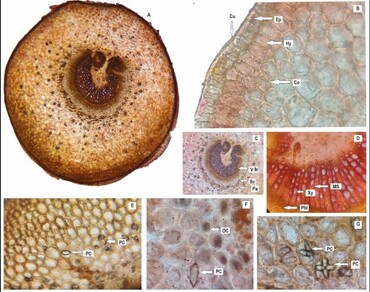
A comparative study of the petiole anatomy of 10 taxa of the genus Glochidion J.R. Forst. & G. Forst. of the family Phyllanthaceae was carried out to examine variations in the petiole anatomy that might be useful in identifying and classifying the various species. The transverse section of the petiole was done by following standard methods. The result showed variations ranging from circular to shield-shaped or entire in the outline of the petiole. The characteristics, viz., number and arrangement of vascular bundles and presence or absence of glands, crystals, and epidermal hairs, are particularly useful. Based on these characters a dichotomous taxonomic key was provided for identification of taxa. All the taxa have crystals and patches of sclerenchymatous cells around the vascular bundles, providing diagnostic features. The variations observed included the petiole outline, vascular bundle arrangement, hypodermis, collenchyma, sclerenchyma, crystal types, presence or absence of glands, and trichome types. These characteristics signify the relationships among each taxon and offer insights into delineating taxa.
References
Abeysinghe PD, Scharaschkin T (2019) Taxonomic value of the petiole anatomy in the genus Cinnamomum (Lauraceae) found in Sri Lanka. Ruhuna J Sci 10(1):1–17
Areej A, Alosaimi (2023) Petiole anatomy of selected species in family Lamiaceae and its systematic relevance. Flora 306:152367. https://doi.org/10.1016/j.flora.2023.152367
Baruah S, Borthakur SK, Ahmed M (2012) Taxonomic status of certain members of Smilax Linnaeus (Smilacaceae) based on foliar epidermal structures. Pleione 6(1):87–92
Baruah S, Baro D, Borthakur SK (2017) Petiole anatomy of Indian species of the genera Smilax L. and Heterosmilax Kunth. (Smilacaceae). Ann Plant Sci 6(10):1690–1693. https://doi.org/10.21746/aps.2017.6.10.1
Bashir K, Sohail A, Ali U, Ullah A, UlHaq Z, Gul B, Ullah I, Sunera AM (2020) Foliar micromorphology and its role in identification of the Apocynaceae taxa. Micros Res Tech 83(7):755–766. https://doi.org/10.1002/jemt.23466
Brahma P, Baruah S (2023) Comparative morphological and ethnobotanical assessment of certain taxa of genus Glochidion (Phyllanthaceae) from Assam, India. J Threat Taxa 15(12):24409–24419. https://doi.org/10.11609/jott.8696.15.12.24409-24419
Brahma P, Baruah S (2024a) Extended distribution of an endemic variety Glochidion zeylanicum var. paucicarpum Chakrab. & N.P. Balakr. (Phyllanthaceae) from Assam. India Vegetos 37:1484–1488. https://doi.org/10.1007/s42535-023-00650-0
Brahma P, Baruah S (2024b) Foliar epidermal micromorphology of genus Glochidion J.R.Forst. & G.Forst. (Phyllanthaceae) by using light and electron microscopy. Curr Bot 15:47–57
Chakrabarty T, Balakrishnan NP (2018) Indo-Burmese phyllanthaceae: a taxonomic revision. M/s Bishen Singh Mahendra Pal Singh, Dehradun, India, pp 194
Filartiga AL, Klimeš A, Altman J, Nobis MP, Crivellaro A, Schweingruber F, Doležal J (2022) Comparative anatomy of leaf petioles in temperate trees and shrubs: the role of plant size, environment and phylogeny. Ann Bot 129(5):567–582. https://doi.org/10.1093/aob/mcac014
Gairola S, Naidoo Y, Bhatt A, Nicholas A (2009) An investigation of the foliar trichomes of Tetradenia riparia (Hochst.) Codd [Lamiaceae]: an important medicinal plant of Southern Africa. Flora Morphol Distrib Funct Ecol Plants 204(4):325–330. https://doi.org/10.1016/j.flora.2008.04.002
Hooker JD (1890) The Flora of British India. Vol. 5. L. Reeve & Co., Henrietta street, Covent Garden, London, pp 456
Jaimez DG, León B, Martínez OG (2021) Comparative anatomy of five species of Campyloneurum (Polypodiaceae) from South America. Flora 282:151881. https://doi.org/10.1016/j.flora.2021.151881
Kanjilal UN, Kanjilal PC, Dey RN, Das A (1940) Flora of Assam. Vol. 4. Prabasi Press, Upper Circular Road, Calcutta, pp 179
Li PT, Gilbert MG (2008) Glochidion. In: Wu ZY, Raven PH, Hong DY (eds) Flora of China, vol 11. Science Press & Missouri Botanical Garden Press, Beijing & St. Louis, pp 193–202
Majeed M, Zafar AT, Althobaiti et al (2022) Comparative petiole histology using microscopic imaging visualization among Amaranthaceous taxa. Flora 297(1):152178. https://doi.org/10.1016/j.flora.2022.152178
Metcalfe CR, Chalk L (1979) Anatomy of Dicotyledonous, 2nd edn. Clarendon Press, Oxford
Mohtashamian M, Hajishirkia’ee FA, Fatehi F, Rastegar A (2022) Petiole anatomy: a contribution to the taxonomy of Acer L (Sapindaceae) in Iran. Nord J Bot 2022:e03417. https://doi.org/10.1111/njb.03417
Park BK, Son DC, Ghimire B (2021) Taxonomic relevance of petiole anatomical and micro-morphological characteristics of Clematis L. (Ranunculaceae) taxa from South Korea. PeerJ 9:e11669. https://doi.org/10.7717/peerj.11669
Radford AE, Dickson WC, Massey JR, Bell CL (1974) Vascular plant systematic. Harper and Raw Publisher, New York
Talip N, Culter DF, Ahmad Puad AS, Ismail BS, Ruzi AR, Ahmad Juhari AA (2017) Diagnostic and systematic significance of petiole anatomy in the identification of Hopea species (Dipterocarpaceae). S Afr J Bot 111:111–253. https://doi.org/10.1016/j.sajb.2017.03.008
Thakur HA, Patil DA (2011) Petiolar anatomy of some unstudied Euphorbiaceae. J Phytol 2(12):54–59
Author Information
Department of Botany, Bodoland University, Assam, India