Vegetos

(An International Journal of Plant Research & Biotechnology)
(eISSN: 2229-4473)
Phytotoxic effects of Lepidium didymum L. fruit extract on germination and growth of Vicia sativa and Rumex dentatus
*Article not assigned to an issue yet
Shadab Mo, Ain Quratul, Aijaz Farha, Akhtar Nazish, Siddiqui M. B.
Research Article | Published: 05 September, 2025
First Page: 0
Last Page: 0
Views: 403
Keywords: Allelopathy, Germination index, GC-MS, Natural herbicide, Weed control
Abstract
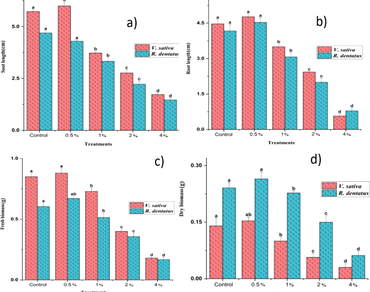
Weeds are biotic agents that cause major ecological problems and considerable losses to crop production worldwide. Increasing food demand necessitates innovative weed-management strategies. The traditional reliance on synthetic herbicides poses environmental and health risks. This study examined the phytotoxic effects of an aqueous extract derived from the fruits of Lepidium didymum on two weed species, Vicia sativa (common vetch) and Rumex dentatus (toothed dock). L. didymum, recognized for its abundant phytochemical content, presents a potential natural alternative to synthetic herbicides. Laboratory bioassays were conducted to evaluate the inhibitory effects of varying concentrations of fruit aqueous extract (FAE) on the seed germination index, seedling growth, biomass accumulation, and chlorophyll and carotenoid content of V. sativa and R. dentatus. The results demonstrated a significant reduction in germination percentage, germination rate, germination vigour, and seedling growth in both weed species, with higher extract concentrations showing stronger phytotoxicity. The effect of the extract on root and shoot elongation and overall plant vigour was quantitatively assessed, showing dose-dependent inhibition. Scanning electron microscopy (SEM) analysis of leaf morphology revealed notable differences, including partially closed stomata and damaged guard cells, in comparison to the control group. Additionally, gas chromatography-mass spectrometry (GC-MS) profiling of a methanolic fruit extract identified twenty-eight components. Further field studies and identification of specific allelochemicals are recommended to validate these laboratory results and optimize the application methods for agricultural use. The results indicated that the fruits of L. didymum possess a high concentration of allelochemicals, which inhibited the growth of weed species and may serve as viable natural herbicide alternatives.
References
Afrayeem SM, Chaurasia AK (2017) Effect of zinc oxide nanoparticles on seed germination and seed vigour in Chilli (Capsicum annuum L). J Pharmacogn Phytochem 6:1564–1566
Ain Q, Mushtaq W, Shadab M, Siddiqui MB (2023) Allelopathy: an alternative tool for sustainable agriculture. Physiol Mol Biol Plants 29:495–511
Arnon DI (1949) Copper enzymes in isolated chloroplasts. Polyphenoloxidase in beta vulgaris. Plant Physiol 24:1
Arora N, Pandey-Rai S (2014) GC–MS analysis of the essential oil of Celastrus paniculatus willd. Seeds and antioxidant, anti-inflammatory study of its various solvent extracts. Indian Crop Prod 61:345–351
Bangarwa KS, Norsworthy KJ (2014) Brassicaceae cover-crop effects on weed management in plasticulture tomato. J Crop Improv 28:145–158. https://doi.org/10.1080/15427528.2013.858381
Bates LS, Waldren RA, Teare ID (1973) Rapid determination of free proline for water-stress studies. Plant Soil 39:205–207
de Almeida L, Gaspar YMS, Silva AAR, Porcari AM, Lacerda JJDJ, Araújo FDS (2024) Allelopathic effect and putative herbicidal allelochemicals from Jatropha Gossypiifolia on the weed bidens bipinnata. Acta Physiol Plant 46:61
Duxbury AC, Yentsch CS (1956) Plankton pigment nomographs. J Mar Res 15:1
Fetouh MI, Hassan FA (2014) Seed germination criteria and seedling characteristics of Magnolia grandiflora L. trees after cold stratification treatments. Int J Curr Microbiol Appl Sci 3:235–241
Gulzar A, Siddiqui MB, Bi S (2016) Phenolic acid allelochemicals induced morphological, ultrastructural, and cytological modification on Cassia Sophera L. and allium Cepa L. Protoplasma 253:1211–1221
Haramoto ER, Gallandt ER (2004) Brassica cover cropping for weed management: A review. Renew Agric Food Syst 19:187–198
Heap I (2014) Global perspective of herbicide-resistant weeds. Pest Manag Sci 70:1306–1315. https://doi.org/10.1002/ps.3696
Jabran K, Mahajan G, Sardana V, Chauhan BS (2015) Allelopathy for weed control in agricultural systems. Crop Prot 72:57–65
Johnson N, Zhang G, Soble A, Johnson S, Baucom RS (2023) The consequences of synthetic auxin herbicide on plant-herbivore interactions. Trends Plant Sci 28(7):765–775
Kato-Noguchi H (2022) Allelopathy and allelochemicals of Imperata cylindrica as an invasive plant species. Plants 11:2551
Khamare Y, Chen J, Marble SC (2022) Allelopathy and its application as a weed management tool: A review. Front Plant Sci 13:1034649. https://doi.org/10.3389/fpls.2022.1034649
Kumar V, Ajeesh R, Jijeesh CM (2015) Chemical seed pre-treatments for better germination and seedling growth of Swietenia macrophylla King. J Environ Biosci 29:2
Li ZH, Wang Q, Ruan X, Pan CD, Jiang DA (2010) Phenolics and plant allelopathy. Molecules 15:8933–8952
Liu W, Dong BZ, Hu J, Xu Z, Zheng C, Nian Y, Zhou H (2023b) Indole-3‐acetonitrile is a critical molecule with weed allopathic suppression function in broccoli (Brassica Oleracea var. italica). Chem Biodivers 20:e202300444
Mehal KK, Kaur A, Singh HP, Batish DR (2023) Investigating the phytotoxic potential of Verbesina encelioides: effect on growth and performance of co-occurring weed species. Protoplasma 260:77–87
Muniz de Lima PA, Jacomino GRDL, da Silva SM, Alves TDA, Pereira MLZ, de Almeida TDFR, Lopes JC (2023) Allelopathic potential of aqueous extracts of passion fruit (Passiflora mucronata) fruit peels on lettuce. Aust J Crop Sci 17:324–331
Author Information
Allelopathy and Plant Taxonomy Laboratory, Department of Botany, Faculty of Life Science, Aligarh Muslim University, Aligarh, India