Vegetos

(An International Journal of Plant Research & Biotechnology)
(eISSN: 2229-4473)
Plant growth promoting Rhizobium isolates from common bean (Phaseolus vulgaris) root nodules exhibited host range variability
*Article not assigned to an issue yet
Research Articles | Published: 26 June, 2026
First Page: 0
Last Page: 0
Views: 28
Keywords: n Phaseolus vulgarisn , Plant growth and development, Phytohormone production, n Rhizobiumn , n 16S rRNAn
Abstract
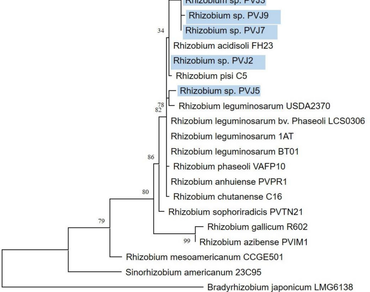
Common bean (Phaseolus vulgaris) is a promiscuous host nodulated by multiple rhizobial taxa and symbiovars. Accordingly, this study evaluated the host-range specificity of common bean Rhizobium isolates. Inoculation tests demonstrated that Rhizobium isolate PVJ5 is host-specific, nodulating exclusively Phaseolus vulgaris, but isolates PVJ8 and PVJ9 exhibit a broad host range, nodulating Phaseolus vulgaris, Vigna umbellata, and Glycine max. Concurrently, all three rhizobia promote the plant growth regardless of the nodulation condition. The Rhizobium isolates have phosphate solubilisation and phytohormone (auxin and gibberellic acid) production abilities. The identified Rhizobium has the potential to serve as a specific and broad host-range inoculum for usage as a consortia bioinoculant for Phaseolus vulgaris and other legumes.
References
Angioi SA, Rau D, Attene G, Nanni L, Bellucci E, Logozzo G, Negri V, Spagnoletti Zeuli PL, Papa R (2010) Beans in Europe: origin and structure of the European landraces of Phaseolus vulgaris L. Theor Appl Genet 121(5):829–843. https://doi.org/10.1007/s00122-010-1353-2
Brambilla S, Stritzler M, Soto G, Ayub N (2022) A synthesis of functional contributions of rhizobacteria to growth promotion in diverse crops. Rhizosphere 24:100611. https://doi.org/10.1016/j.rhisph.2022.100611
Efstathiadou E, Ntatsi G, Savvas D, Tampakaki AP (2021) Genetic characterization at the species and symbiovar level of indigenous rhizobial isolates nodulating Phaseolus vulgaris in Greece. Sci Rep 11:8674. https://doi.org/10.1038/s41598-021-88051-8
Fu X, Harberd N (2003) Auxin promotes Arabidopsis root growth by modulating gibberellin response. Nature 421:740–743. https://doi.org/10.1038/nature01387
Gellért C, Ebrahimkhalili N, Siwakoti S, Zhu H, Kereszt A (2026) Not all allies are welcome: partner discrimination in legume-Rhizobium symbiosis. Mol Plant-Microbe Interact 39:153–322. https://doi.org/10.1094/MPMI-08-25-0108-FI
Hernandez-Lucas I, Segovia L, Martínez-Romero E, Pueppke SG (1995) Phylogenetic relationships and host range of Rhizobium spp. that nodulate Phaseolus vulgaris L. Appl Environ Microbiol 61:2775–2779. https://doi.org/10.1128/aem.61.7.2775-2779.1995
Hnini M, Aurag J (2024) Prevalence, diversity and applications potential of nodules endophytic bacteria: a systematic review. Front Microbiol 15:1386742. https://doi.org/10.3389/fmicb.2024.1386742
Hungria M, Ardley J, O’Hara GW, Howieson JG (2016) Preservation of rhizobia. Working with rhizobia. Australian Centre for International Agricultural Research, Canberra, pp 61–71
Kawade K, Sugiura D, Oikawa A, Kawaguchi M (2024) Control of root nodule formation ensures sufficient shoot water availability in Lotus japonicus. Plant Physiol 195:2542–2550. https://doi.org/10.1093/plphys/kiae126
Laguerre G, Nour SM, Macheret V, Sanjuan J, Drouin P, Amarger N (2001) Classification of rhizobia based on nodC and nifH gene analysis reveals a close phylogenetic relationship among Phaseolus vulgaris symbionts. Microbiology 147:981–993. https://doi.org/10.1099/00221287-147-4-981
León-Cadena A, Naranjo HD, Jiménez-Parra J, Ochoa J, Avalos–Loayza M, Murillo P et al (2026) Updating the description of Rhizobium diversity associated with common bean cultivars in the Ecuadorian Andes: a phylogenetic and functional perspective. PLoS ONE 21:e0339774. https://doi.org/10.1371/journal.pone.0339774
Murashige T, Skoog F (1962) A revised medium for rapid growth and bioassays with tobacco tissue cultures. Physiol Plant 15:473–497. https://doi.org/10.1111/j.1399-3054.1962.tb08052.x
Nautiyal CS (1999) An efficient microbiological growth medium for screening phosphate solubilizing microorganisms. FEMS Microbiol Lett 170:265–270. https://doi.org/10.1111/j.1574-6968.1999.tb13383.x
Nichio BTdL, Chaves RBR, Pedrosa FdO, Raittz RT (2025) Exploring diazotrophic diversity: unveiling Nif core distribution and evolutionary patterns in nitrogen-fixing organisms. BMC Genom 26:81. https://doi.org/10.1186/s12864-024-10994-9
Patra NK, Benjongtoshi, (2023) Sustainable performance of French bean (Phaseolus vulgaris L.) cultivation, a livelihood component in Eastern Himalayan Region. Int J Agric Sustain 21:2247784. https://doi.org/10.1080/14735903.2023.2247784
Peix A, Ramírez-Bahena MH, Velázquez E, Bedmar EJ (2015) Bacterial associations with legumes. Crit Rev Plant Sci 34:17–42. https://doi.org/10.1080/07352689.2014.897899
Pongener B, Deb CR, Paul A (2024a) Prospecting beneficial microsymbiont associated with root nodules of crop legumes of North-Eastern India, Nagaland. Proc Nat Acad Sci, India Sect b: Biol Sci 94:835–843. https://doi.org/10.1007/s40011-024-01601-8
Pongener B, Deb CR, Paul A (2024b) Crop legumes grown in jhum fields and home gardens in Nagaland and study of the root nodule morphology. Environ Ecol 42:1219–1223. https://doi.org/10.60151/envec/WXDK2076
Pongener B, Paul A, Deb CR (2024c) Isolation of root nodule endophytes from cowpea (Vigna unguiculata L.) growing in jhum field in Nagaland (India). Appl Biol Res 26:459–465. https://doi.org/10.48165/abr.2024.26.01.53
Porter SS, Dupin SE, Denison RF, Kiers ET, Sachs JL (2024) Host-imposed control mechanisms in legume-rhizobia symbiosis. Nat Microbiol 9:1929–1939. https://doi.org/10.1038/s41564-024-01762-2
Ramírez MDA, España M, Sekimoto H, Okazaki S, Yokoyama T, Ohkama-Ohtsu N (2021) Genetic diversity and characterization of symbiotic bacteria isolated from endemic Phaseolus cultivars located in contrasting agroecosystems in Venezuela. Microbes Environ. https://doi.org/10.1264/jsme2.ME20157
Román-Ponce B, Jing ZY, Soledad V-MM, Hua SX, Feng CW, Carlos APJ, Wu GX, Lian GJ, Yan J, Hong WG, Tao WE (2016) Rhizobium acidisoli sp. nov., isolated from root nodules of Phaseolus vulgaris in acid soils. Int J Syst Evol Microbiol 66:398–406. https://doi.org/10.1099/ijsem.0.000732
Shamseldin A, Velázquez E (2020) The promiscuity of Phaseolus vulgaris L. (common bean) for nodulation with rhizobia: a review. World J Microbiol Biotechnol 36:63. https://doi.org/10.1007/s11274-020-02839-w
Tamura K, Stecher G, Kumar S (2021) MEGA11: molecular evolutionary genetics analysis version 11. Mol Biol Evol 38:3022–3027. https://doi.org/10.1093/molbev/msab120
Wekesa CS, Furch ACU, Oelmüller R (2021) Isolation and characterization of high-efficiency rhizobia from western Kenya nodulating with common bean. Front Microbiol 12:697567. https://doi.org/10.3389/fmicb.2021.697567
Author Information
Department of Botany, Nagaland University, Lumami, India