Vegetos

(An International Journal of Plant Research & Biotechnology)
(eISSN: 2229-4473)
Predominant gene effects in intraspecific hybrids derived from Muskmelon (Cucumis melo L.) and Mangalore melon (Cucumis melo ssp. agrestis var. acidulus) for shelf-life, fruit yield and fruit quality traits through generation mean analysis
*Article not assigned to an issue yet
Research Articles | Published: 30 September, 2026
First Page: 0
Last Page: 0
Views: 92
Keywords: Muskmelon, Mangalore melon, Intraspecific hybrids, Shelf life, Generation mean analysis
Abstract
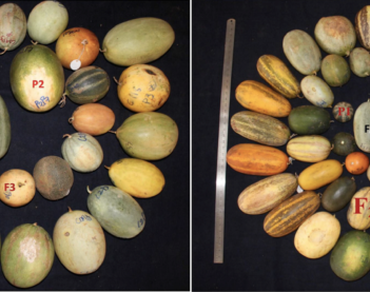
Muskmelon (Cucumis melo L.) is valued for nutrition and medicinal properties. Most varieties are climacteric with a 15-day shelf life at ambient conditions. Limited market access and cold storage affect quality. Increasing shelf life for transport is a key breeding goal. Mangalore melon (Cucumis melo subsp. agrestis var. acidulus), known as Mangalore southe, has a one-year shelf life. It hybridizes with muskmelon, producing hybrids with a three-month shelf life. To study inheritance of fruit quality and shelf life, we evaluated one experimental cross (Arka Siri × SS17) across five generations (P1, P2, F1, F2, F3) in an RCBD design during late Kharif 2020 and Summer 2021. Generation mean analysis showed significant mean effects (m), indicating generational variability. Additive (d) and dominance (h) gene effects contributed to trait inheritance, with additive effects dominant in fruit shape index (? 0.52?±?0.11), pulp width (? 0.19?±?0.07), shelf life (? 11.90?±?2.35 days), and fruit yield (? 621.70?±?145.20 g). Epistatic interactions, including additive × additive (i) and dominance × dominance (l), were detected for several traits. Duplicate?type non?allelic interactions were identified for fruit weight, yield, and shelf life, while complementary epistasis appeared in peduncle fruit length, flesh thickness, and fruit yield. Model adequacy was confirmed using ?2 goodness?of?fit tests (p?>?0.05 for accepted models) and residual diagnostics. Non-additive gene action suggests reciprocal recurrent selection may effectively exploit both effects to improve yield. These findings, supported by confidence intervals and model validation metrics, provide robust insights into inheritance patterns and guide breeding programs in muskmelon and Mangalore melon.
References
Cavalli LL (1952) An analysis of linkage in quantitative inheritance. In: Reeve ECR, Waddington CH (eds) Quantitative inheritance. HMSO, London, pp 135–144. https://doi.org/10.5555/19541603514
Chikh-Rouhou H, Kienbaum L, Gharib A, Avellán OF, Claver AG (2024) Combining ability and hybrid breeding in Tunisian melon (Cucumis melo L.) for fruit traits. Horticulturae 10(7):724. https://doi.org/10.3390/horticulturae10070724
Feyzian A, Dehghani H, Rezai AM, Jalali Javaran M (2009) Generation mean analysis for yielding and fruit quality traits in melon (Cucumis melo L). J Agric Sci Technol 11(4):441–452
Hayman BI (1958) The separation of epistatic from additive and dominance variation in generation. Heredity 12:371–390
Hayman BI, Mather K (1955) The description of genetic interactions in continuous variation. Biometrics 11:69–82
Hiremata V, Shet RM, Gunnaiah R, Anjappa P (2023) Mangalore melon (Cucumis melo ssp. agrestis var. acidulus): a neglected and underutilized vegetable of the Western Ghats of India. Genet Resour Crop Evol 70(6):1895–1902. https://doi.org/10.1007/s10722-023-01585-w
Hiremata V, Shet RM, Gunnaiah R, Prashantha A (2025) Assessment of genetic variability for intraspecific hybrid derived from muskmelon and Mangalore melon (Arka Siri × SS-17). Electron J Plant Breed 16(1):96. https://doi.org/10.37992/2025.1601.016
Hiremata V, Shet RM, Gunnaiah R, Prashantha A, Hongal S, Naika MBN, Nishani S (2022a) Assessment of genetic variability for fruit yield and quality traits in F2 generation of intraspecific hybrids derived from muskmelon and Mangalore melon. Pharma Innov 11(12):3121–3126
Hiremata V, Shet RM, Gunnaiah R, Prashantha A, Naika MBN, Peerajade DA, Hongal S, Nishani S and Ashok (2022b) Character association and path analysis of fruit yield and yield components in F2 population of intraspecific hybrid derived from muskmelon (Cucumis melo L.) and Mangalore melon (C. melo var. acidulus). Biol Forum Int J 14(4a):180–184
Kumari R, Kumar R, Gupta M (2021) Estimation of epistasis and genetic components of variance for different traits in cucumber (Cucumis sativus). Indian J Agric Sci. https://doi.org/10.56093/ijas.v91i7.115026
Manohar SH, Murthy HN (2012) Estimation of phenotypic divergence in a collection of Cucumis melo, including shelf-life of fruit. Sci Hortic 148:74–82
Mather K (1949) Biometrical genetics. Methuen and Co. Ltd., London
Mather K, Jinks JL (1982) Biometrical genetics: the study of continuous variation, 3rd edn. Chapman and Hall, London
Moon S, Jha A, Singh M (2017) Inheritance of fruit yield and its components in muskmelon (Cucumis melo L.) using generation mean analysis. Indian J Hortic 74(3):365–370
Patil DS, Musmade AM, Jagtap VS (2014) Generation mean analysis of yield and components in muskmelon (Cucumis melo L.). Asian J Hort 9(1):81–88
Rachman MA, Sobir S, Syukur M (2023) Genetics analysis and heritability of fruit characters in muskmelon (Cucumis melo L.) using extreme parental difference. Agrivita J Agric Sci 45(2):115–124
Rani R, Reddy R, Raju S (2013) Study of gene effect for yield and its component traits in bitter gourd (Momordica charantia L.) by generation mean analysis. Electron J Plant Breed 4(3):1237–1241
Ranjitha M, Pitchaimuthu M, Samuel S, Singh TH, Varalakshmi B (2023) Dissecting gene action for yield and quality traits in muskmelon (Cucumis melo L.) through generation mean analysis. Indian J Genet Plant Breed 83(3):389–397
Reddy BPK, Begum H, Sunil N, Reddy MT (2017) Variance component analysis of quantitative traits in muskmelon (Cucumis melo L.). Int J Curr Microbiol Appl Sci 6(6):2277. https://doi.org/10.20546/ijcmas.2017.606.269
Saha K, Choudhary H, Munshi AD, Singh A (2022) Heterosis and combining ability for yield traits and its relationship with gene action in muskmelon (Cucumis melo). Indian J Agric Sci 92(5):602. https://doi.org/10.56093/ijas.v92i5.124701
Sangamesh, Adivappar N, Hiremata V, Vani NU and Mirji P (2024) Frequency distribution and genetic variability for yield attributing traits in F2 population of tomato cross, IIHR-2373 × Arka Alok. Vegetos, pp 1–7
Shashikumar KT, Pitchaimuthu M, Rawal RD (2016) Generation mean analysis of horticultural traits in muskmelon (Cucumis melo L.). Int J Agric Sci Res Dev 6(2):399–406
Shet RM, Gunnaiah R, Tirkannanavar S, Hongal S, Hiremata V, Venugopal KC (2025) Phenotypic characterization of Mangalore melon (Cucumis melo subsp. agrestis var. acidulus) accessions from Southern India based on qualitative and quantitative traits. Genet Resour Crop Evol. https://doi.org/10.1007/s10722-025-02500-1
Shet RM, Hiremata V, Gunnaiah R, Rathod S (2024) Genetic diversity, variability, and correlation studies in South Indian culinary melon (Cucumis melo ssp. agrestis var. acidulus) accessions. Indian J Plant Genet Resour 37(1):118–124. https://doi.org/10.61949/0976-1926.2024.v37i01.14
Swamy KRM (2017) Origin, distribution and systematics of culinary cucumber (Cucumis melo subsp. agrestis var. conomon). J Hortic Sci 12(1):1–22
Swamy KRM and PremNath (2022) Nutritive and medicinal value and uses of Mangalore melon. Culinary Melons of South India. Westville Publishing House, New Delhi, pp 236–246
Author Information
University of Agricultural Sciences, Bangalore, India