Vegetos

(An International Journal of Plant Research & Biotechnology)
(eISSN: 2229-4473)
Response surface methodology for optimizing cellulase production in Enterobacter cloacae
*Article not assigned to an issue yet
Research Article | Published: 25 May, 2026
First Page: 0
Last Page: 0
Views: 79
Keywords: Cellulase production, Response surface methodology (RSM), Agro-waste utilization, n Enterobacter cloacaen , Fermentation optimization
Abstract
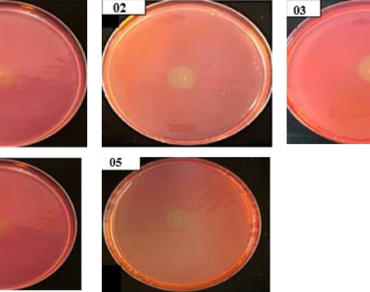
Cellulase enzymes are essential for the efficient bioconversion of lignocellulosic biomass into biofuels and other value-added products. The optimization of cellulase production from microbial sources can enhance enzyme yield and reduce costs, making biofuel production more feasible. This study focuses on the isolation and optimization of cellulase production from bacterial strains obtained from North Gujarat, India. Out of 35 bacterial isolates screened, isolate 3(Enterobacter cloacae) exhibited the highest cellulolytic activity. Optimization using Response Surface Methodology (RSM) significantly improved cellulase production, achieving a maximum enzyme activity of 38.54 IU/mL under optimal conditions with rice husk as a cost-effective carbon source. Critical fermentation parameters, including pH, temperature, and metal ion supplementation, influenced cellulase production. The enzyme was purified via ammonium sulphate precipitation, yielding a specific activity of 4.9 U/mg. SDS-PAGE analysis determined the molecular weight of the purified enzyme to be 55 ± 1 kDa. The study demonstrates the potential of bacterial cellulases for industrial applications, particularly in biofuel production and agricultural waste management. The findings emphasize the importance of optimizing fermentation parameters for enhanced cellulase production. This work paves way for scaling up production and improving enzyme stability for commercial applications.
References
Afzal I, Shinwari ZK, Sikandar S, Shahzad S (2019) Plant beneficial endophytic bacteria: mechanisms, diversity, host range and genetic determinants. Microbiol Res 221:36–49. https://doi.org/10.1016/j.micres.2019.02.001
Annamalai N, Rajeswari MV, Elayaraja S, Balasubramanian T (2013) Thermostable, haloalkaline cellulase from Bacillus halodurans CAS 1 by conversion of lignocellulosic wastes. Carbohydr Polym 94(1):409–415. https://doi.org/10.1016/j.carbpol.2013.01.066
Annamalai N, Thavasi R, Vijayalakshmi S, Balasubramanian T (2011) A novel thermostable and halostable carboxymethylcellulase from marine bacterium Bacillus licheniformis AU01. World J Microbiol Biotechnol 27(9):2111–2115. https://doi.org/10.1007/s11274-011-0674-x
Banerjee S, Maiti TK, Roy RN (2020) Production, purification, and characterization of cellulase from Acinetobacter junii GAC 16.2, a novel cellulolytic gut isolate of Gryllotalpa africana, and its effects on cotton fiber and sawdust. Ann Microbiol 70(1):28. https://doi.org/10.1186/s13213-020-01569-6
Bhardwaj N, Kumar B, Agrawal K, Verma P (2021) Current perspective on production and applications of microbial cellulases: a review. Bioresour Bioprocess 8(1):95. https://doi.org/10.1186/s40643-021-00447-6
Bhat SA, Bashir O, Bilal M, Ishaq A, Din Dar MU, Kumar R et al (2021) Impact of COVID-related lockdowns on environmental and climate change scenarios. Environ Res 195:110839. https://doi.org/10.1016/j.envres.2021.110839
Chaudhary R, Patel P, Chavda N, Parikh J, Bhatt K, Kanani D, Raval P (2025) Sustainable biodiesel production via transesterification of Bacillus sp.(OQ135194) lipids: optimization strategies. https://doi.org/10.33263/LIANBS144.207
Chaudhary RK, Patel PH, Chavda NR, Patel VK, Chaudhary KK (2023) Bacillus paralicheniformis (OQ202112)-Mediated biodiesel production using groundnut husk: A sustainable approach for bioenergy generation. J Appl Biol Biotechnol. https://doi.org/10.7324/JABB
Chavda NR, Patel PH, Chaudhary RK (2023) Isolation and production of cellulase from bacteria using agro waste. Biosci Biotechnol Res Asia 20(4):1467–1479. https://doi.org/10.13005/bbra/3192
Chavda NR, Panchal KS, Chaudhary RK, Patel PH (2021) Bacterial cellulases and its applications: a review. Biochem Anal Biochem 10:400
Chen KW, Sun TY, Wu YD (2023) New insights into the cooperativity and dynamics of dimeric enzymes. Chem Rev 123(16):9940–9981. https://doi.org/10.1021/acs.chemrev.3c00042
Corrêa PS, JúniorMorais WG, Martins AA, Caetano NS, Mata TM (2020) Microalgae biomolecules: extraction, separation and purification methods. Processes 9(1):10. https://doi.org/10.3390/pr9010010
Gastelum-Arellanez A, Paredes-López O, Olalde-Portugal V (2014) Extracellular endoglucanase activity from Paenibacillus polymyxa BEb-40: production, optimization and enzymatic characterization. World J Microbiol Biotechnol 30(11):2953–2965. https://doi.org/10.1007/s11274-014-1723-z
Ghazanfar M, Irfan M, Shakir HA, Khan M, Nadeem M, Irfan A (2022) Cellulase production optimization by Bacillus aerius through response surface methodology in submerged fermentation. Cellul Chem Technol 56(3–4):321–330
Irfan M, Bakhtawar J, Shakir HA, Khan M, Ali S (2019) Utilization of peanut shells as substrate for cellulase production in submerged fermentation through Box-Behnken design. Int J Biol Chem 12(2):28–39. https://doi.org/10.26577/ijbch-2019-v2-4
Juturu V, Wu JC (2014) Microbial cellulases: engineering, production and applications. Renew Sustain Energy Rev 33:188–203. https://doi.org/10.1016/j.rser.2014.01.077
Kalntremtziou M, Papaioannou IA, Vangalis V, Polemis E, Pappas KM, Zervakis GI et al (2023) Evaluation of the lignocellulose degradation potential of Mediterranean forests soil microbial communities through diversity and targeted functional metagenomics. Front Microbiol. https://doi.org/10.3389/fmicb.2023.1121993
Karlapudi AP, Venkateswarulu TC, Srirama K, Dirisala VR, Kamarajugadda BP, Kota RK et al (2019) Purification and lignocellulolytic potential of cellulase from newly isolated Acinetobacter indicus KTCV2 strain. Iran J Sci Technol Trans A Sci 43(3):755–761. https://doi.org/10.1007/s40995-018-0600-2
Laemmli UK (1970) Cleavage of structural proteins during the assembly of the head of bacteriophage T4. Nature 227(5259):680–685. https://doi.org/10.1038/227680a0
Liaqat S, Ahmad I, Shakir HA, Khan M, Franco M, Irfan M (2024) Production of cellulases from Pseudomonas stutzeri using mango peels as a substrate in submerged fermentation. Cellul Chem Technol 58(9–10):1037–1049
Miller GL (1959) Use of dinitrosalicylic acid reagent for determination of reducing sugar. Anal Chem 31(3):426–428. https://doi.org/10.1021/ac60147a030
Nakajima-Kambe T, Okada N, Takeda M, Akutsu-Shigeno Y, Matsumura M, Nomura N et al (2005) Screening of novel cellulose-degrading bacterium and its application to denitrification of groundwater. J Biosci Bioeng 99(4):429–433. https://doi.org/10.1263/jbb.99.429
Nakamura K, Mörck R, Reimann A, Kringstad KP, Hatakeyama H (1991) Mechanical properties of solvolysis lignin-derived polyurethanes. Polym Adv Technol 2(1):41–47. https://doi.org/10.1002/pat.1991.220020106
Palop MLL, Valles S, Pinaga F, Flors A (1989) Isolation and characterization of an anaerobic, cellulolytic bacterium, Clostridium celerecrescens sp. nov. Int J Syst Bacteriol 39(1):68–71. https://doi.org/10.1099/00207713-39-1-68
Patel BN, Patel VS, Patel P, Patel KN (2020) Isolation and optimization of cellulase producing actinomycetes from the soil of Mehsana district, Gujarat. Int J Adv Res Biol Sci 7:27–37. https://doi.org/10.22192/ijarbs.2020.07.01.XXX
Patel PH, Panchal KS, Patel BN, Patel HP (2021) Production and partial purification of pectinase from Streptomyces chartreusis. Crop Res. https://doi.org/10.31830/2454-1761.2021.012
Shankar T, Sankaralingam S, Balachandran C, Chinnathambi A, Nasif O, Ali Alharbi S et al (2021) Purification and characterization of carboxymethylcellulase from Bacillus pumilus EWBCM1 isolated from earthworm gut (Eudrilus eugeniae). J King Saud Univ 33(1):101261
Singhania RR, Ruiz HA, Awasthi MK, Dong CD, Chen CW, Patel AK (2021) Challenges in cellulase bioprocess for biofuel applications. Renew Sustain Energy Rev 151:111622. https://doi.org/10.1016/j.rser.2021.111622
Sriariyanun M, Tantayotai P, Yasurin P, Pornwongthong P, Cheenkachorn K (2016) Production, purification and characterization of an ionic liquid tolerant cellulase from Bacillus sp. isolated from rice paddy field soil. Electron J Biotechnol 19:23–28. https://doi.org/10.1016/j.ejbt.2015.11.002
Stat-Ease Inc. (2018) Design-Expert® software (version 11). Stat-Ease Inc., Minneapolis, USA
Tahir A, Afzal ATIA, Ahmad IRFAN, Sukmawati D, Franco MARCELO, Anindyawati T, Irfan M (2025) Potential of melon peels for the production of cellulose degrading enzymes from Bacillus subtilis strain 2I in submerged fermentation. Cellul Chem Technol. https://doi.org/10.35812/cellulosechemtechnol.2025.59.06
Tuncer M, Kuru A, Isikli M, Sahin N, Celenk FG (2004) Optimization of extracellular endoxylanase, endoglucanase and peroxidase production by Streptomyces sp. F2621 isolated in Turkey. J Appl Microbiol 97(4):783–791. https://doi.org/10.1111/j.1365-2672.2004.02361.x
Větrovský T, Steffen KT, Baldrian P (2014) Potential of cometabolic transformation of polysaccharides and lignin in lignocellulose by soil actinobacteria. PLoS ONE 9(2):e89108. https://doi.org/10.1371/journal.pone.0089108
Waheeb MS, Elkhatib WF, Yassien MA, Hassouna NA (2024) Optimized production and characterization of a thermostable cellulase from Streptomyces thermodiastaticus strain. AMB Express 14(1):129. https://doi.org/10.1186/s13568-024-01787-0
Whitman WB, Rainey FA, Kämpfer P, Trujillo ME, DeVos P, Hedlund B et al (2015) Bergey’s manual of systematics of archaea and bacteria. Wiley. https://doi.org/10.1002/9781118960608
Wilson K (2001) Preparation of genomic DNA from bacteria. Curr Protoc Mol Biol. https://doi.org/10.1002/0471142727.mb0204s56
Zhang C, Chen W, Dong T, Wang Y, Yao M, Xiao W et al (2023) Elimination of enzymes catalysis compartmentalization enhancing taxadiene production in Saccharomyces cerevisiae. Front Bioeng Biotechnol. https://doi.org/10.3389/fbioe.2023.1141272
Author Information
Department of Biotechnology, Mehsana Urban Institute of Sciences, Ganpat University, Mehsana, India