Vegetos

(An International Journal of Plant Research & Biotechnology)
(eISSN: 2229-4473)
Seed germination treatments for recalcitrant seeds of Mucuna bracteata DC. Ex Kurz
*Article not assigned to an issue yet
Kumari Anita, Kumar Nitesh, Sharma Arti, Devi Ruchika, Sharma Priyanka, Punyal Sweta, Thakur Ankita, Sharma Sangeeta
Research Article | Published: 11 March, 2026
First Page: 0
Last Page: 0
Views: 894
Keywords: α-amylase, GA3n , L-Dopa, n M. bracteatan , Medicinal value
Abstract
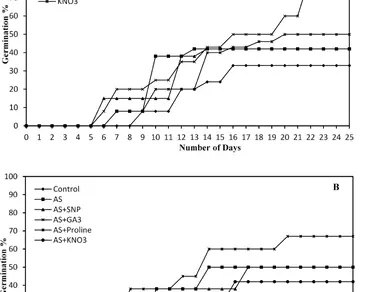
Mucuna bracteata DC. ex Kurz possesses immense medicinal value. Leaves, seeds, roots and whole plant is rich in alkaloids, flavonoids and phenolics that have antioxidant, antimicrobial and anti-inflammatory properties. Owing to the presence of L-Dopa, it is extensively used in ayurvedic formulations to treat Parkinson’s disease. Being a mycorrhizal species, it is also used as a cover crop for palm oil and rubber plantations. The demand of this plant for pharmaceutical purposes could be met through large-scale cultivation. Understanding seed physiological aspects would be significant in developing some cost-effective methods for optimizing seed germination performance and in turn cultivation. Influence of eco-physiological factors on various seed germination characteristics and α-amylase activity of seeds of M. bracteata from the Anni Khad Watershed area from Kullu (Himachal Pradesh) were studied for 25 days. Various treatments (SNP, GA3, KNO3, proline, and acid scarification) were applied individually and in combination with acid scarification. Seed germination was enhanced to varying degrees by all the treatments applied. Among all the treatments (individual and combined), proline (1 mM) effectively enhanced seed germination up to 83% compared to 33% in control on 22 day of incubation. Enhanced germination due to different treatments was accompanied by the increase in α-amylase activity. These findings highlight practical and cost-effective approaches to improve germination and break seed dormancy, contributing to the conservation and commercial cultivation of M. bracteata.
References
Ali Q, Ashraf M, Anwar F (2008) Seed composition and seedling growth response of various genetically diverse lines of chickpea (Cicer arietinum) to salt stress. Pak J Bot 40(5):2057–2066
Ashraf M, Foolad MR (2007) Role of glycine betaine and proline in improving plant abiotic stress resistance. Environ Exp Bot 59(2):206–216. https://doi.org/10.1016/j.envexpbot.2005.12.006
Bethke PC, Libourel IGL, Vitecek J, Jones RL, Freeling M (2006) The Arabidopsis aleurone layer responds to nitric oxide, gibberellin, and abscisic acid. Plant Physiol 140(2):555–564. https://doi.org/10.1104/pp.105.072918
Copeland LO, McDonald MB (2001) Seed science and technology. Kluwer Academic Publishers
Diallo OK, Berhe T (2003) Processing of Mucuna for human food in the Republic of Guinea. Trop Subtrop Agroecosyst 1(2–3):193–196
El-Shabrawi HM, Ahmed MB, Abdalla NA, El-Badri AM, Madian SA, Mostafa MM, Abdel-Hady MS (2022) Synergistic effects of nitric oxide and proline enhance drought tolerance and germination traits in wheat. Plant Physiol Rep 27:23–34. https://doi.org/10.1007/s40502-021-00617-z
Evans WC (1997) Trease and Evans’ pharmacognosy. Gen Pharmacol 2(29):291
Filner P, Varner JE (1967) A test for de novo synthesis of enzymes: density labeling with H2O18 of barley alpha-amylase induced by gibberellic acid. Proc Natl Acad Sci U S A 58(4):1520–1526
Govt of Himachal Pradesh, Forest Department (2022) Working plan for the forests of Anni forest division
Hartmann HT, Kester DE (1989) Plant propagation: principles and practices 1–559
Hastuti PB, Parwati WDU, Purwanto H, Suparyanto T, Nirwantono R, Pardamean B (2024) Seed dormancy breaking and germination rate improvement in Mucuna bracteata seeds using mechanical and fungicide treatments. BIO Web Conf 94:06002. https://doi.org/10.1051/bioconf/20249406002
International Seed Testing Association (1996) International rules for seed testing. Seed Sci Technol 21:1–288
Kalcec N, Peranic N, Barbir R et al (2022) Spectroscopic study of L-DOPA and dopamine binding on novel gold nanoparticles towards more efficient drug-delivery system for Parkinson’s disease. Spectroc Acta Pt A-Molec Biomolec Spectr 268:120707
Liu Y, Oduor AMO, Zhang Z, Manea A, Tooth IM, Leishman MR (2017) An integrative approach to understanding seed dormancy and germination of the invasive legume Leucaena leucocephala. Biol Invasions 19(4):1051–1064. https://doi.org/10.1007/s10530-016-1313-7
Liyanage KK, Baskin CC, Baskin JM (2022) Habitat-specific dormancy-release mechanisms in four physically dormant legume species from arid and semi-arid environments. Seed Sci Res 32(4):266–277. https://doi.org/10.1017/S0960258522000195
Musoff MM, Zulkarami B, Tajuddin SN, Latiff A (2016) Effect of scarification methods on seed germination and seedling growth of Mucuna bracteata. J Trop Res Sustain Sci 4(1):29–35. https://doi.org/10.1016/S0141-8130(02)00115-2
Natarajan K, Narayanan N, Ravichandran N (2012) Review on “Mucuna”-the wonder plant. Int J Pharm Sci Rev Res 17(1):86–93
Pardon L, Bessou C, Nelson PN, Dubos B, Ollivier J, Toma M, Nouvellon Y, Marichal R, Caliman JP (2016) Key unknowns in nitrogen budget for oil palm plantations. A review. Agron Sustain Dev 36:20
Ramesh T, Chandrasekaran S, Balasubramanian A (2017) Mucuna bracteata: a cover crop and green manure for plantation crops. Agrotechnol 6(1):1–4. https://doi.org/10.4172/2168-9881.1000174
Rane M, Suryawanshi S, Patil R, Aware C, Jadhav R, Gaikwad S, Singh P, Yadav S, Bapat V, Gurav R (2019) Exploring the proximate composition, antioxidant, anti-Parkinson’s and anti-inflammatory potential of two neglected and underutilized Mucuna species from India. S Afr J Bot 124:304–310
Rao A, Prasad B (2015a) Seed dormancy and germination ecology of Mucuna bracteata under warm and moist conditions. J Trop Agric 52(3):215–222
Rao VR, Prasad KVSK (2015b) Hard seed coat imposes dormancy in Mucuna bracteata, resulting in poor germination under natural conditions. J Trop Agric 53(1):83–87. https://doi.org/10.13140/RG.2.1.3549.9927
Sharma P, Sharma N, Kaushal R (2022) Seed dormancy breaking treatments in hard coated multipurpose leguminous tree species. Indian J Ecol 49(3):842–847
Siddique M, Hamid A, Islam M, Hossain A (2006) Effects of gibberellic acid on α-amylase activity in germinating seeds of chickpea (Cicer arietinum L.). J Agron Crop Sci 192(2):162–165. https://doi.org/10.1111/j.1439-037X.2006.00197.x
Szabados L, Savoure A (2010) Proline: a multifunctional amino acid. Trends Plant Sci 15(2):89–97. https://doi.org/10.1016/j.tplants.2009.11.009
Thakur P, Kumar S, Malik JA, Berger JD, Nayyar H (2010) Cold stress effects on reproductive development in grain crops: an overview. Environ Exp Bot 67(3):429–443. https://doi.org/10.1016/j.envexpbot.2009.09.004
de Morais LF, Almeida JCC, Deminicis BB, de Padua FT, Morenz MJF, de Abreu JBR, Araújo RP, de Nepomuceno DD (2014) Methods for breaking dormancy of seeds of tropical forage legumes. Am J Plant Sci 5(13):1831–1835. https://doi.org/10.4236/ajps.2014.513196
Author Information
Department of Botany, GB Pant Memorial Govt. College, Rampur Bushahr, India