Vegetos

(An International Journal of Plant Research & Biotechnology)
(eISSN: 2229-4473)
Standardization of clonal propagation protocol in Ginkgo biloba: an important endangered medicinal plant
*Article not assigned to an issue yet
Upadhyaya Manju Lata, Bahukhandi Amit, Tiwari Deep C., Singh Prakash
Short Communication | Published: 22 August, 2026
First Page: 0
Last Page: 0
Views: 3
Keywords: n Ginkgo biloban , IBA hormone, Clonal propagation, Himalaya
Abstract
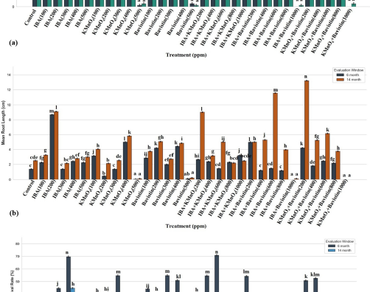
Ginkgo biloba, a living fossil that is endangered and economically important, has been utilized in both traditional and modern medicine systems. The species reported a very poor regeneration pattern and a slow growth rate, therefore, the present aim of the study is to standardize the clonal propagation protocol using different hormones and stem cutting collected from Uttarakhand. Different hormonal concentrations i.e., Indole Butyric Acid (IBA), Bavistin and Potassium Permanganate (KMnO4) alone (100, 200, 300, 400 and 500 ppm) and in combinations (IBA?+?Bavistin, IBA?+?KMnO4, IBA?+?Bavistin?+?KMnO4) in different concentrations (200, 400, 600, 800, and 1000 ppm) were used. As a result, IBA 200 ppm and Bavistin 200 ppm were shown to significantly improve (p?4?+?Bavistin and IBA?+?Bavistin (600 ppm). The treatment of IBA (300 ppm) led to the highest survival rates (70%) with a maximum (average) number of roots (3.0 ind.) and root length (8.7 cm), while the control had a 5% survival rate. The standardization of clonal propagation technique with different growth hormones and their combinations offers an alternative strategy for its rapid mass multiplication and can be applicable for the conservation of this endangered species in future.
References
Belwal T, Giri L, Bahukhandi A, Tariq M, Kewlani P, Bhatt ID, Rawal RS (2019) Ginkgo biloba. Nonvitamin and Nonmineral Nutritional Supplements. Academic Press, 241–250
Bhattarai N, Joshi SD (2012) Seasonal variation in rooting behaviour of Ginkgo biloba L. cuttings. J Nat Hist Mus 26:175–180
Bidak LM, Heneidy SZ, Halmy MWA, El-Kenany ET (2022) Sustainability potential for Ginkgo biloba L. plantations under climate change uncertainty: an ex-situ conservation perspective. Acta Ecol Sin 42(2):101–114
Chauhan JMS, Bhandari MS (2019) Effect of hormonal concentration on rooting behaviour of Ginkgo biloba L. in agro-climatic zone of Dehradun, Uttarakhand. India. Trop Plant Res 6(2):306–311
Gopichand RL (2015) Standardization of propagation and agro techniques in Ginkgo biloba L.: A medicinally important plant. J Med Plants 3(4):6–15
Isah T (2015) Rethinking Ginkgo biloba L.: medicinal uses and conservation. Pharmacogn Rev 9(18):140–148
Isah T (2020) Nodal segment explant type and preconditioning influence in vitro shoot morphogenesis in Ginkgo biloba L. Plant Physiol Rep 25(1):74–86
Liao MJ, Li Q, Luo QY, Chen XY, Chen JY, He Y (2024) Pharmacological effects of Ginkgo biloba and its active ingredients in the treatment of cardiovascular diseases. Tradit Med Res 9(5):1–18
Lodhiyal LS, Lodhiyal N, Gupta R, Tamta S, Siddiqui F, Chauhan HK (2023) Vegetative propagation of Berberis asiatica Roxb. ex DC., Ginkgo biloba L., Rauvolfia serpentina (L.) Benth ex Kurz, and Rhododendron arboreum Sm. through stem cuttings. J Appl Res Med Aromat Plants 36:100509
Pandey A, Tamta S, Giri D (2011) Role of auxin on adventitious root formation and subsequent growth of Ginkgo biloba L. Int J Biodivers Conserv 3(4):142–146
Pandey A, Sati P, Malviya MK, Singh S, Kumar A (2014) Use of endophytic bacterium (Pseudomonas sp., MTCC9476) in propagation and conservation of Ginkgo biloba L.: a living fossil. Curr Sci 106:1066–1067
Sati P, Dhyani P, Bhatt ID, Pandey A (2019) Ginkgo biloba flavonoid glycosides in antimicrobial perspective with reference to extraction method. J Tradit Complement Med 9(1):15–23
Shareena G, Kumar D (2022) Traversing through half a century research timeline on Ginkgo biloba, in transforming a botanical rarity into an active functional food ingredient. Biomed Pharmacother 153:113299
Sofi PA (2018) Phenodynamics of Ginkgo biloba L.: a living fossil under threat under temperate conditions of Kashmir Himalayas India. Chem Sci Rev Lett 7(26):469–473
Author Information
Department of Botany, Soban Singh Jeena University, Almora, India