Vegetos

(An International Journal of Plant Research & Biotechnology)
(eISSN: 2229-4473)
Statistical optimization of cow products for an organic liquid panchagavya and its effect on Arachis hypogaea
*Article not assigned to an issue yet
Research Article | Published: 20 May, 2026
First Page: 0
Last Page: 0
Views: 85
Keywords: Central composite design (CCD), Gibberellic acid (GA), Groundnut (Arachis hypogaea)n , Fermented Panchagavya, Plant growth-promoting substances
Abstract
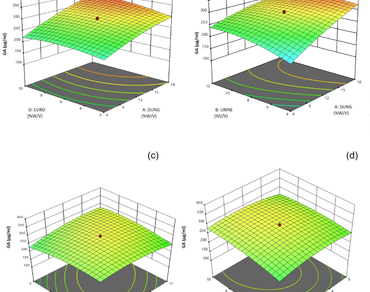
Traditionally, fermented panchagavya is prepared by mixing five cow products namely dung, urine, milk, curd, and ghee for use in agriculture. The most used and reported ratio of dung: urine: milk: curd: ghee is 10.0: 6.0: 4.0: 4.0: 1.0 for panchagavya. To increase the plant growth-promoting activity of panchagavya preparation, central composite design (CCD) was used to optimize four cow products (dung, urine, milk, and curd) keeping ghee constant and quality was measured in terms of gibberellic acid (GA) produced as a response during the fermentation. A total of 30 experimental runs were prepared with different ratios of cow products and incubated at room temperature for 20 days. The quadratic model was found significant and suggested the optimized panchagavya having dung: urine: milk: curd: ghee ratio of 18.0: 7.0: 2.5: 9.0: 1.0. An experimental run for the suggested ratio gave 338.0 µg mL−1 GA which was 1.36 times more GA than the commonly used ratio of five cow products. A 50.0 L fermented panchagavya with optimized ratio was prepared and was tested on groundnut (Arachis hypogaea) in the field. The fermented panchagavya has shown the positive effect on plant growth and increased the plant height, shoot length, root length, and nodule numbers by 1.46 1.41, 3.29, and 3.00 times, respectively than the control. The leaves numbers, width, and length were also increased 1.90, 1.12, and 3.13 times, respectively in the panchagavya treated plants. Field evaluation showed an about fivefold increase in the yield compared to control.
References
Amalraj ELD, Kumar GP, Ahmed SMH, Abdul R, Kishore N (2013) Microbiological analysis of panchagavya, vermicompost, and FYM and their effect on plant growth promotion of pigeon pea (Cajanus cajan L.) in India. Org Agric 3:23–29. https://doi.org/10.1007/s13165-013-0042-2
Argaw A (2017) Organic and inorganic fertilizer application enhances the effect of Bradyrhizobium on nodulation and yield of peanut (Arachis hypogea L.) in nutrient-depleted and sandy soils of Ethiopia. Int J Recycl Org Waste Agric 6:219–231. https://doi.org/10.1007/s40093-017-0169-3
Bonanomi G, De Filippis F, Zotti M, Idbella M, Cesarano G, Al-Rowaily S, Abd-ElGawad A (2020) Repeated applications of organic amendments promote beneficial microbiota, improve soil fertility and increase crop yield. Appl Soil Ecol 156:103714. https://doi.org/10.1016/j.apsoil.2020.103714
Bric JM, Bostock RM, Silverstone SE (1991) Rapid in situ assay for indoleacetic acid production by bacteria immobilized on a nitrocellulose membrane. Appl Environ Microbiol 57:535–538. https://doi.org/10.1128/aem.57.2.535-538.1991
Cappucino JC, Sherman N (1992) Nitrogen cycle. Microbiology: a laboratory manual. Pearson, New Jersey
Chakraborty B, Sarkar I (2019) Quality analysis and characterization of panchagavya, jeevumrutha, and sasyamrutha. Int J Curr Microbiol App Sci 8:2018–2026. https://doi.org/10.20546/ijcmas.2019.805.234
Chen D, Wang X, Zhang W, Zhou Z, Ding C, Liao Y, Li X (2020) Persistent organic fertilization reinforces soil-borne disease suppressiveness of rhizosphere bacterial community. Plant Soil 452:313–328. https://doi.org/10.1007/s11104-020-04576-3
Dima AD, Pârvulescu OC, Mateescu C, Dobre T (2020) Optimization of substrate composition in anaerobic co-digestion of agricultural waste using central composite design. Biomass Bioenergy 138:105602
Gohil R, Patel K, Shah H, Vyas S, Desai M, Rajput K (2020) Isolation and screening of plant growth-promoting bacteria from fermented panchagavya. Biosci Biotechnol Res Commun 13:42–48
Graham HD, Henderson JHM (1961) Reaction of gibberellic acid and gibberellins with Folin-Wu phosphomolybdic acid reagent and its use for quantitative assay. Plant Physiol 36:405. https://doi.org/10.1104/pp.36.4.405
Howitt SM, Udvardi MK (2000) Structure, function, and regulation of ammonium transporters in plants. Biochim Biophys Acta Biomembr 1465:152–170. https://doi.org/10.1016/S0005-2736(00)00136-X
Hussain A, Zahir ZA, Ditta A, Tahir MU, Ahmad M, Mumtaz MZ, Hussain S (2020) Production and implication of bio-activated organic fertilizer enriched with zinc-solubilizing bacteria to boost up maize (Zea mays L.) production and biofortification under two cropping seasons. Agronomy (Basel) 10:39. https://doi.org/10.3390/agronomy10010039
Ijaz M, Perveen S, Nawaz A, Ul-Allah S, Sattar A, Sher A, Rasheed I (2020) Eco-friendly alternatives to synthetic fertilizers for maximizing peanut (Arachis hypogea L.) production under arid regions in Punjab, Pakistan. J Plant Nutr 43:762–772. https://doi.org/10.1080/01904167.2019.1702203
Immanuel R, Rao GS, Perumal MS, Arivukkarasu K, Mullaivendhan V (2021) Nutrient uptake and use efficiency of maize (Zea mays L.) as influenced by microbial seed inoculation, NPK fertilization, and panchagavya foliar application. Plant Arch 21:2041–2045. https://doi.org/10.51470/PLANTARCHIVES.2021.V21.S1.334
Kgasudi BK, Mantswe M (2020) Cow urine: a plant growth enhancer, bio fertilizer, pesticide and antifungal agent. Int J Curr Microbiol Appl Sci 9(2):1294–1298
Malligawad LH (2010) Effect of organics on the productivity of groundnut and its residual effects on succeeding safflower under rainfed farming situations. In: 19th World congress of soil science, Soil solutions for a changing world
Natarajan K (2002) Book on panchagavya – panchagavya manual. Other India Press, Mapusa, Goa, India
Panchal P, Patel PH, Patel AG, Desai A (2017) Effect of panchagavya on growth yield and economics of chickpea (Cicer arietinum). Int J Chem Stud 5:265–267
Patel D, Pardhi D, Rathod T, Solanki A, Raval V, Panchal R, Rajput K (2025a) Unveiling the potential of Bacillus safensis PG-54 isolated from fermented panchagavya on Sorghum bicolor under salinity stress. Discov Plants 2:1–21. https://doi.org/10.1007/s44372-025-00164-w
Patel D, Pardhi D, Rathod T, Solanki A, Raval V, Panchal R, Joshi R, Rajput K (2025b) Mechanistic insights of plant-microbe interactions in mitigation of salinity stress. In: Saraf M, Goswami D, Maheshwari DK (eds) Climate change and soil microorganisms for environmental sustainability. Microorganisms for Sustainability, vol 28. Springer, Singapore. https://doi.org/10.1007/978-981-96-3425-5_12.
Ramakrishnan B, Maddela NR, Venkateswarlu K, Megharaj M (2021) Organic farming: does it contribute to contaminant-free produce and ensure food safety? Sci Total Environ. https://doi.org/10.1016/j.scitotenv.2021.145079
Sreenivasa M, Naik N, Bhat S (2012) Nutrient status and microbial load of different organic liquid manures. Karnataka J Agric Sci 24:583–584
Tekulu K, Taye G, Assefa D (2020) Effect of starter nitrogen and phosphorus fertilizer rates on yield and yield components, grain protein content of groundnut (Arachis hypogaea L.), and residual soil nitrogen content in a semiarid north Ethiopia. Heliyon 6:e05101. https://doi.org/10.1016/j.heliyon.2020.e05101
Ukale DU, Bhagwat RV, Upadhyay S, Cukkemane N, Cukkemane A (2016) Metabolic analysis of liquid formulations of organic manures and its influence on growth and yield of Solanum lycopersicum L. (tomato) crop in field. Biocatal Agric Biotechnol 8:50–54. https://doi.org/10.1016/j.bcab.2016.08.007
Uthirapandi V, Suriya S, Boomibalagan P, Eswaran S, Ramya S, Vijayanand N, Kathiresan D (2018) Organic fertilizing effect of panchagavya on growth and biochemical parameters of holy basil (Ocimum sanctum L.). Int J Curr Microbiol App Sci 7:2637–2644. https://doi.org/10.20546/ijcmas.2018.706.312
Author Information
Department of Microbiology and Biotechnology, School of Sciences, Gujarat University, Ahmedabad, India