Vegetos

(An International Journal of Plant Research & Biotechnology)
(eISSN: 2229-4473)
Zinc-based nutritional antimicrobials as a dual-action strategy against Xanthomonas citri in Citrus limon
*Article not assigned to an issue yet
Research Article | Published: 11 March, 2026
First Page: 0
Last Page: 0
Views: 788
Keywords: n Citrus limonn , Citrus canker, Zinc oxide, n Xanthomonas citrin , Antibacterial efficacy, In-planta assay
Abstract
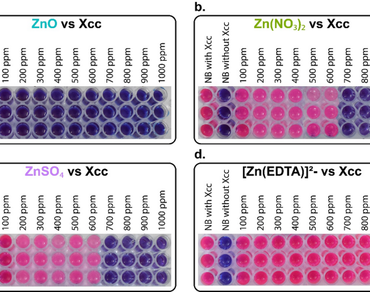
Citrus canker, caused by Xanthomonas citri pv. citri, is a major constraint to citrus production worldwide, including the high-value cultivar Citrus limon (Kaji Nemu) in Assam, India. Conventional management depends largely on copper-based bactericides and antibiotics, which raise concerns regarding environmental contamination and resistance development. This study evaluated the comparative antibacterial efficacy of four zinc-based compounds—zinc oxide, zinc nitrate, zinc sulphate, and zinc EDTA as potential sustainable alternatives. In-vitro assessment using a micro broth dilution assay showed zinc oxide to be the most effective, with a minimum inhibitory concentration of 100 ppm, while zinc nitrate and zinc sulphate were effective at 700 ppm; zinc EDTA showed no inhibition up to 1000 ppm. In-planta evaluation under greenhouse conditions confirmed the superior performance of zinc oxide, which significantly reduced disease incidence, disease severity, and in-planta bacterial colonization. Zinc oxide achieved more than 70% reduction in disease severity and maintained the lowest X. citri pv. citri population. Two-way ANOVA and Tukey’s HSD tests revealed significant effects of treatment, time, and their interaction. The dual role of zinc oxide as a micronutrient and antimicrobial agent highlights its potential as an environmentally compatible component of sustainable citrus canker management, particularly in regions facing copper resistance and ecological concerns.
References
Agrios GN (2005) Plant diseases caused by prokaryotes: bacteria and mollicutes. In: Plant pathology. Elsevier, pp 615–703
Akhtar S, Ahmed R, Begum K et al (2024) Evaluation of morphological traits, biochemical parameters and seeding availability pattern among citrus Limon ‘Assam lemon’ accessions across Assam. Sci Rep 14:3886. https://doi.org/10.1038/s41598-024-54392-3
Ali S, Hameed A, Binyamin R et al (2024) Morphogenetic characterization of Xanthomonas citri pv. citri and its management. J King Saud Univ - Sci 36:103339. https://doi.org/10.1016/j.jksus.2024.103339
Behlau F, Belasque J, Bergamin Filho A et al (2008) Copper sprays and windbreaks for control of citrus canker on young orange trees in Southern Brazil. Crop Prot 27:807–813. https://doi.org/10.1016/j.cropro.2007.11.008
Bhuyan DAP (2024) Survey on different diseases found in citrus Limon (Lemon) of 4 districts of upper Assam, India. Afr J Biomed Res 5476–5481. https://doi.org/10.53555/AJBR.v27i3S.3349
Broadley MR, White PJ, Hammond JP et al (2007) Zinc in plants. New Phytol 173:677–702. https://doi.org/10.1111/j.1469-8137.2007.01996.x
Dimapilis EAS, Hsu C-S, Mendoza RMO, Lu M-C (2018) Zinc oxide nanoparticles for water disinfection. Sustain Environ Res 28:47–56. https://doi.org/10.1016/j.serj.2017.10.001
Hembade VL, Yashveer S, Taunk J et al (2022) Chitosan-salicylic acid and zinc sulphate nano-formulations defend against yellow rust in wheat by activating pathogenesis-related genes and enzymes. Plant Physiol Biochem 192:129–140. https://doi.org/10.1016/j.plaphy.2022.10.002
Kausik S, Nath BC, Bhattacharyya PN et al (2024) Bioprospecting of citrus (Citrus L.) germplasms against citrus canker pathogenesis in Assam, North-East India. Plant Breed 143:457–468. https://doi.org/10.1111/pbr.13176
Lebaka VR, Ravi P, Reddy MC et al (2025) Zinc oxide nanoparticles in modern science and technology: multifunctional roles in Healthcare, environmental Remediation, and industry. Nanomaterials 15:754. https://doi.org/10.3390/nano15100754
Li J, Kolbasov VG, Lee D et al (2021) Residue dynamics of streptomycin in citrus delivered by foliar spray and trunk injection and effect on ‘Candidatus liberibacter asiaticus’ titer. Phytopathology® 111:1095–1103. https://doi.org/10.1094/PHYTO-09-20-0427-R
Manyi-Loh C, Mamphweli S, Meyer E, Okoh A (2018) Antibiotic use in agriculture and its consequential resistance in environmental sources: potential public health implications. Molecules 23:795. https://doi.org/10.3390/molecules23040795
Mendes CR, Dilarri G, Forsan CF et al (2022) Antibacterial action and target mechanisms of zinc oxide nanoparticles against bacterial pathogens. Sci Rep 12:2658. https://doi.org/10.1038/s41598-022-06657-y
Ogunyemi SO, Abdallah Y, Zhang M et al (2019) Green synthesis of zinc oxide nanoparticles using different plant extracts and their antibacterial activity against Xanthomonas oryzae pv. oryzae. Artif Cells Nanomed Biotechnol 47:341–352. https://doi.org/10.1080/21691401.2018.1557671
Rafiq H, Aftab Z-H, Anjum T et al (2022) Bio-fabrication of zinc oxide nanoparticles to rescue mung bean against cercospora leaf spot disease. Front Plant Sci 13:1052984. https://doi.org/10.3389/fpls.2022.1052984
Raghupathi KR, Koodali RT, Manna AC (2011) Size-dependent bacterial growth Inhibition and mechanism of antibacterial activity of zinc oxide nanoparticles. Langmuir 27:4020–4028. https://doi.org/10.1021/la104825u
Reddy KM, Feris K, Bell J et al (2007) Selective toxicity of zinc oxide nanoparticles to prokaryotic and eukaryotic systems. Appl Phys Lett 90:213902. https://doi.org/10.1063/1.2742324
Shahbaz E, Ali M, Shafiq M et al (2022) Citrus canker pathogen, its mechanism of Infection, eradication, and impacts. Plants 12:123. https://doi.org/10.3390/plants12010123
Sharma BD, Hore DK, Gupta SG (2004) Genetic resources of citrus of north-eastern India and their potential use. Genet Resour Crop Evol 51:411–418. https://doi.org/10.1023/B:GRES.0000023456.70577.3d
Sirelkhatim A, Mahmud S, Seeni A et al (2015) Review on zinc oxide nanoparticles: antibacterial activity and toxicity mechanism. Nano Micro Lett 7:219–242. https://doi.org/10.1007/s40820-015-0040-x
Wightwick AM, Salzman SA, Reichman SM et al (2013) Effects of copper fungicide residues on the microbial function of vineyard soils. Environ Sci Pollut Res 20:1574–1585. https://doi.org/10.1007/s11356-012-1114-7
Food and Agriculture Organization of the United Nations. (2020). FAOSTAT statistical database: Crops and livestock products. FAO. https://www.fao.org/faostat/
National Horticulture Board. (2019). Indian horticulture database 2018–19. Ministry of Agriculture & Farmers Welfare, Government of India. https://nhb.gov.in/
Ministry of Agriculture & Farmers Welfare (2021). Agricultural statistics at a glance 2021. Government of India. https://agriwelfare.gov.in/Documents/CWWGDATA/Agricultural_Statistics_at_a_Glance_2021_1.pdf
Author Information
Department of Plant Pathology, Assam Agricultural University, Jorhat, India