Vegetos

(An International Journal of Plant Research & Biotechnology)
(eISSN: 2229-4473)
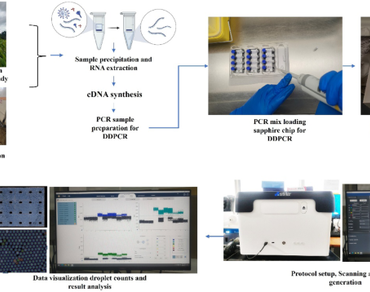
An optimized droplet digital PCR (ddPCR) protocol for gene expression studies in plant system and viral load estimation in waste water system
*Article not assigned to an issue yet
Research Article | Published: 15 June, 2026
First Page: 0
Last Page: 0
Views: 101
Keywords: ddPCR, Method, Gene expression, Plant, Virus
Abstract
Droplet digital PCR (ddPCR) has emerged as a powerful and precise molecular tool for quantifying nucleic acids, offering higher sensitivity and absolute quantification compared to traditional qPCR. This study presents a standardized and optimized droplet PCR protocol designed for two distinct applications: gene expression analysis in plants and viral detection in water systems. For plant-based studies, the protocol ensures accurate quantification of target transcripts, addressing challenges such as low-abundance gene detection and inconclusive variability in expression levels. In water systems, the protocol enables highly sensitive detection of viral pathogens, improving environmental surveillance and risk assessment. Methodological optimizations, including RNA extraction, cDNA synthesis, primer design, and reaction conditions, are detailed to enhance reproducibility and efficiency. The protocol’s robustness was validated through case studies demonstrating its effectiveness across different sample types. This standardized approach provides a reliable framework for researchers conducting gene expression analysis in plants and pathogen monitoring in environmental water samples, contributing to advancements in both agricultural biotechnology and public health.
References
BogožalecKošir A, Muller S, Žel J et al (2023) Fast and accurate multiplex identification and quantification of seven genetically modified soybean lines using six-color digital PCR. Foods 12:4156. https://doi.org/10.3390/foods12224156
Bustin SA, Beaulieu J-F, Huggett J et al (2010) MIQE précis: practical implementation of minimum standard guidelines for fluorescence-based quantitative real-time PCR experiments. BMC Mol Biol 11:74. https://doi.org/10.1186/1471-2199-11-74
Demeke T, Dobnik D (2018) Critical assessment of digital PCR for the detection and quantification of genetically modified organisms. Anal Bioanal Chem 410:4039–4050. https://doi.org/10.1007/s00216-018-1010-1
Deepa K, Sheeja TE, Santhi R et al (2014) A simple and efficient protocol for isolation of high quality functional RNA from different tissues of turmeric (Curcuma longa L.). Physiol Mol Biol Plants 20:263–271
de la Cruz BM, Kneis D, Geissler M et al (2023) Evaluating the sensitivity of droplet digital PCR for the quantification of SARS-CoV-2 in wastewater. Front Public Health 11:1271594. https://doi.org/10.3389/fpubh.2023.1271594
Flood MT, D’Souza N, Rose JB, Aw TG (2021) Methods evaluation for rapid concentration and quantification of SARS-CoV-2 in raw wastewater using droplet digital and quantitative RT-PCR. Food Environ Virol 13:303–315. https://doi.org/10.1007/s12560-021-09488-8
Git A, Dvinge H, Salmon-Divon M et al (2010) Systematic comparison of microarray profiling, real-time PCR, and next-generation sequencing technologies for measuring differential microRNA expression. RNA 16:991–1006. https://doi.org/10.1261/rna.1947110
Gogoi G, Boro RR, Singh SD et al (2025) Post-pandemic surveillance of SARS-CoV-2 in wastewater bodies using integrated molecular analysis. Clean Water 3:100079. https://doi.org/10.1016/j.clwat.2025.100079
Hargadon KM, Goodloe TB III (2025) A highly sensitive tissue-specific qRT-PCR-based assay for detection of melanoma cells in tumor-draining lymph nodes. Curr Protoc 5:e70139. https://doi.org/10.1002/cpz1.70139
Huang Z, Sun H, Wu D et al (2026) Development of a TaqMan probe-based quantitative PCR assay targeting the N gene for detection of Carpione rhabdovirus. J Fish Dis 49(5):e70072. https://doi.org/10.1111/jfd.70072
Kreitmann L, Miglietta L, Xu K et al (2023) Next-generation molecular diagnostics: Leveraging digital technologies to enhance multiplexing in real-time PCR. TrAC Trends Anal Chem 160:116963. https://doi.org/10.1016/j.trac.2023.116963
Kumar K, Muthamilarasan M, Prasad M (2013) Reference genes for quantitative real-time PCR analysis in the model plant foxtail millet (Setariaitalica L.) subjected to abiotic stress conditions. Plant Cell Tissue Organ Cult PCTOC 115:13–22. https://doi.org/10.1007/s11240-013-0335-x
Liu S, Pei P, Li L et al (2022) Mitochondrial DNA copy number in rett syndrome caused by methyl-CpG-binding protein-2 variants. J Pediatr 241:154–161. https://doi.org/10.1016/j.jpeds.2021.09.052
Liu Y, Li J, Guo Z et al (2025) Development and validation of a droplet digital PCR assay for sensitive detection and quantification of Phytophthora nicotianae. Front Plant Sci 16:1573949. https://doi.org/10.3389/fpls.2025.1573949
Livak KJ, Schmittgen TD (2001) Analysis of relative gene expression data using real-time Quantitative PCR and the 2−ΔΔCT method. Methods 25:402–408. https://doi.org/10.1006/meth.2001.1262
Long S, Berkemeier B (2022) Ultrasensitive detection and quantification of viral nucleic acids with Raindance droplet digital PCR (ddPCR). Methods 201:49–64. https://doi.org/10.1016/j.ymeth.2021.04.025
Madic J, Zocevic A, Senlis V et al (2016) Three-color crystal digital PCR. Biomol Detect Quantif 10:34–46. https://doi.org/10.1016/j.bdq.2016.10.002
Malla B, Shrestha S, Haramoto E (2025) Optimization of a 6-plex crystal digital PCR® assay and its application to simultaneous surveillance of enteric and respiratory viruses in wastewater. Sci Total Environ 970:178939. https://doi.org/10.1016/j.scitotenv.2025.178939
Pabinger S, Rödiger S, Kriegner A et al (2014) A survey of tools for the analysis of quantitative PCR (qPCR) data. Biomol Detect Quantif 1:23–33. https://doi.org/10.1016/j.bdq.2014.08.002
Santhoshkumar R, Yusuf A (2021) Comparative differential expression of CURS genes and determination of curcumin content at different growth stages of Curcuma longa L. and its wild relative C. zanthorrhiza Roxb. Genet Resour Crop Evol 68:105–116. https://doi.org/10.1007/s10722-020-00970-z
Sasi S, Krishnan S, Kodackattumannil P et al (2023) DNA-free high-quality RNA extraction from 39 difficult-to-extract plant species (representing seasonal tissues and tissue types) of 32 families, and its validation for downstream molecular applications. Plant Methods 19:84. https://doi.org/10.1186/s13007-023-01063-5
Shi K, Chen Y, Yin Y et al (2022) a multiplex crystal digital PCR for detection of African swine fever virus, classical swine fever virus, and porcine reproductive and respiratory syndrome virus. Front Vet Sci 9:926881. https://doi.org/10.3389/fvets.2022.926881
Shrestha S, Malla B (1987) Haramoto E (2025) 6-plex crystal digital PCR® for comprehensive surveillance of respiratory and foodborne bacterial pathogens in wastewater. Environ Pollut Barking Essex 375:126298. https://doi.org/10.1016/j.envpol.2025.126298
Skrypina NA, Timofeeva AV, Khaspekov GL et al (2003) Total RNA suitable for molecular biology analysis. J Biotechnol 105:1–9. https://doi.org/10.1016/S0168-1656(03)00140-8
Tan LL, Loganathan N, Agarwalla S et al (2023) Current commercial dPCR platforms: technology and market review. Crit Rev Biotechnol 43:433–464. https://doi.org/10.1080/07388551.2022.2037503
The dMIQE Group, Huggett JF (2020) The digital MIQE guidelines update: minimum information for publication of quantitative digital PCR experiments for 2020. Clin Chem 66:1012–1029. https://doi.org/10.1093/clinchem/hvaa125
Zmienko A, Samelak-Czajka A, Goralski M et al (2015) Selection of reference genes for qPCR- and ddPCR-based analyses of gene expression in senescing barley leaves. PLoS ONE 10:e0118226. https://doi.org/10.1371/journal.pone.0118226
Author Information
Biological Sciences and Technology Division, Centre for Infectious Diseases, CSIR-North East Institute of Science and Technology, Jorhat, India