Vegetos

(An International Journal of Plant Research & Biotechnology)
(eISSN: 2229-4473)
Role of small-scale forestry in biodiversity conservation and carbon stock: A case study from Central Nepal Himalaya
*Article not assigned to an issue yet
Lohani Anusha, Khadka Sumina, Bhatta Suresh Prashad, Khanal Niraj, Sharma Krishna Prasad
Research Articles | Published: 17 June, 2026
First Page: 0
Last Page: 0
Views: 66
Keywords: Community forest, Diversity indices, Forest regeneration, Soil carbon
Abstract
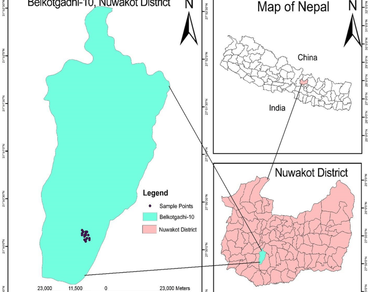
Forest vegetation is important for maintaining a healthy ecosystem. In Nepal, small-scale community managed forestry is considered as highly successful program in biodiversity conservation and carbon capture. This study assessed sub-tropical mixed community managed forest of Nuwakot district of central Nepal focusing on forest structure and carbon stock potential. Using stratified sampling, 30 plots (10 m × 10 m) were established, with nested sub-plots for vegetation data collection: 10 m × 10 m for adults, 5 m × 5 m for saplings, and 1 m × 1 m for seedlings. Our findings revealed 19 tree species under 16 families, with Castanopsis indica (IVI, 90.7) and Schima wallichii (IVI, 82.3) dominating the forest. High species diversity was observed as indicated by Shannon’s index (3.35) and Simpson’s index (0.03) though species evenness was low (0.18). Regeneration was good with 89.1% seedling, 6.4% sapling and 4.6% adults and a reverse J-shaped density-diameter curve. Forest recorded 112.6 ton/ha carbon with highest in S. wallichii (38.6 ton/ha) and C. indica (37.1 ton/ha). The soil in the study forest was black, with high humus content, containing 2.5% carbon and a pH of 5.26. This study therefore suggests that the mid-hill community forests of Nepal have good potential for biodiversity conservation and climate mitigation through carbon sequestration.
References
Acharya R, Shrestha BB (2011) Vegetation structure, natural regeneration and management of Parroha community forest in Rupandehi district. Nepal Sci World 9(9):70–81. https://doi.org/10.3126/sw.v9i9.5523
Acharya S, Joshi R, Maraseni TN, Bhattarai P (2025) Unraveling elevation-driven variations in forest structure and composition in Western Nepal. Diversity 17(8):588. https://doi.org/10.3390/d17080588
Aryal S, Bhattarai DR, Devkota RP (2013) Comparison of carbon stocks between mixed and pine-dominated forest stands within the Gwalinidaha Community Forest in Lalitpur District, Nepal. Small-scale For 12(4):659–666. https://doi.org/10.1007/s11842-013-9236-4
Ayer S, Prabhakar A, Adhikari K, Poudel S, Basnet S, Singh A (2024) How do regeneration status,vegetation diversity, stand structure, and carbon stock vary across ecological regions of Nepal. Eur J Ecol 10(1):37–48. https://doi.org/10.17161/eurojecol.v10i1.19587
Begum F, Bajracharya RM, Sharma S, Situala BK (2009) Land use effects on soil quality indicators in the mid-hills of Central Nepal. In: International Conference on Emerging Technologies in Environmental Science and Engineering. Aligarh Muslim University, Aligarh, India (pp. 488–495)
Bhandari SK, Maraseni T, Timilsina YP, Parajuli R (2021) Species composition, diversity, and carbon stock in trees outside forests in middle hills of Nepal. Policy Econ 125:102402. https://doi.org/10.1016/j.forpol.2021.102402
Bhatta KP, Aryal A, Baral H, Khanal S, Acharya AK, Phomphakdy C, Dorji R (2021) Forest structure and composition under contrasting precipitation regimes in the high mountains, Western Nepal. Sustainability 13(13):7510. https://doi.org/10.3390/su13137510
Bhatta SP, Sharma KP, Balami S (2018) Variation in carbon storage among tree species in the planted forest of Kathmandu, Central Nepal. Curr Sci 115(2):274–282. https://doi.org/10.18520/cs/v115/i2/274-282
Bhatta SP, Devkota A (2020a) Carbon stock in the community managed sal (Shorea robusta) forests of Dadeldhura district, Western Nepal. South For 82(1):47–55. https://doi.org/10.2989/20702620.2019.1686690
Bhatta SP, Devkota A (2020b) Community structure and regeneration status of Sal (Shorea robusta Gaertn.) forests of Dadeldhura district, Western Nepal. Community Ecol 21(2):191–201. https://doi.org/10.1007/s42974-020-00021-8
Chaudhary S, Aryal B (2025) Diversity and distribution of tree species with respect to edaphic and physical factors in Shorea robusta Gaertn. forests along the altitudinal gradient. Vegetos 38(2):813–824. https://doi.org/10.1007/s42535-024-00854-y
Chazdon RL, Guariguata MR (2016) Natural regeneration as a tool for large-scale forest restoration in the tropics: prospects and challenges. Biotropica 48(6):716–730. https://doi.org/10.1111/btp.12381
Chave J, Andalo C, Brown S, Cairns MA, Chambers JQ, Eamus D, Yamakura T (2005) Tree allometry and improved estimation of carbon stocks and balance in tropical forests. Oecologia 145(1):87–99. https://doi.org/10.1007/s00442-005-0100-x
Dhakal S, Mohanty A, Rijal KP (2021) Assessment of carbon sequestration and tree diversity in Gokarna forest, Kathmandu, Nepal. Sustainable Climate Action and Water Management. Springer Singapore, Singapore, pp 167–180
Dhakal TM, Thapa LB, Yadav RKP, Pokhrel CP (2023) Plant communities in Shivapuri-Nagarjun National Park, Central Nepal. Banko Janakari 33(2):11–23. https://doi.org/10.3126/banko.v33i2.55086
Department of Hydrology and Meterology [DHM] (2022) Annual and monthly report of temperature and precipitation of Kakani weather station of Nuwakot, Babar Mahal, Kathmandu, Nepal (1990–2022)
Ghimire P (2021) Carbon storage dynamics of different forest types in central, Nepal. Indian J Ecol 48(1):196–203
Jnawali N, Ghimire S, Panta M, Bhujel P (2025) Assessing the effect of aspect on carbon stock and biodiversity in community forests of Kavrepalanchok and Kathmandu, Nepal. Sci Rep Life Sci 6(2):9–25. https://doi.org/10.5281/zenodo.15658952
Joshi G, Sharma KP, Chettri MK (2021) Vegetation structure and carbon stock of two community managed Shorea robusta forests of Dhangadhi, Nepal. Amrit Res J 2(1):11–18
Karna S, Jayakumar S (2026) Differential impact of fire on tree diversity, composition, structure and carbon stock in tropical savanna. Next Sustain 7:100229. https://doi.org/10.1016/j.nxsust.2025.100229
Khaine I, Woo SY, Kwak MJ, Lee SH, Je SM, You H, Kim J (2018) Factors affecting natural regeneration of tropical forests across a precipitation gradient in Myanmar. Forests 9(143):1–17. https://doi.org/10.3390/f9030143
Khumbongmayum AD, Khan ML, Tripathi RS (2005) Survival and growth of seedlings of a few tree species in the four sacred groves of Manipur, Northeast India. Curr Sci 88(11):1781–1788
Lamsal P, Aryal KR, Adhikari H, Paudel G, Maharjan SK, Khatri DJ, Sharma RP (2023) Effects of forest management approach on carbon stock and plant diversity: A case study from Karnali Province. Nepal Land 12(6):1233. https://doi.org/10.3390/land12061233
Liu HD, Chen Q, Chen YF, Xu Z, Dai Y, Liu H (2020) Effects of biotic/abiotic factors on the seedling regeneration of Dacrydium pectinatum formation in tropical montane forests of Hainan Island, China. Glob Ecol Conserv 24:e01370. https://doi.org/10.1016/j.gecco.2020.e01370
Luyssaert S, Schulze ED, Börner A, Knohl A, Hessenmöller D, Law BE, Grace J (2008) Old-growth forests as global carbon sinks. Nature 455(7210):213–215. https://doi.org/10.1038/nature07276
MacDicken KG (1997) A guide to monitoring carbon storage in forestry and agroforestry projects. Winrock International Institute for Agricultural Development
Mandal RA, Jha PK, Dutta IC, Thapa U, Karmacharya SB (2016) Carbon sequestration in tropical and subtropical plant species in collaborative and community forests of Nepal. Adv Ecol 2016(1):1529703. https://doi.org/10.1155/2016/1529703
Marks CO, Muller-Landau HC, Tilman D (2016) Tree diversity, tree height and environmental harshness in eastern and western North America. Ecol Lett 19(7):743–751. https://doi.org/10.1111/ele.12608
Mensah S, Noulekoun F, Salako VK, Dimobe K, Sheppard J, Assogbadjo A, Kakai RG, Seifert T (2025) Legacy effects of fire on tree diversity, structure and aboveground carbon in tropical semi-arid naturally assembled communities. Ecol Inf 92:103487. https://doi.org/10.1016/j.ecoinf.2025.103487
Nair R, Mohan Kumar B, Nair VD (2009) Agroforestry as a strategy for carbon sequestration. J Plant Nutr Soil Sci 172(1):10–23. https://doi.org/10.1002/jpln.200800030
Nepali BR, Skartveit J, Baniya CB (2021) Impacts of slope aspects on altitudinal species richness and species composition of Narapani-Masina landscape, Arghakhanchi, West Nepal. J Asia-Pac Biodivers 14(3):415–424. https://doi.org/10.1016/j.japb.2021.04.005
Nolan KA, Callahan JE (2006) Beachcomber biology: The Shannon-Weiner species diversity index. In: Proceedings of the Workshop/Conference of the Association for Biology Laboratory Education (ABLE) 27:334–338
Pan Y, Birdsey RA, Fang J, Houghton R, Kauppi PE, Hayes D (2023) A large and persistent carbon sink in the world’s forests. Science 333(6045):988–993. https://doi.org/10.1126/science.1201609
Pan Y, Birdsey RA, Phillips OL, Houghton RA, Fang J, Kauppi PE, Murdiyarso D (2024) The enduring world forest carbon sink. Nature 631(8021):563–569. https://doi.org/10.1038/s41586-024-07602-x
Pandey HP, Bhusal M (2016) A comparative study on carbon stock in Sal (Shorea robusta) forest in two different ecological regions of Nepal. Banko Janakari 26(1):24–31. https://doi.org/10.3126/banko.v26i1.15498
Pandey R, Bargali SS, Bargali K (2023) Tree biomass and carbon stock in subtropical Sal forest of Central Himalaya, India. Vegetos 36(4):1154–1164. https://doi.org/10.1007/s42535-022-00503-2
Pandey HP, Maren IE, Dutta IC (2012) REDD + in community forests, western Nepal: A case from Gorkha district. Central Himalaya. LAP LAMBERT Academic Publishing GmbH & Co, Saarbrucken
Pandey SS (2007) Tree species diversity in existing community-based forest management systems in central mid-hills of Nepal. Uppsala, Sweden: Swedish Biodiversity Centre. Swedish University of Agricultural Sciences
Pati PK, Kaushik P, Malasiya D, Khan ML, Khare PK (2025) Impact of fire frequencies on biomass and carbon storage in tropical moist deciduous forest community of Bandhavgarh tiger reserve, central India. Discov For 1:3. https://doi.org/10.1007/s44415-025-00003-6
Poudel A, Sasaki N, Abe I (2020) Assessment of carbon stocks in oak forests along the altitudinal gradient: A case study in the Panchase Conservation Area in Nepal. Glob Ecol Conserv 23:e01171. https://doi.org/10.1016/j.gecco.2020.e01171
Poudel TR, Aryal PC, Khan MT, Roberts NJ, Poudel M, Shrestha DP (2025) Forest structure, diversity, and regeneration in a community-managed forest of Nepal: A model for carbon sequestration and sustainable management. Plant-Environ Interact 6:e70044. https://doi.org/10.1002/pei3.70044
Pratt RB, Jacobsen AL, Hernandez J, Ewers FW, North GB, Davis SD (2012) Allocation tradeoffs among chaparral shrub seedlings with different life history types (Rhamnaceae). Am J Bot 99(9):1464–1476. https://doi.org/10.3732/ajb.1200193
Press JR, Shrestha KK, Sutton DA (2000) Annotated checklist of the flowering plants of Nepal (pp. x+-430)
R Core Team (2024) R: A language and environment for statistical computing. R Foundation for Statistical Computing. https://www.r-project.org/
Rawat DS, Dash SS, Sinha BK, Kumar V, Banerjee A, Singh P (2018) Community structure and regeneration status of tree species in Eastern Himalaya: A case study from Neora Valley National Park, West Bengal, India. Taiwania 63(1). https://doi.org/10.6165/tai.2018.63.16
Rodrigues PMS, Schaefer CEGR, Silva JDO, Junior WGF, Santos RMD, Neri AV (2018) The influence of soil on vegetation structure and plant diversity in different tropical savannic and forest habitats. J Plant Ecol 11:226–236. https://doi.org/10.1093/jpe/rtw13
Sarkar M, Devi A (2014) Assessment of diversity, population structure and regeneration status of tree species in Hollongapar Gibbon Wildlife Sanctuary, Assam, Northeast India. Trop Plant Res 1(2):26–36
Sharma KP, Bhatta SP, Lamsal SK (2020a) Species diversity and regeneration status of community-managed hill sal (Shorea robusta) forest in Central Nepal. Curr Sci 119(1):83–92. https://doi.org/10.18520/cs/v119/i1/83-92
Sharma KP, Bhatta SP, Khatri GB, Pajiyar A, Joshi DK (2020b) Estimation of carbon stock in the chir pine (Pinus roxburghii Sarg.) plantation forest of Kathmandu valley, Central Nepal. J Environ Sci 36(1):37–46. https://doi.org/10.7747/JFES.2020.36.1.37
Sharma RP, Gupta MK (2015) Soil fertility status and soil quality index in Tibrekot community forest, western Nepal. Indian J For 38(3):201–208. https://doi.org/10.18488/journal.ijfs/2015.38.3/ijfs.38.3.201.208
Shrestha O, Magar LK (2024) Assessment of carbon stock in community forest (A case study from Barahi community forest). J Sustain Environ Manag 3(4):209–213. https://doi.org/10.3126/josem.v3i4.86532
Simpson EH (1949) Measurement of diversity. Nature 163(4148):688–688. https://doi.org/10.1038/163688a0
Singh SL, Sahoo UK (2021) Tree species composition, diversity and soil organic carbon stock in homegardens and shifting cultivation fallows of Mizoram, Northeast India. Vegetos 34(1):220–228. https://doi.org/10.1007/s42535-021-00194-1
Singh S, Malik ZA, Sharma CM (2016) Tree species richness, diversity, and regeneration status in different oak (Quercus spp.) dominated forests of Garhwal Himalaya, India. J Asia-Pac Biodivers 9:293–300. https://doi.org/10.1016/j.japb.2016.06.002
Slik JF, Paoli G, McGuire K, Amaral I, Barroso J, Bastian M, Zweifel N (2013) Large trees drive forest aboveground biomass variation in moist lowland forests across the tropics. Glob Ecol Biogeogr 22(12):1261–1271. https://doi.org/10.1111/geb.12092
Stephenson NL, Das A, Condit R, Russo SE, Baker PJ, Zavala MA (2014) Rate of tree carbon accumulation increases continuously with tree size. Nature 507(7490):90–93. https://doi.org/10.1038/nature12914
Thapa Y, Sharma KP (2023) Tree diversity and regeneration of a mid-hill community managed mixed-forest of Sindhupalchowk, Nepal. Himal Biodivers 9:1–11. https://doi.org/10.3126/hebids.V9i1.59576
Walkley A, Black IA (1934) An examination of the Degtjareff method for determining soil organic matter, and a proposed modification of the chromic acid titration method. Soil Sci 37(1):29–38. https://doi.org/10.1097/00010694-193401000-00003
Wentworth TR, Peet RK, Lee MT, Roberts SD (2008) Woody plant inventories, CVS-EEP Protocol. Carolina Vegetation Survey, Version 4(4). Retrieved from https://cvs.bio.unc.edu/protocol/woodystems.pdf
Weaver W (1963) The mathematical theory of communication. University of Illinois Press
Yadav BK, Bhatta KP, Ayer S, Basnet P, Dhakal N, Sharma S, Kadariya R, Bhandari SK (2025) Elevation shapes tree composition, structure and diversity more than soil properties in the Annapurna Conservation Area, Nepal. Tree People 20:100902. https://doi.org/10.1016/j.tfp.2025.100902
Zanne AE, Lopez-Gonzalez G, Coomes DA, Ilic J, Jansen S, Chave J (2009) Global wood density database. Dryad. https://doi.org/10.5061/dryad.234
Author Information
Department of Botany, Tribhuvan University, Kathmandu, Nepal