Vegetos

(An International Journal of Plant Research & Biotechnology)
(eISSN: 2229-4473)
Bioactivity of Valeriana, Passiflora, and Lavandula against insects: an integrative review with lexicometric analysis
*Article not assigned to an issue yet
da Silva Cicera Simoni, Moreira Maria Rosilene Cândido, Leite Laura Hévila Inocêncio, Cândido Estelita Lima
Review Articles | Published: 11 July, 2026
First Page: 0
Last Page: 0
Views: 64
Keywords: Chemical insecticides, Biopesticides, Disease vectors, n Lavandulan
Abstract
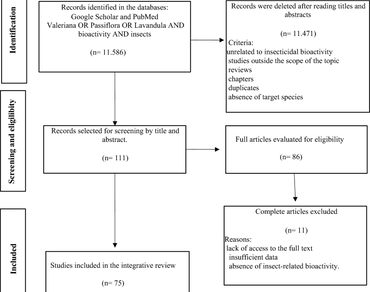
The widespread use of chemical insecticides has been raising environmental and health concerns, leading to a search for sustainable alternatives. This study researched the bioactivity of Valeriana, Passiflora, and Lavandula species on insects, with the aim of evaluating their potential as natural insecticides. The study consisted of six stages, including an integrative literature review, data collection and critical analysis, and discussion and synthesis of the results. The search was conducted in Google Scholar and PubMed (2012–2024) using the PICo strategy and the search terms “Valeriana OR Passiflora OR Lavandula AND bioactivity AND insects”, covering publications in Portuguese, English, and Spanish. The conclusions of the selected articles were analyzed using the IRaMuTeQ software via Similarity Analysis (SA), Descending Hierarchical Clustering (DHC), and Word Cloud (WC). The corpus contained 35,320,158 occurrences, with 201 segments classified into 253 (79.85%), resulting in three distinct classes identified by DHC. Class 3 (44.78%) grouped terms related to “synthetic pesticides”, while classes 1 (29.9%) and 2 (25.37%) comprised words associated with the bioactivity of natural products. The similarity analysis revealed «lavandula» and «study» as the most central terms, strongly linked to «species», «linalool», «thymol», «mosquito», and «larva», indicating a prevalence of studies focused on the Lavandula species and their volatile compounds in biological control. «Valeriana» and «Passiflora» emerged as linked to «mechanism» and «efficacy», highlighting their complementary potential as botanical agents for sustainable pest management.
References
Abdelgaleil SAM, Abd El-Ghany NM, Abdel-Rahman H, Mohamed MI, El-Aswad AF (2024) Monoterpenes: chemistry, insecticidal activity against stored product insects and modes of action—a review. Int J Pest Manag 70(3):267–289. https://doi.org/10.1080/09670874.2023.2181778
Ahmed S, Zia A, Mehmood SA, Panhwar WA, Khan W, Shah M, Ullah I (2020) Change in malate dehydrogenase and alpha amylase activities in Rubus fruticosus and Valeriana jatamansi treated granary weevil, Sitophilus granarius. Braz J Biol 81:387–391. https://doi.org/10.1590/1519-6984.226952
Al-Harbi P, Al Attar N, Hikal D, Mohamed Khedr S, Hamed A, Abdel Latef A, Ibrahim A, Abdein M (2021) Evaluation of insecticidal effects of plant essential oils extracted from basil, black seeds and lavender against Sitophilus oryzae. Plants 10:50829. https://doi.org/10.3390/plants10050829
Al-Sarar AS, Al-Shehry HA, Al-Dhafery N, Shaalan EAS (2014) Fumigant toxicity and antiacetylcholinesterase activity of Saudi Mentha longifolia and Lavandula dentata species against Callosobruchus maculatus (F.) (Coleoptera: Bruchidae). Turk J Entomol 38:11–18
Baranitharan M (2021) Phytochemical compounds of Lavandula angustifolia essential oil as potential mosquito repellent agents. Int J Atmospheric Oceanic Sci 5(1):6–12. https://doi.org/10.11648/j.ijaos.20210501.12
Bedair H, Rady HA, Hussien AM et al (2022) Detection of pesticides in vegetables using enzyme inhibition methods: a comprehensive review. Food Anal Methods 15:1979–2000. https://doi.org/10.1007/s12161-022-02254-x
Blore K, Benelli G, Govindarajan M, Alharbi NS, Kadaikunnan S, Khaled JM, Maggi F (2022) Efficacy of metallic nanoparticles as a control tool against adult mosquito vectors: a review. Front Trop Dis 3:969299. https://doi.org/10.3389/fitd.2022.969299
Casas JL et al (2023) Essential oils from selected Mediterranean aromatic plants—characterization and biological activity as aphid biopesticides. Life 13(8):1621. https://doi.org/10.3390/life13081621
Çelik C, Kirmizibekmez H (2025) The genus Valeriana L.: ethnopharmacology, phytochemistry and biological activities—an updated review. Phytochem Rev 24(5):3337–3441. https://doi.org/10.1007/s11101-024-10061-x
Chen HW et al (2016) Sesquiterpenes and a monoterpenoid with acetylcholinesterase inhibitory activity from Valeriana officinalis var. latiofolia in vitro and in vivo. Fitoterapia 110:142–149. https://doi.org/10.1016/j.fitote.2016.03.003
Damalas CA, Koutroubas SD (2020) Botanical pesticides for eco-friendly pest management: drawbacks and limitations. Pest Manag Sci 76(1):1–9. https://doi.org/10.1002/ps.5656
Dua VK, Alam MF, Pandey AC, Rai S, Chopra AK, Kaul VK, Dash AP (2008) Insecticidal activity of Valeriana jatamansi (Valerianaceae) against mosquitoes. J Am Mosq Control Assoc 24(2):315–318. https://doi.org/10.2987/5642.1
El-Bakry AM et al (2016) Insecticidal activity of natural plant essential oils against some stored product insects and their side effects on wheat seed germination. Egypt J Biol Pest Control 26(1):83
Ercole FF, Melo LS, Alcoforado CLGC (2014) Revisão integrativa versus revisão sistemática. REME Rev Min Enferm. https://doi.org/10.35699/2316-9389.2014.50174
Fadia AY, Al-Naser Z, Al-Hakim W (2015) Chemical composition of essential oils of Lavandula angustifolia Miller and Rosmarinus officinalis L. and fumigant toxicity against larvae of Ephestia kuehniella Zeller. Int J Chem Technol Res 8:1382–1390
Faraone N, Hillier NK, Cutler GC (2015) Plant essential oils synergize and antagonize the toxicity of different conventional insecticides against Myzus persicae (Hemiptera: Aphididae). PLoS ONE 10(5):e0127774. https://doi.org/10.1371/journal.pone.0127774
Feng YX, Wang Y, Chen ZY, Guo SS, You CX, Du SS (2019) Efficacy of bornyl acetate and camphene from Valeriana officinalis essential oil against two storage insects. Environ Sci Pollut Res 26:16157–16165. https://doi.org/10.1007/s11356-019-05035-y
Finetti L, Gendusa M, Campolo O, Giunti G, Laudani F, Palmeri V, Ricupero M, Desneux N, Tirillini B, Gallina Toschi T, Ruiu L, Vanin S (2021) Monoterpenes alter TAR1-driven physiology in Drosophila species. J Exp Biol 224(1):232116. https://doi.org/10.1242/jeb.232116
Gaire S, Scharf ME, Gondhalekar AD (2019) Toxicity and neurophysiological impacts of plant essential oil components on bed bugs (Cimicidae: Hemiptera). Sci Rep 9:3961. https://doi.org/10.1038/s41598-019-40447-5
Germinara GS (2017) Bioactivities of Lavandula angustifolia essential oil against stored-grain pest Sitophilus granarius. Insects Bull 70(1):129–138
Ghalbane I, Alahyane H, Aboussaid H, Chouikh N, Costa J, Romane A, El Messoussi S (2022) Chemical composition and insecticidal properties of Moroccan Lavandula dentata and Lavandula stoechas essential oils against Ceratitis capitata. Neotrop Entomol 51:628–636. https://doi.org/10.1007/s13744-022-00975-6
Gupta A, Sharma S, Naik SN, Sharma RK (2023) Plant essential oils as sustainable biopesticides: challenges, formulation strategies and commercialization prospects. Ind Crops Prod 198:116686. https://doi.org/10.1016/j.indcrop.2023.116686
Liu XC, Zhou L, Liu ZL (2013) Identification of insecticidal constituents of Valeriana jatamansi Jones essential oil against Liposcelis bostrychophila Badonnel. J Chem 2013:853912
Loganathan S et al (2022) Biological synthesis and characterization of Passiflora subpeltata Ortega aqueous leaf extract in silver nanoparticles and their evaluation of antibacterial, antioxidant, anti-cancer and larvicidal activities. J King Saud Univ Sci 34(3):101846. https://doi.org/10.1016/j.jksus.2022.101846
López MD, Cantó-Tejero M, Pascual-Villalobos MJ (2021) Biological activities of essential oils and their applications in sustainable agriculture. Agronomy 11(1):92. https://doi.org/10.3390/agronomy11010092
Moshrefi Zenoozi Z, Soltaninezhad B, Hashemi M, Noori SMA (2022) A review of effective essential oils and their biologically active compounds to protect the safety of food stored against insect pests. J Essent Oil Res 34:111–122. https://doi.org/10.1080/10412905.2022.2032420
Nikolova K et al (2024) Chemical compositions, pharmacological properties and medicinal effects of genus Passiflora L.: a review. Plants 13(2):228. https://doi.org/10.3390/plants13020228
Oliveira JAC, Silva JM, Araújo AM et al (2024) Effects of essential oils on biological traits and potential molecular targets in Spodoptera frugiperda. Plants 13(13):1801. https://doi.org/10.3390/plants13131801
Pang YP, Singh SK, Gao Y, Lassiter TL, Mishra RK, Zhu KY, Brimijoin S (2012) Novel and viable acetylcholinesterase target site for developing effective and environmentally safe insecticides. Curr Drug Targets 13(4):471–482. https://doi.org/10.2174/138945012799499785
Price KL, Lummis SCR (2022) Characterisation of the effects of thymol on RDL receptors from the honey bee parasite Varroa destructor. Pestic Biochem Physiol 183:105064. https://doi.org/10.1016/j.pestbp.2022.105064
Saad MG, Abou-Taleb HK, Abdelgaleil SAM (2018) Insecticidal activities of monoterpenes and phenylpropenes against Sitophilus oryzae and their inhibitory effects on acetylcholinesterase and adenosine triphosphatases. Entomol Exp Appl 53(2):173–181. https://doi.org/10.1007/s13355-017-0532-x
Sales HJSP (2015) Lavandula L. - application of in vitro culture to the production of essential oils and its economic potential in Portugal. Rev Bras Plantas Med 17:992–999. https://doi.org/10.1590/1983-084X/14_101
Sayada N, Tine S, Soltani N (2021) Toxicity and physiological effects of Lavandula angustifolia essential oil against adults of Rhyzopertha dominica (F.) (Coleoptera: Bostrichidae). https://doi.org/10.1007/978-3-030-51210-1_238
Senthil-Nathan S (2020) A review of resistance mechanisms of synthetic insecticides and botanicals, phytochemicals, and essential oils as alternative larvicidal agents against mosquitoes. Front Physiol. https://doi.org/10.3389/fphys.2019.01591
Sen-Utsukarci B et al (2019) Chemical composition and antioxidant, cytotoxic and insecticidal potential of Valeriana alliariifolia in Turkey. Arch Ind Hyg Toxicol. https://doi.org/10.2478/aiht-2019-70-3273
Silvério MRS, Espindola LS, Lopes NP, Vieira PC (2020) Natural plant products for the control of Aedes aegypti: the main vector of important arboviruses. Molecules 25(15):3484. https://doi.org/10.3390/molecules25153484
Sittichok S, Chantawee A, Soonwera M (2018a) Efficacy of Thai herbal shampoos from Averrhoa carambola L., Hibiscus sabdariffa L. and Passiflora edulis Sims. for controlling head lice (Pediculus humanus capitis). Int J Agric Technol 14(5):751–766
Stoechas L (2016) Chemical constituents and larvicidal activity of Lavandula stoechas (Lamiaceae) essential oil from Morocco against Anopheles labranchiae.
Thompson GD, Dutton R, Sparks TC (2000) Spinosad – a case study: an example from a natural products discovery programme. Pest Manag Sci 56:696–702
Tong F, Coats JR (2010) Effects of monoterpenoid insecticides on [3H]-TBOB binding in house fly GABA receptor and 3⁶Cl⁻ uptake in American cockroach ventral nerve cord. Pestic Biochem Physiol 98(3):317–324. https://doi.org/10.1016/j.pestbp.2010.07.003
Author Information
Federal University of Cariri - UFCA, Crato, Brazil