Vegetos

(An International Journal of Plant Research & Biotechnology)
(eISSN: 2229-4473)
Characterization of Indian lotus (Nelumbo nucifera Gaertn.) accessions reveals valuable genetic resources for ornamental breeding
*Article not assigned to an issue yet
Research Articles | Published: 26 September, 2026
First Page: 0
Last Page: 0
Views: 93
Keywords: n Nelumbo nuciferan , Germplasm characterization, Genetic diversity, Ornamental breeding
Abstract
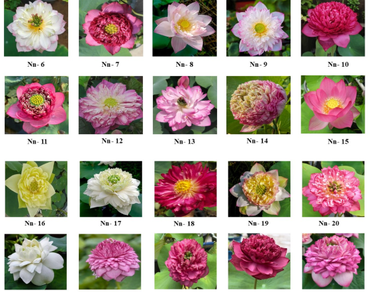
Lotus (Nelumbo nucifera Gaertn.), belonging to the family Nelumbonaceae, is an economically and culturally important aquatic ornamental crop; however, systematic phenotypic characterization of Indian lotus germplasm remains comparatively limited. This study evaluated 30 N. nucifera accessions for 24 vegetative, floral, and reproductive traits at the TNAU Botanical Garden, Coimbatore, during 2024, using a Completely Randomized Design with three replications. Significant genotypic variation (P ? 0.05) was observed for all evaluated traits studied. Days to flower bud emergence ranged from 33.22 to 83.10 days, while flower bud production varied from 3.94 to 18.66 buds. Flower diameter ranged from 9.20 to 17.15 cm, petal number from 20.50 to 1008.00, flower longevity from 2.94 to 5.87 days, rhizome production from 3.00 to 7.50, and seed capsule formation from 0.00 to 13.50. Flower longevity showed an inverse association with flowering earliness, with early-flowering accessions generally exhibiting shorter flower longevity, whereas Nn-22, the latest-flowering accession, recorded the longest longevity. Nn-22 also exhibited large leaf area, vigorous vegetative growth, high petal number, large bud circumference, and extended flower longevity. Nn-23 combined high bud weight with large flower size, while Nn-9, Nn-10, and Nn-11 displayed favourable combinations of vegetative vigour and floral traits. Nn-2 and Nn-6 were characterized by early flowering and high bud production, whereas Nn-30 combined earliness with high rhizome production. These contrasting trait combinations identify accessions with complementary breeding value for vigorous plant architecture, abundant and long-lasting flowers, larger blooms, and rapid propagation, providing a quantitative foundation for the targeted utilization of Indian lotus germplasm in ornamental breeding.
References
Abd Rasid NS, Naim MN, Che Man H, Abu Bakar NF, Mokhtar MN (2019) Evaluation of surface water treated with lotus plant; Nelumbo nucifera. J Environ Chem Eng 7(3):103048. https://doi.org/10.1016/j.jece.2019.103048
Chen Y, Zhou R, Lin X, Wu K, Qian X, Huang S (2008) ISSR analysis of genetic diversity in sacred lotus cultivars. Aquat Bot 89(3):311–316. https://doi.org/10.1016/j.aquabot.2008.03.006
Chen H, Li J, Yao R, Yan S, Wang Q (2020) Mechanism of lipid metabolism regulation by soluble dietary fibre from micronized and non-micronized powders of lotus root nodes as revealed by their adsorption and activity inhibition of pancreatic lipase. Food Chem 305:125435. https://doi.org/10.1016/j.foodchem.2019.125435
Fu Y, Liu F, Li S, Tian D, Dong L, Chen Y, Su Y (2021) Genetic diversity of the wild Asian lotus (Nelumbo nucifera) from Northern China. Hortic Plant J 7(5):488–500. https://doi.org/10.1016/j.hpj.2021.04.005
Goel A, Sharma S, Sharga A (2001) The conservation of the diversity of Nelumbo (lotus) at the National Botanical Research Institute, Lucknow. India Botanic Gardens Conservation News 3(6):52–54
Guo HB (2009) Cultivation of lotus (Nelumbo nucifera Gaertn. ssp. nucifera) and its utilization in China. Genet Resour Crop Evol 56(3):323–330. https://doi.org/10.1007/s10722-008-9366-2
Hu J, Pan L, Liu H, Wang S, Wu Z, Ke W, Ding Y (2012) Comparative analysis of genetic diversity in sacred lotus (Nelumbo nucifera Gaertn.) using AFLP and SSR markers. Mol Biol Rep 39(4):3637–3647. https://doi.org/10.1007/s11033-011-1138-y
Jena J, Gopalakrishnan A (2012) Aquatic biodiversity management in India. Proc Natl Acad Sci India Sect B Biol Sci 82(Suppl 2):363–379
Jiang H, Chen J, Liu G, Zhou P, Jin Q, Wang Y, Guo H, Qian P, Xu Y (2023) Screening of early flowering lotus (Nelumbo nucifera Gaertn.) cultivars and effects of different cultivars on flowering period. Plants 12(8):1683. https://doi.org/10.3390/plants12081683
Kubo N, Hirai M, Kaneko A, Tanaka D, Kasumi K (2009) Classification and diversity of sacred and American Nelumbo species: the genetic relationships of flowering lotus cultivars in Japan using SSR markers. Plant Genet Resour 7(3):260–270. https://doi.org/10.1017/S1479262109356580
Kumar DL, Singh MK, Hiremath V, Durga M L, Jain R, A P, Madhavi K (2025) Exploring the versatility of lotus: a comprehensive review of utilisation patterns, genetics and agronomy aspects. The Journal of Horticultural Science and Biotechnology 100(6):651–669. https://doi.org/10.1080/14620316.2025.2496468
Li Q, Zhu Z (2024) An analysis of the evolution of lotus images in traditional Chinese art and their botanical causes. Trames J Human Soc Sci 28(4):411–433
Li Z, Liu X, Gituru RW, Juntawong N, Zhou M, Chen L (2010) Genetic diversity and classification of Nelumbo germplasm of different origins by RAPD and ISSR analysis. Sci Hortic 125(4):724–732. https://doi.org/10.1016/j.scienta.2010.05.005
Li Y, Zhu F-L, Zheng X-W, Hu M-L, Dong C, Diao Y, Wang Y-W, Xie K-Q, Hu Z-L (2020) Comparative population genomics reveals genetic divergence and selection in lotus, Nelumbo nucifera. BMC Genomics 21(1):146. https://doi.org/10.1186/s12864-019-6376-8
Li H, Yang X, Zhang Y, Gao Z, Liang Y, Chen J, Shi T (2021) Nelumbo genome database, an integrative resource for gene expression and variants of Nelumbo nucifera. Sci Data 8(1):38. https://doi.org/10.1038/s41597-021-00828-8
Lin Z, Liu M, Damaris RN, Nyong’a TM, Cao D, Ou K, Yang P (2019a) Genome-wide DNA methylation profiling in the lotus (Nelumbo nucifera) flower showing its contribution to the stamen petaloid. Plants (Basel) 8(5):135. https://doi.org/10.3390/plants8050135
Lin Z, Zhang C, Cao D, Damaris RN, Yang P (2019b) The latest studies on lotus (Nelumbo nucifera)-an emerging horticultural model plant. Int J Mol Sci 20(15):3680. https://doi.org/10.3390/ijms20153680
Mekbib Y, Huang S-X, Ngarega BK, Li Z-Z, Shi T, Ou K-F, Liang Y-T, Chen J-M, Yang X-Y (2020) The level of genetic diversity and differentiation of tropical lotus, Nelumbo nucifera Gaertn. (Nelumbonaceae) from Australia, India, and Thailand. Bot Stud 61(1):15. https://doi.org/10.1186/s40529-020-00293-3
Ming R, VanBuren R, Liu Y, Yang M, Han Y, Li LT, Zhang Q, Kim MJ, Schatz MC, Campbell M, Li J (2013) Genome of the long-living sacred lotus (Nelumbo nucifera Gaertn.). Genome Biol 14(5):R41. https://doi.org/10.1186/gb-2013-14-5-r41
Moose SP, Mumm RH (2008) Molecular plant breeding as the foundation for 21st century crop improvement. Plant Physiol 147(3):969–977. https://doi.org/10.1104/pp.108.118232
Qiu ZZ, Chin KB (2022) Evaluation of antioxidant activities of lotus rhizome root powder prepared by different drying conditions and its application to raw and cooked pork patties. Food Packag Shelf Life 33:100917. https://doi.org/10.1016/j.fpsl.2022.100917
Roy S, Jannat M, Tabassum N, Islam MN (2022) Morphological and genotypic characterization of different lotus (Nelumbo nucifera Gaertn.) samples available in Bangladesh. Bangladesh J Plant Taxon 29(1):85–95. https://doi.org/10.3329/bjpt.v29i1.60450
Shankar R (2022) Nutraceutical Studies of the Rhizome of the Genus Nelumbo Adans.-A Review. Zenodo (CERN European Organization for Nuclear Research)
Sheng J, Li X, Zhang D (2022) Gibberellins, brassinolide, and ethylene signaling were involved in flower differentiation and development in Nelumbo nucifera. Hortic Plant J 8(2):243–250. https://doi.org/10.1016/j.hpj.2021.06.002
Sridhar KR, Bhat R (2007) Lotus-A potential nutraceutical source. J Agric Technol 3(1):143–155
Tian DK, Mo HB, Zhang WW, Huang X, Li C, Xu YY (2014) Progress on international lotus registration and construction of international nelumbo database. Acta Hortic 1035:79–85. https://doi.org/10.17660/ActaHortic.2014.1035.9
Wang Q, Zhang X, Bao M (2005) Lotus flower cultivars in China. China Forestry Publishing House
Yang M, Liu F, Han Y, Xu L, Juntawong N, Liu Y (2013) Genetic diversity and structure in populations of Nelumbo from America, Thailand and China: implications for conservation and breeding. Aquat Bot 107:1–7. https://doi.org/10.1016/j.aquabot.2013.01.001
Zhang Q, Wang Q (2006) The discovery of tropical lotus flowers and the clas?sification system of lotus varieties. Chin Landsc Archit. 82–85
Author Information
Department of Floriculture and Landscape Architecture, Tamil Nadu Agricultural University, Coimbatore, India