Vegetos

(An International Journal of Plant Research & Biotechnology)
(eISSN: 2229-4473)
Characterization and functional evaluation of bacteria isolated from naturally fermented pulses
*Article not assigned to an issue yet
Halder Shinjini Dhar, Chakraborty Ankita, Chakraborty Kama, Adhikary Krishnendu, Bandyopadhyay Bidyut, Pal Pritha
Research Articles | Published: 21 September, 2026
First Page: 0
Last Page: 0
Views: 24
Keywords: 16S rRNA sequencing, Microbial succession, Fermented pulses, Morphological and biochemical phenotyping, Antimicrobial and antioxidant assays
Abstract
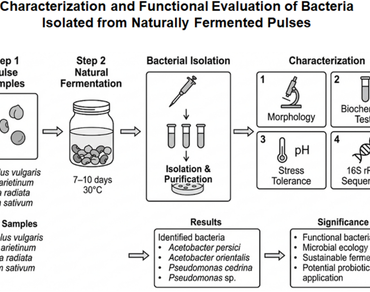
Fermented plant-based foods are dynamic microbial ecosystems that enhance nutrition and sustainable food processing. The complex carbohydrates and the phytochemical bioactive compounds present in pulses, such as Phaseolus vulgaris (kidney bean), Cicer arietinum (Bengal gram), Vigna radiata (green gram), and Pisum sativum (yellow pea), promote microbial colonization. However, there is a lack of detailed characterization of the bacterial community associated with these pulses. In the present study, bacteria isolated from the spontaneous fermentation of these four pulse varieties were comparatively studied after 10 days of fermentation under controlled laboratory conditions. An integrated approach of phenotypic and biochemical characterization, environmental stress tolerance, antimicrobial and antioxidant activity assays, and 16 S rRNA gene sequencing and phylogenetic analysis was employed to characterize bacterial isolates. This research paper represents a comparative environmental assessment of bacterial diversity in different naturally fermented pulse substrates, unlike previous studies that mainly concentrated on individual fermented legumes or specific groups of probiotic bacteria. The dominant isolates obtained by molecular characterization were Acetobacter persici, Acetobacter orientalis, Pseudomonas cedrina and Pseudomonas sp. The isolates recovered not only possessed tolerance to various pH, temperature, and salinity levels; they also showed measurable antimicrobial and antioxidant activity under the conditions used, indicating functional characteristics of the microbes involved in the spontaneous fermentation process. While several functional characteristics were identified with probiotics, these isolates need to be fully validated for safety, antibiotic susceptibility profiles, adhesion, and in vivo testing before they can be considered confirmed probiotics. In conclusion, the results offer a comparative approach for understanding bacterial diversity associated with naturally fermented pulses and a scientific basis for further studies on microbial ecology and sustainable fermentation technologies.
Graphical Abstract

References
Amin M, Rezaei M, Majd MH (2019) Probiotic potential and fermentation properties of lactic acid bacteria isolated from traditional fermented vegetables. Food Sci Nutr 7(5):1610–1620. https://doi.org/10.1002/fsn3.1002
Chouhan GK, Singh S, Mukherjee A, Gaurav AK, Lepcha A, Kumari S, Verma JP (2022) Exploration of plant growth-promoting rhizobacteria (PGPR) for improving productivity and soil fertility under sustainable agricultural practices. Re-visiting the Rhizosphere Ecosystem for Agricultural Sustainability. Springer Nature, Singapore, pp 245–269. https://doi.org/10.1007/978-981-19-4101-6_13
Labba IM, Andlid T, Lindgren Å, Sandberg AS, Sjöberg F (2020) Isolation, identification, and selection of strains as candidate probiotics and starters for fermentation of Swedish legumes. Food Nutr Res 64:4410. https://doi.org/10.29219/fnr.v64.4410
Marco ML, Heeney D, Binda S, Cifelli CJ, Cotter PD, Foligné B, Hutkins R et al (2017) Health benefits of fermented foods: microbiota and beyond. Curr Opin Biotechnol 44:94–102. https://doi.org/10.1016/j.copbio.2016.11.010
Mondal R, Aruna B (2024) Preservative efficacy of bacteriocin produced by lactic acid bacteria isolated from fermented green gram batter. Res Perspect Microbiol Biotechnol 8:30–45. https://doi.org/10.9734/bpi/rpmab/v8/2875
Nwagu TN, Ugwuodo CJ, Onwosi CO et al (2020) Evaluation of the probiotic attributes of Bacillus strains isolated from traditional fermented African locust bean seeds (Parkia biglobosa), daddawa. Ann Microbiol 70:20. https://doi.org/10.1186/s13213-020-01564-x
Ray RC, Montet D (2014) Microorganisms and fermentation of traditional foods. In: Ray RC, Montet D (eds) Fermented Foods. CRC, Boca Raton, pp 1–36. https://doi.org/10.1201/b16703
Sáez GD, Hébert EM, Saavedra L, Zárate G (2017) Molecular identification and technological characterization of lactic acid bacteria isolated from fermented kidney bean flours (Phaseolus vulgaris L. and P. coccineus) in northwestern Argentina. Food Res Int 102:605–615. https://doi.org/10.1016/j.foodres.2017.09.042
Sharma N, Mahato DK, Cho MH, Lee YR (2020) Fermented soybean products: insights into nutritional and health benefits. Food Res Int 136:109503. https://doi.org/10.1016/j.foodres.2020.109503
Somashekaraiah R, Shruthi B, Deepthi BV, Sreenivasa MY (2019) Probiotic potential, stress tolerance, and antagonistic activity of food-associated lactic acid bacteria. Int J Food Prop 22(1):245–262. https://doi.org/10.1080/10942912.2019.1573833
Swain MR, Anandharaj M, Ray RC, Rani RP (2014) Fermented fruits and vegetables of Asia: a potential source of functional microorganisms. Biotechnol Res Int 2014:250424. https://doi.org/10.1155/2014/250424
Tamang JP, Watanabe K, Holzapfel WH (2016) Diversity of microorganisms in global fermented foods and beverages. Front Microbiol 7:377. https://doi.org/10.3389/fmicb.2016.00377
Xu H, Li D, Jiang X, Pei Q, Li Z, Madjirebaye P, Xie M, Xiong T, Liu Z (2025) Screening of lactic acid bacteria isolated from fermented cowpea and optimization of biomass production conditions. Foods 14(2):150. https://doi.org/10.3390/foods14020150
Yumnam H, Nath S, Chakraborty P, Sharma I (2025) Assessment of potential probiotic lactic acid bacteria in rice-based fermented products of Southern Assam, Northeast India. Front Microbiol 16:1536593. https://doi.org/10.3389/fmicb.2025.1536593
Lebeer S, Vanderleyden J, De Keersmaecker SCJ (2008) Genes and molecules of lactobacilli supporting probiotic action. Microbiol Mol Biol Rev 72(4):728–764. https://doi.org/10.1128/MMBR.00017-08
Pan X, Chen F, Wu T, Tang H, Zhao Z (2009) The acid and bile tolerance and antimicrobial property of lactic acid bacteria isolated from naturally fermented vegetables. Brazilian J Microbiol 40(4):759–766.
Author Information
Department of Microbiology, School of Life Sciences, Swami Vivekananda University, West Bengal, India