Vegetos

(An International Journal of Plant Research & Biotechnology)
(eISSN: 2229-4473)
Comparative anatomy and taxonomic insights of the endemic Indian genus Haplanthodes (Acanthaceae)
*Article not assigned to an issue yet
Research Article | Published: 06 May, 2026
First Page: 0
Last Page: 0
Views: 673
Keywords: Andrographideae, Spiny bottlebrush, Endemic, Morpho-anatomy, Taxonomic delimitations
Abstract
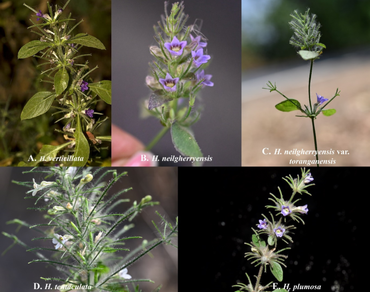
The genus Haplanthodes (family: Acanthaceae) is endemic to India and comprises five taxa. Due to their morphological similarities, they are often difficult to distinguish from one another. To clarify interspecific relationships and identify key diagnostic characteristics, a comparative study was conducted examining the organoleptic, macroscopic, and anatomical features of the stems, roots, cladodes, and leaves of all five taxa. The findings suggest that both external and internal morphological features provide valuable insights into the macro and microstructural classification of Haplanthodes. The genus has a unique morphological feature that sets it apart from other genera in the Acanthaceae family, such as Andrographis and Haplanthus. At the species level, H. verticillata, cladodes are stiff, spinose, and verticillate; whereas in H. tentaculata, they are of similar size but smooth and non-spinose; in H. plumosa, the lower half of the cladodes are densely hairy, giving a plume-like appearance; and in H. neilgherryensis and H. neilgherryensis var. toranganensis, they are thin, soft, and filiform. These features are particularly useful for species identification in the absence of reproductive structures. Anatomical differences in the leaf midrib also support species-level distinctions: H. verticillata exhibits a plano-convex, squarish outline with conjoint, closed, collateral vascular bundles; H. plumosa, H. neilgherryensis, H. tentaculata, and H. neilgherryensis var. toranganensis show a convex, triangular to wavy-squarish outline with similar vascular bundle configurations. These foundational anatomical and morphological data contribute to a more robust framework for species delimitation within the genus and provide a basis for future studies within the tribe Acantheae and the broader Acanthaceae family.
References
Abeysinghe PD, Scharaschkin T (2019) Taxonomic value of the petiole anatomy in the genus Cinnamomum (Lauraceae) found in Sri Lanka. Ruhuna J Sci 10(1):1–17. https://doi.org/10.4038/rjs.v10i1.47
Ahmad KJ (1974) Cuticular studies in some Nelsonioideae (Acanthaceae). Bot J Linn Soc 68(1):73–80. https://doi.org/10.1111/j.1095-8339.1974.tb01748.x
Ayurvedic Pharmacopoeia of India (API) (2008) The Ayurvedic Pharmacopoeia of India. Government of India, Ministry of Health & Family Welfare, Department of AYUSH. (Part I–VI; 2008)
Bashir K, Sohail A, Ali U, Ullah A, UlHaq Z, Gul B, Ullah I, Sunera AM (2020) Foliar micromorphology and its role in identification of the Apocynaceae taxa. Microsc Res Tech 83(7):755–766. https://doi.org/10.1002/jemt.23466
Brahma P, Baruah S (2025) Petiole anatomy to delimit taxonomy of genus Glochidion J.R. Forst. & G. Forst. (Phyllanthaceae). Vegetos. https://doi.org/10.1007/s42535-025-01455-z
Deshmukh PV, Surveswaran S, Gore RD, Lekhak MM (2021) Taxonomic studies in the genus Haplanthodes (Acanthaceae). Phytotaxa 516(3):201–222. https://doi.org/10.11646/phytotaxa.516.3.1
Forman L, Bridson D (1992) The herbarium handbook. Royal Botanic Gardens, Kew
Kulkarni VM, Srinivasan M, Gangurde A, Marne PA, Salvi DS, Tagalpallewar AA, Nagar S, Pawar AT, Baheti AM (2025) Network pharmacology, in-silico and in-vivo studies for analgesic and antipyretic activities of Haplanthodes tentaculata leaves. J Ethnopharmacol. https://doi.org/10.1016/j.jep.2025.120301
Kumar RA, Sridevi K, Kumar NV, Nanduri S, Rajagopal S (2004) Anticancer and immunostimulatory compounds from Andrographis paniculata. J Ethnopharmacol 92(2–3):291–295. https://doi.org/10.1016/j.jep.2004.03.004
Kumar S, Singh B, Bajpai V (2021) Andrographis paniculata (Burm. f.) Nees: traditional uses, phytochemistry, pharmacological properties and quality control/quality assurance. J Ethnopharmacol 275:114054. https://doi.org/10.1016/j.jep.2021.114054
Magvision (2026) Magnus Opto Systems India Pvt. Ltd. Accessed 12 Mar 2026. https://www.magnusopto.com/products/software.html
Manzitto-Tripp EA, Darbyshire I, Daniel TF, Kiel CA, McDade LA (2021) Revised classification of Acanthaceae and worldwide dichotomous keys. Taxon 71:103–153. https://doi.org/10.1002/tax.12600
Metcalfe CR, Chalk L (1979) Anatomy of the dicotyledons, vol I. Clarendon Press (Oxford University Press), Oxford
Okhuarobo A, Falodun JE, Erharuyi O, Imieje V, Falodun A, Langer P (2014) Harnessing the medicinal properties of Andrographis paniculata for diseases and beyond: a review of its phytochemistry and pharmacology. Asian Pac J Trop Dis 4(3):213–222. https://doi.org/10.1016/S2222-1808(14)60273-4
POWO (2026) Plants of the World Online. Facilitated by the Royal Botanic Gardens, Kew. https://powo.science.kew.org. Accessed 12 Mar 2026
Prihatini R, Syarif A, Bakhtiar A (2018) Leaf epidermis and phytochemical studies of sambiloto (Andrographis paniculata (Burm. F.) Nees). J Phys Conf Ser 1116(5):052050. https://doi.org/10.1088/1742-6596/1116/5/052050
Reeve RM (1948) An adaptable staining schedule for plant tissues. Stain Technol 23:13–15
Singh R, Dhiman M, Saklani A, Immanuel Selvaraj C, Kate AS (2022) Isolation and characterization of a novel flavanone glycoside from an endemic plant Haplanthodes neilgherryensis. J Asian Nat Prod Res 24(1):96–101. https://doi.org/10.1080/10286020.2021.1880394
Singha PK, Roy S, Dey S (2003) Antimicrobial activity of Andrographis paniculata. Fitoterapia 74(7–8):692–694. https://doi.org/10.1016/S0367-326X(03)00159-X
Subramanian R, Zaini Asmawi M, Sadikun A (2012) A bitter plant with a sweet future? A comprehensive review of an oriental medicinal plant: Andrographis paniculata. Phytochem Rev 11(1):39–75. https://doi.org/10.1007/s11101-011-9235-4
Sudhakaran MV (2012) Botanical pharmacognosy of Andrographis paniculata (Burm.f.) Wall. ex Nees. Pharmacogn J 4(1):1–10. https://doi.org/10.5530/pj.2012.1.1
Surveswaran S, Tiwari N, Karanth PK, Deshmukh PV, Lekhak MM (2022) Molecular phylogenetics and character evolution in Haplanthodes (Acanthaceae), an endemic genus from peninsular India. Nord J Bot. https://doi.org/10.1111/njb.03238
Thakur AK, Chatterjee SS, Kumar V (2015) Adaptogenic potential of andrographolide: an active principle of the king of bitters (Andrographis paniculata). J Tradit Complement Med 5(1):42–50. https://doi.org/10.1016/j.jtcme.2014.10.003
Author Information
Biodiversity & Palaeobiology (Plants & Diatoms) Group, Agharkar Research Institute, Pune, India