Vegetos

(An International Journal of Plant Research & Biotechnology)
(eISSN: 2229-4473)
Comparative anatomy of five species of Senna Mill. (Leguminosae) from Bangladesh
*Article not assigned to an issue yet
Research Article | Published: 05 December, 2025
First Page: 0
Last Page: 0
Views: 523
Keywords: Senna, Anatomy, Trichome, Vascular bundle, Taxonomy
Abstract
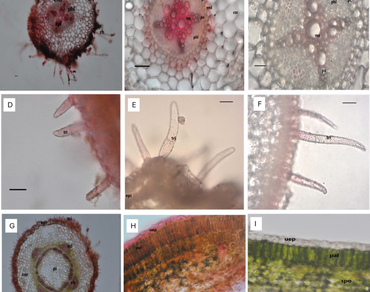
This research examined the anatomical characteristics of five Senna Mill. species of the Leguminosae family from Bangladesh: S. alata (L.) Roxb., S. hirsuta (L.) Irwin & Barneby, S. occidentalis Roxb., S. sophera (L.) Roxb., and S. tora (L.) Roxb. for a better understanding of interspecific relations to help taxonomic identification in applied fields like pharmacology and phytotherapy. During the primary growth stage, no significant differences were observed in their root structures, although distinctive features appeared in the stem trichomes and leaf palisade parenchyma layers. In the secondary growth stage, these species generally showed similar root structures, with S. tora being an exception, characterized by a higher number of vessels and vascular rays. Notable differences were seen in secondary stem structure, especially in the cortex layers, trichomes, vascular bundles, and sclerenchyma patch shapes. Leaflet trichomes and stomata were prominent anatomical features at this stage, though mature leaflets of S. tora lacked trichomes entirely. Three stoma types: paracytic, anisocytic, and tetracytic were identified. Variations in xylem row count and palisade parenchyma layers were also recorded. Measurements of stem and leaf traits in mature plants indicated that S. occidentalis had the highest values across all parameters. Cluster analysis of anatomical features grouped the species into two main clusters.
References
Ahmed ZU, Hassan MA, Begum ZNT, Khondker M, Kabir SMMH, Ahmed M, Ahmed ATA, Rahman AKA, and EU Huque 2008. Encyclopedia of FloraFauna of Bangladesh. Angiosperms: Dicotyledons (Balsaminaceae-Euphorbiaceae). Asiatic Society of Bangladesh, Dhaka 7: 546–555
Alamgir ANM (2017) Therapeutic use of medicinal plants and their extracts, vol 73. Springer, Berlin
Alshehri MM, Quispe C, Herrera-Bravo J, Sharifi-Rad J, Tutuncu S, Aydar EF, Topkaya C, Mertdinc Z, Ozcelik B et al (2022) A review of recent studies on the antioxidant and Anti-Infectious properties of Senna plants. Oxid Med Cell Longev. https://doi.org/10.1155/2022/6025900
Amirabadizadeh H, Jafari A, Mahmoodzadeh H (2015) Comparative morphology, anatomy and palynological studies of perennial species of onobrychis (Fabaceae) in Northeast Iran. Nord J Bot. https://doi.org/10.1111/njb.00580
Begum A, Rahman MO, Begum M (2014) Stomatal and trichome diversity in Senna Mill. From Bangladesh. Bangladesh J Plant Taxon 21(1):43–51. https://doi.org/10.3329/bjpt.v21i1.19264
Coutinho ÍAC, Rando JG, Conceição AS, Meira RMSA (2016) A study of the morphoanatomical characters of the leaves of Chamaecrista (L.) Moench sect. Apoucouita (Leguminosae-Caesalpinioideae). Acta Bot Bras. https://doi.org/10.1590/0102-33062016abb0035
Engel T (1992) Petiolar anatomy of North American astragalus species (Fabaceae) with persistent petioles. Aliso 13(2):339–345. https://doi.org/10.5642/aliso.19921302.05
Esau K (1997) Anatomy of seed plants 2nd Edition. Wiley
Esievo K, Fatokun O, Ibrahim J, Kunle O (2016) Pharmacognostic studies of the leaf of Senna Siamea (lam.) irwin & Barneby family: caesalpiniaceae. Eur J Med Plants 16(2):1–7. https://doi.org/10.9734/ejmp/2016/28586
Flores AS, Costa ES, Dias GB (2019) Foliar anatomy of Rhynchosia spp. (leguminosae, papilionoideae) from Roraima state, Northern Brazilian Amazon. Acta Amazonica 49(1):28–35. https://doi.org/10.1590/1809-4392201801691
Francino DMT, Coutinho ÍAC, Dalvi VC, Azevedo AA, Conceição AdeS, Meira RMSA (2015) Anatomical interpretations of the taxonomy of Chamaecrista (L.) Moench sect. Absus (Leguminosae–Caesalpinioideae). Plant Syst Evol 301(8):2087–2103. https://doi.org/10.1007/s00606-015-1208-z
Hossain U, Rahman MO (2018) Ethnobotanical uses and informant consensus factor of medicinal plants in barisal district, Bangladesh. Bangladesh J Plant Taxon 25(2):241–255. https://doi.org/10.3329/bjpt.v25i2.39530
Ibrahim MA, Islam MS (2014) Anti-diabetic effects of the acetone fraction of Senna Singueana stem bark in a type 2 diabetes rat model. J Ethnopharmacol 153(2):392–399. https://doi.org/10.1016/j.jep.2014.02.042
Doty MK, Rashid P, Shethi KJ (2020) Study of petiole anatomy and pollen morphology of five species of Senna Mill. From Bangladesh. Dhaka Univ J Biol Sci 29(2):245–252. https://doi.org/10.3329/dujbs.v29i2.48769
Le JJi H, Zhou X, Wei X, Chen Y, Fu Y, Ma Y, Han Q, Sun Y, Gao Y, Wu H (2021) Pharmacology, toxicology, and metabolism of sennoside A, A medicinal Plant-Derived natural compound. Front Pharmacol. https://doi.org/10.3389/fphar.2021.714586
De Lima AG, De Freitas Mansano V, De Oliveira MTL, Lewis GP, Bacon CD, Souza VC (2025a) A synopsis of Senna ser. Bacillares (Leguminosae, Caesalpinioideae, Cassieae) in Brazil, including a remarkable new species from Amazonia. https://doi.org/10.1007/s12228-025-09835-0.
De Lima AG, De Freitas Mansano V, Trovó M, Bacon CD (2025b) Morphometric and taxonomic studies of Senna ser. Coriaceae (Leguminosae, Caesalpinioideae, Cassieae), including a new species from Chapada Diamantina, Bahia, Brazil. Braz J Bot. https://doi.org/10.1007/s40415-024-01054-3
Marazzi B, Endress PK, De Queiroz LP, Conti E (2006) Phylogenetic relationships within Senna (Leguminosae, Cassiinae) based on three Chloroplast DNA regions: patterns in the evolution of floral symmetry and extrafloral nectaries. Am J Bot. https://doi.org/10.3732/ajb.93.2.288
Nassar MAAA, Ramadan HRH, Ibrahim HMS (2013) Anatomical structures of vegetative and reproductive organs of Senna occidentalis (Caesalpiniaceae). Turk J Bota 37(3):342–352. https://doi.org/10.3906/bot-1111-26
Nayan SI, Chowdhury FI, Akter N, Rahman MM, Selim S, Saffoon N, Khan F, Subhan N, Hossain M, Ahmed KS, Hossain H, Haque MA, Alam MA (2021) Leaf powder supplementation of Senna Alexandrina ameliorates oxidative stress, inflammation, and hepatic steatosis in high-fat diet-fed obese rats. PLoS ONE 16(4):e0250261. https://doi.org/10.1371/journal.pone.0250261
Ogundipe OT, Kadiri AB, Adekanmbi OH (2009) Foliar epidermal morphology of some Nigerian species of Senna (Caesalpiniaceae). Indian J Sci Technol 2(10):5–9. https://doi.org/10.17485/ijst/2009/v2i10/30709
Oladeji OS, Adelowo FE, Oluyori AP (2021) The genus Senna (Fabaceae): a review on its traditional uses, botany, phytochemistry, pharmacology and toxicology. S Afr J Bot 138:1–32. https://doi.org/10.1016/j.sajb.2020.11.017
Pereira LBS, Costa-Silva R, Felix LP, Agra MF (2018) Leaf morphoanatomy of mororó (Bauhinia and Schnella, Fabaceae). Rev Bras Farmacogn 28(4):383–392. https://doi.org/10.1016/j.bjp.2018.04.012
Rahman AHMM, Biswas C, Islam R, Zaman ATMN (2013) Assessment of traditional medicinal plants used by local people of Monirampur thana under Jessore district of Bangladesh assessment of traditional medicinal plants used by local people of Monirampur upazilla under Jessore district of Bangladesh. Wudpecker J Med Plants. https://www.researchgate.net/publication/288829761
Rodrigues IMC, Souza Filho APS, Ferreira FA, Ilkiu-Borges F, Gurgel ESC (2009) Anatomia e histoquímica Das folhas de Senna Alata. Planta Daninha 27(3):515–526. https://doi.org/10.1590/s0100-83582009000300012
Săvulescu E, Georgescu MI, Popa V, Luchian V (2018) Morphological and anatomical properties of the Senna Alexandrina Mill. (Cassia Angustifolia Vahl.). Agriculture for Life, Life for Agriculture Conference Proceedings, 1(1), 305–310. https://doi.org/10.2478/alife-2018-0045
Souto FS, Silva AL, dos Santos EAV, de Fátima Agra M (2024) Taxonomic implications of the leaf anatomy of twelve species of Senna ser. Bacillares (Leguminosae) from Northeastern Brazil. Braz J Bot 47:1023–1038. https://doi.org/10.1007/s40415-024-01024-9
Souto FS, Queiroz RTde, Fátima Agra Mde (2021) Senna pluribracteata (Leguminosae, Caesalpinioideae), a new species from Paraíba State, Brazil, with notes on leaf anatomy. Syst Bot 46(2):352–360. https://doi.org/10.1600/036364421X16231782047325
Srinivasan N (2018) Pharmacognostical and phytochemical evaluation of Cassia Alata Linn. J Med Plants Stud 6(5):69–77
Thacker KD, Gavade SK, Lekhak MM, Gondaliya AD, Rajput KS (2021) Comparison of petiole anatomy in Flemingia and its potential for delimitation of species. Flora. https://doi.org/10.1016/j.flora.2021.151790
Author Information
Department of Botany, University of Dhaka, Dhaka, Bangladesh