Vegetos

(An International Journal of Plant Research & Biotechnology)
(eISSN: 2229-4473)
Comparative phytochemical profiling and bioactivities of assam tea clones with teen ali superiority
*Article not assigned to an issue yet
Research Article | Published: 25 May, 2026
First Page: 0
Last Page: 0
Views: 67
Keywords: Radical scavenging activity, Polysaccharide characterization, GC-MS profiling, antimicrobial potential, Nutraceutical development
Abstract
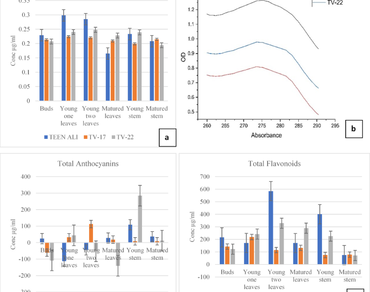
Tea is one of the most widely consumed beverages worldwide, valued for its taste and health benefits. We investigated three Assam tea clones TV-17, TV-22, and Teen Ali to evaluate differences in their phytochemical composition and bioactive properties. We measured natural compounds such as caffeine, flavonoids, tannins, and polysaccharides, tested their antioxidant activity, and examined their ability to inhibit bacteria. Teen Ali exhibited the highest caffeine and flavonoid contents and showing the strongest antioxidant activity, which helps neutralize harmful free radicals. It also contained unique bioactive molecules, such as vitamin E and quercetin, known for supporting human health. While its antibacterial effect was moderate, Teen Ali’s dense polysaccharide structure may offer additional health and environmental stress benefits. The findings demonstrate substantial biochemical variation among Assam tea clones—biochemical differences among clones may significantly influence their nutraceutical potential. By identifying Teen Ali as a particularly rich source of bioactive compounds, this work opens new possibilities for developing value-added tea products and plant-based health supplements.
References
Balandrin MF, Kinghorn AD, Farnsworth NR (1993) Plant-derived natural products in drug discovery and development: An overview. ACS Symp Ser 534:2–12. https://doi.org/10.1021/bk-1993-0534.ch001
Benzie IFF, Strain JJ (1996) The ferric reducing ability of plasma (FRAP) as a measure of antioxidant power: the FRAP assay. Anal Biochem 239:70–76. https://doi.org/10.1006/abio.1996.0292
Bhandari L, Bhatta MR, Ranjitkar R (2018) Phytochemicals, polyphenols and antioxidant activity of Camellia sinensis (L.) Kuntze (tea leaf) from Ilam District, Nepal. J Plant Resour 16:78
Brand-Williams W, Cuvelier ME, Berset C (1995) Use of a free radical method to evaluate antioxidant activity. Lebensm Wiss Technol 28:25–30
Chan EWC, Lim YY, Chew YL (2007) Antioxidant activity of Camellia sinensis leaves and tea from a lowland plantation in Malaysia. Food Chem 102(4):1214–1222. https://doi.org/10.1016/j.foodchem.2006.07.009
Chang C, Yang M, Wen H, Chern J (2002) Estimation of total flavonoid content in propolis by two complementary colorimetric methods. J Food Drug Anal 10:178–182
Chu YH, Chang CL, Hsu HF (2000) Flavonoid content of several vegetables and their antioxidant activity. J Sci Food Agric 80(5):561–566. https://doi.org/10.1002/(SICI)1097-0010(200004)80:5%3C561::AID-JSFA646%3E3.0.CO;2-Q
Dubois M, Gilles KA, Hamilton JK, Rebers PA, Smith F (1956) Colorimetric method for the determination of sugars and related substances. Anal Chem 28:350–356. https://doi.org/10.1021/ac60111a017
Dudonne S, Vitrac X, Coutiere P, Woillez M, Mérillon JM (2009) Comparative study of antioxidant properties and total phenolic content of 30 plant extracts of industrial interest using DPPH, ABTS, FRAP, SOD, and ORAC assays. J Agric Food Chem 57(5):1768–1774
Elangovan M, Dhanarajan MS, Rajalakshmi A, Jayachitra A (2014) Analysis of phytochemicals, antibacterial and antioxidant activities of Moringa oleifera Lam. leaf extract—an in vitro study. Int J Drug Dev Res 6:173–180
Elgailani IEH (2015) Spectrophotometric and phytochemical analysis of black tea (Camellia sinensis leaves). J Appl Ind Sci 3:167–171
Farhoosh R, Golmovahhed GA, Khodaparast MH (2007) Antioxidant activity of various extracts of old tea leaves and black tea wastes (Camellia sinensis L). Food Chem 100(1):231–236. https://doi.org/10.1016/j.foodchem.2005.09.046
Farooq S, Sehgal A (2019) Synergistic antioxidant interactions between green tea and Ocimum gratissimum. Asian Pac J Trop Biomed 9:333
Giusti MM, Wrolstad RE (2001) Characterization and measurement of anthocyanins by UV-visible spectroscopy. J Food Anal Chem 1:F1–F2
Goldstein J, Lee E (2017) Scanning electron microscopy of polysaccharides: a review. J Microsc 265:45–62. https://doi.org/10.1111/jmi.12465
Graham HN (1992) Green tea composition, consumption, and polyphenol chemistry. Prev Med 21(3):334–350. https://doi.org/10.1016/0091-7435(92)90041-F
Hafidh RR, Abdulamir AS, Vern LS et al (2011) Inhibition of growth of highly resistant bacterial and fungal pathogens by a natural product. Open Microbiol J 5:96
Haque MM, Hasan MR, Akter S et al (2019) Phytochemical screening, proximate composition and heavy metals of Camellia sinensis leaves. Int J Adv Res 7(Jul):195–201. https://doi.org/10.21474/IJAR01/9345
Harborne JB (1998) Phytochemical Methods: A Guide to Modern Techniques of Plant Analysis, 3rd edn. Springer, Dordrecht
Jakubczyk K, Kochman J, Kwiatkowska A et al (2020) Antioxidant properties and nutritional composition of matcha green tea. Foods 9(4):483. https://doi.org/10.3390/foods9040483
Jamal (2023) Embracing nature’s therapeutic potential: herbal medicine. Int J Multidiscip Sci Arts 2(1):117–126. https://doi.org/10.47709/ijmdsa.v2i1.2620
Ji HG, Lee YR, Lee MS et al (2018) Diverse metabolite variations in tea (Camellia sinensis L.) leaves grown under various shade conditions revisited: a metabolomics study. J Agric Food Chem 66(8):1889–1897. https://doi.org/10.1021/acs.jafc.7b04768
Kaur A, Kaur M, Kaur P et al (2015) Estimation and comparison of total phenolic and total antioxidants in green tea and black tea. Glob J Biosci Biotechnol 4:116–120
Kim Y, Goodner KL, Park JD et al (2011) Changes in antioxidant phytochemicals and volatile composition of Camellia sinensis by oxidation during tea fermentation. Food Chem 129(4):1331–1342. https://doi.org/10.1016/j.foodchem.2011.05.012
Kukric ZZ, Topalic-Trivunovic LN, Kukavica BM et al (2012) Characterization of antioxidant and antimicrobial activities of nettle leaves (Urtica dioica L). Acta Period Technol 43:257–272
Leaves L, Leaves L (2014) Antioxidant activity by DPPH radical scavenging method of Ageratum conyzoides. Am J Ethnomed 1:244–249
Liu Z, Luo Z, Jia C et al (2016) Synergistic effects of Potentilla fruticosa L. leaves combined with green tea polyphenols in a variety of oxidation systems. J Food Sci 81:C1091–C1101
Makkar HPS, Becker K (1993) Nutrients and anti-nutrients in conventional and non-conventional oilseeds. J Sci Food Agric 63:29–34
Mareček V, Mikyška A, Hampel D et al (2017) ABTS and DPPH methods as a tool for studying antioxidant capacity of spring barley and malt. J Cereal Sci 73:40–45. https://doi.org/10.1016/j.jcs.2016.11.004
Medina-Meza IG, Aluwi NA, Saunders J, Ganjyal GM (2016) Total saponin content of chickpea (Cicer arietinum) and lentil (Lens culinaris) seeds and fractions. Food Chem 204:225–231. https://doi.org/10.1016/j.foodchem.2016.02.011
Moeller SM, Jacques PF, Blumberg JB (2000) The potential role of dietary xanthophylls in cataract and age-related macular degeneration. J Am Coll Nutr 19(Suppl 5):522S–527S. https://doi.org/10.1080/07315724.2000.10718975
Mosii LTJ, Pheko-Ofitlhile T, Kobue-Lekalake R, Mazimba O (2023) Terminalia prunioides pods herbal tea: antioxidant activity, proximate, and metal content analysis. Food Chem Adv 2:100280. https://doi.org/10.1016/j.focha.2023.100280
Motor S, Ozturk S, Ozcan O et al (2014) Evaluation of total antioxidant status, total oxidant status and oxidative stress index in patients with alopecia areata. Int J Clin Exp Med 7(4):1089
Mukherjee PK, Bahadur S, Harwansh RK et al (2017) Paradigm shift in natural product research: traditional medicine inspired approaches. Phytochem Rev 16:803–826. https://doi.org/10.1007/s11101-016-9489-6
Niedzielska E, Smaga I, Gawlik M et al (2016) Oxidative stress in neurodegenerative diseases. Mol Neurobiol 53:4094–4125. https://doi.org/10.1007/s12035-015-9337-5
Re R, Pellegrini N, Proteggente A et al (1999) Antioxidant activity applying an improved ABTS radical cation decolorization assay. Free Radic Biol Med 26:1231–1237. https://doi.org/10.1016/S0891-5849(98)00315-2
Roshanak S, Rahimmalek M, Goli SAH (2016) Evaluation of seven different drying treatments in respect to total flavonoid, phenolic, vitamin C content, chlorophyll, antioxidant activity and color of green tea (Camellia sinensis or C. assamica) leaves. J Food Sci Technol 53:721–729. https://doi.org/10.1007/s13197-015-2030-x
Singh N, Kulkarni GT, Kumar Y (2018) Antioxidant activity assessment of Camellia sinensis leaves extract in Guinea pig plasma. Int J Pharm Sci Res 9(11):5002–5008
Sowbagyalakshmi Prabha L, Venkatachalapathi T, Venkatesan RS (2016) Phytochemical analysis of green tea (Camellia sinensis) and assessment of its scavenging ability on CdCl₂. Int J Curr Res Chem Pharm Sci 3:47–57
Tshivhandekano I, Ntushelo K, Ngezimana W, Tshikalange TE, Mudau FN (2014) Chemical compositions and antimicrobial activities of Athrixia phylicoides DC. (bush tea), Monsonia burkeana (special tea) and synergistic effects of both combined herbal teas. Asian Pac J Trop Med 7:S448–S453
Unachukwu UJ, Ahmed S, Kavalier A et al (2010) White and green teas (Camellia sinensis var. sinensis): variation in phenolic, methylxanthine, and antioxidant profiles. J Food Sci 75(6):C541–C548. https://doi.org/10.1111/j.1750-3841.2010.01705.x
Wickens AP (2001) Ageing and the free radical theory. Respir Physiol 128(3):379–391. https://doi.org/10.1016/S0034-5687(01)00313-9
Yousefbeyk F, Ebrahimi-Najafabadi H, Dabirian S et al (2023) Phytochemical screening and bioactivities of medicinal plants. Pharm Sci 29:100–110
Yusufzai SK, Khan MS, Hanry EL et al (2019) GC-MS analysis of chemical constituents and in vitro antioxidant activity of the organic extracts from the stem of Bridelia stipularis. Sains Malays 48(5):999–1009. https://doi.org/10.17576/jsm-2019-4805-08
Author Information
Department of Biotechnology, Kalasalingam Academy of Research and Education, Krishnankoil, India