Vegetos

(An International Journal of Plant Research & Biotechnology)
(eISSN: 2229-4473)
Computational insights into the glutathione S-transferase gene family in grain amaranths (Amaranthus caudatus L. and Amaranthus cruentus L.)
*Article not assigned to an issue yet
Research Articles | Published: 17 August, 2026
First Page: 0
Last Page: 0
Views: 37
Keywords: Amaranthus, Glutathione S-transferase, Genome-wide analysis, Abiotic stress, Gene duplication, Expression profiling
Abstract
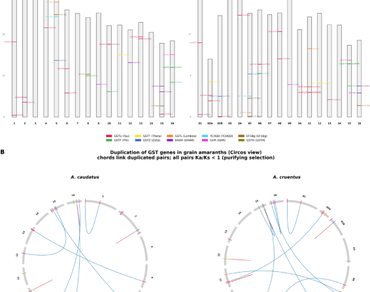
Glutathione S-transferases (GSTs) are a large, multifunctional superfamily of enzymes central to cellular detoxification, redox homeostasis and abiotic-stress tolerance in plants. Grain amaranths are highly nutritious, climate-resilient pseudocereals, yet their GST repertoire has remained uncharacterized. Here we present the first genome-wide identification and comparative analysis of the GST gene family in two cultivated grain amaranths, Amaranthus caudatus and Amaranthus cruentus. Using the annotated A. cruentus reference proteome and de-novo protein-to-genome prediction on the chromosome-level A. caudatus assembly (GCA_055266045.1), 45 AcrGST and 35 AcGST genes were identified and assigned to ten classes, with Tau and Phi being the most abundant in both species. The predicted proteins were largely acidic to neutral, hydrophilic (all GRAVY< 0) and cytosolic, with a small plastidic component. The genes were unevenly distributed across the chromosomes and displayed conserved class-specific exon–intron architecture (mean ~4 coding exons) and conserved motifs. Gene-duplication analysis identified both tandem and segmental duplications, and all duplicated pairs evolved under purifying selection (Ka/Ks 0.026–0.442, all <1). Promoter regions were enriched in stress and hormone-responsive cis-elements. Cross-species, ortholog-based expression profiling using A. hypochondriacus leaf transcriptomes revealed that several GST members were transcriptionally responsive to salinity and drought, with salinity eliciting the broader response. Collectively, these results provide a verified, fully reproducible framework of the amaranth GST family and candidate genes for abiotic-stress improvement of these underutilized crops.
References
Almagro Armenteros JJ, Salvatore M, Emanuelsson O et al (2019) Detecting sequence signals in targeting peptides using deep learning. Life Sci Alliance 2:e201900429
Altschul SF, Gish W, Miller W, Myers EW, Lipman DJ (1990) Basic local alignment search tool. J Mol Biol 215:403–410
Dixon DP, Edwards R (2010) Glutathione transferases. Arabidopsis Book 8:e0131
Edwards R, Dixon DP (2005) Plant glutathione transferases. Methods Enzymol 401:169–186
Frova C (2006) Glutathione transferases in the genomics era: new insights and perspectives. Biomol Eng 23:149–169
Garnier J, Gibrat JF, Robson B (1996) GOR method for predicting protein secondary structure from amino acid sequence. Methods Enzymol 266:540–553
Gasteiger E, Hoogland C, Gattiker A et al (2005) Protein identification and analysis tools on the ExPASy server. In: Walker JM (ed) The proteomics protocols handbook. Humana Press, pp 571–607
Katoh K, Standley DM (2013) MAFFT multiple sequence alignment software version 7: improvements in performance and usability. Mol Biol Evol 30:772–780
Lescot M, Déhais P, Thijs G et al (2002) PlantCARE, a database of plant cis-acting regulatory elements. Nucleic Acids Res 30:325–327
Li H (2023) Protein-to-genome alignment with miniprot. Bioinformatics 39:btad014
Nei M, Gojobori T (1986) Simple methods for estimating the numbers of synonymous and non-synonymous nucleotide substitutions. Mol Biol Evol 3:418–426
Nianiou-Obeidat I, Madesis P, Kissoudis C et al (2017) Plant glutathione transferase-mediated stress tolerance: functions and biotechnological applications. Plant Cell Rep 36:791–805
Patro R, Duggal G, Love MI, Irizarry RA, Kingsford C (2017) Salmon provides fast and bias-aware quantification of transcript expression. Nat Methods 14:417–419
Price MN, Dehal PS, Arkin AP (2010) FastTree 2-approximately maximum-likelihood trees for large alignments. PLoS ONE 5:e9490
Sappl PG, Carroll AJ, Clifton R et al (2009) The Arabidopsis glutathione transferase gene family displays complex stress regulation and co-silencing of multiple genes results in altered metabolic sensitivity to oxidative stress. Plant J 58:53–68
Tiwari S, Vaish S, Singh N, Basantani M, Bhargava A (2023) Genome-wide identification and characterization of glutathione S-transferase gene family in quinoa (Chenopodium quinoa Willd.). 3 Biotech 13:230
Tiwari S, Vaish S, Singh N et al (2024) In-silico based genome-wide identification and analysis of glutathione S-transferase gene family in beet (Beta vulgaris subsp. vulgaris). Sugar Tech 26:1357–1369
Tiwari S, Srivastava S, Basantani M, Bhargava A (2026) Bioinformatics based characterization and in silico expression profiling of the glutathione S-transferase gene family in spinach (Spinacia oleracea L.). Vegetos. https://doi.org/10.1007/s42535-026-01857-7
Author Information
Department of Integrated and Advanced Technology, School of Engineering and Sciences, Sir Padampat Singhania University, Udaipur, India