Vegetos

(An International Journal of Plant Research & Biotechnology)
(eISSN: 2229-4473)
Genetic architecture of biochemical traits for heterosis and combining ability in bitter gourd (Momordica charantia L.)
*Article not assigned to an issue yet
Saini Diksha, Bisht Yashpal Singh, Saurabh Amit, Rawat Anand Singh, Ahir Megha, Khan Ruksana, Himanshi
Research Article | Published: 08 June, 2026
First Page: 0
Last Page: 0
Views: 92
Keywords: Bitter gourd, Combining ability, Gene action, Heterosis, Quality
Abstract
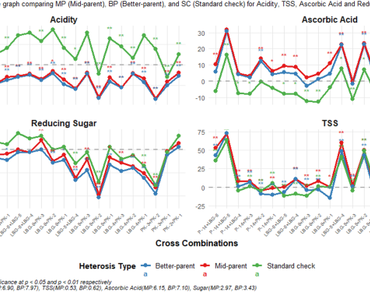
Bitter gourd is an important cucurbitaceous vegetable valued for its nutritional and medicinal properties. However, limited availability of superior quality hybrids has restricted its improvement for biochemical traits. The present investigation was conducted to study heterosis, combining ability and gene action governing biochemical traits in bitter gourd. Seven diverse inbred lines, namely PK-1, PK-2, PK-3, LBG-4, LBG-5, LBG-6 and P-14, were crossed in a half-diallel mating design to produce 21 F₁ hybrids, which were evaluated along with the commercial check ‘Solan Hara’ in a randomized complete block design with three replications. The hybrid P-14 × LBG-5 exhibited superior performance with significant desirable heterosis for TSS, ascorbic acid, chlorophyll, phenols, flavonoids, antioxidant activity and dry matter, while showing desirable negative heterosis for acidity, sugar content and moisture content. Combining ability analysis identified LBG-5, P-14 and PK-1 as good general combiners for improvement of quality traits. Significant and desirable specific combining ability effects were observed in hybrids P-14 × LBG-5, PK-3 × PK-2, LBG-5 × PK-2 and LBG-5 × LBG-4 for most biochemical characters. Genetic analysis revealed low GCA:SCA and predictability ratios, indicating the predominance of non-additive gene action for all traits. Dominance variance was higher than additive variance along with high broad-sense and low narrow-sense heritability estimates. The findings suggested that heterosis breeding could be effectively utilized for improvement of nutritional quality in bitter gourd and the hybrid P-14 × LBG-5 may be exploited further in future breeding programmes and commercial cultivation.
References
Acharya SK, Kaushik RA, Ameta KD, Dubey RB, Upadhyay B (2019) Heterosis and combining ability in bitter gourd (Momordica charantia L.). Int J Bioassay 8(1):5692–5711
Alhariri A, Behera TK, Munshi AD, Singh JG (2020) Gene action and combining ability analysis for horticultural traits in bitter gourd. Indian J Hort 77(3):484–490. https://doi.org/10.5958/0974-0112.2020.00069.9
AOAC (2012) Official methods of analysis, 19th edition. Association of official analytical chemist, Washington DC, USA
Bortolotti M, Mercatelli D, Polito L (2019) Momordica charantia, a nutraceutical approach for inflammatory related diseases. Front Pharmacol 10:486. https://doi.org/10.3389/fphar.2019.00486
Bouaziz M, Fki I, Jemai H, Ayadi M (2008) Effect of storage on refined and husk olive oils composition: stabilization by addition of natural antioxidants from Chemlali olive leaves. J Food Chem 108(1):253–262. https://doi.org/10.1016/j.foodchem.2007.10.074
Crozier A, Lean ME, Mcdonal MS, Black C (1997) Quantitative analysis of flavonoid content of commercial, tomatoes, onion, lettuce and celery. J Agric Food Chem 45(3):590–595. https://doi.org/10.1021/jf960339y
Griffing B (1956) Concept of general and specific combining ability in relation to diallel crossing system. Aust J Biol Sci 9(4):463–493
Hayes HK, Immer IR, Smith DC (1956) Methods of Plant Breeding, pp. 535. New York, McGraw Hill Company Inc.
Khan R, Sarolia DK, Kaushik RA, Dubey RB, Mahawer LN (2017) Combining ability studies in bitter gourd (Momordica charantia L.). Electron J Plant Breed 8(1):1298–1302. https://doi.org/10.5958/0975-928X.2017.00186.7
Kumar N, Bahadur V, Kerketta A (2024) Evaluation of different bitter gourd (Momordica charantia L.) hybrids for growth, yield and quality under Prayagraj agroclimatic conditions. Int J Res Agron 7(5):148–150. https://doi.org/10.33545/2618060X.2024.v7.i5Sc.732
Kumari M, Behera TK, Munshi AD, Talukadar A (2015) Inheritance of fruit traits and generation mean analysis for estimation of horticultural traits in bitter gourd. Indian J Hort 72(1):43–48
Kundu S, Mandal AR, Mukherjee D, Banerjee S, Ghosh T, Mandal AK, Chattopadhyay A (2022) Breeding bitter gourd (Momordica charantia L.) for simultaneous improvement in yield, nutritional quality and downy mildew diseases tolerance. Ann Plant Soil Res 24(2):250–258. https://doi.org/10.47815/apsr.2022.10157
Laxuman SA, Patil PM, Salimath PR, Dharmatti AS, Byadgi N (2012) Heterosis and combining ability analysis for productivity traits in bitter gourd (Momordica charantia L.). Karnataka J Agric Sci 25(1):9–13
Mallikarjunarao K, Das AK, Nandi A, Baisakh B, Tripathy P, Sahu GS (2018) Heterosis and combining ability of quality and yield of bitter gourd (Momordica charantia L.). J Pharmacogn Phytochem 7(3):05–09
Naik BPK, Dalai S, Mallikarjunarao K, Kumar P (2022) Combining ability studies in bitter gourd (Momordica charantia L.) for yield and yield attributes. Int J Hortic Food Sci 4(1):54–56. https://doi.org/10.33545/26631067.2022.v4.i1a.86
Panse VG, Sukhatme PV (1967) Statistical methods for agricultural workers ICAR Publication. New Delhi, 259.
Ranganna S (1991) Manual of analysis of fruits and vegetables products. Tata-McGraw Hill Publication, New Delhi, India, p 1152p
Rao PG, Behera TK, Gaikwad AB, Munshi AD, Jat GS, Boopalakrishnan G (2018) Mapping and QTL analysis of gynoecy and earliness in bitter gourd (Momordica charantia L.) using genotyping-by sequencing (GBS) technology. Front Plant Sci 9:1555. https://doi.org/10.3389/fpls.2018.01555
Sadasivam S, Manickam A (2005) Phenol sulphuric acid method for total carbohydrate Biochemical methods. New Delhi, New Age international (P), Ltd, 10.
Singh P, Singh AK, Mishra D, Kumar R (2020) Genetic magnitude of heterosis for yield and quality traits in bitter gourd (Momordica charantia L.). Int J Curr Microbiol App Sci 9(3):2472–2483. https://doi.org/10.20546/ijcmas.2020.903.283
Singleton V, Rossi J (1965) Colorimetry of total phenolic compounds with phosphomolybdic phosphotungstic acid reagents. Am J Enol Vitic 16:144–158
Singh RK, Chaudhary BD (1997) Biometrical Methods in Quantitative Genetic Analysis, pp. 342. Kalyani Publishers, Ludhiana, Punjab.
Sridhar MR (2015) Combining ability studies in bitter gourd (Momordica charantia L.) in relation to Line×Tester crossing system. Indian J Ecol 42(2):377–381
Thangamani C, Pugalendhi L (2013) Heterosis studies in bitter gourd for yield and related characters. Int J Veg Sci 19(2):109–125. https://doi.org/10.1080/19315260.2012.677115
Vidya, Rathod V, Gasti VD, Masuthi DA, Hirekurubar RB (2024) Manifestation of heterosis for yield and its contributing traits in bitter gourd (Momordica charantia L.). Int J Adv Biochem Res 8(8):1274–1279. https://doi.org/10.33545/26174693.2024.v8.i8p.2064
Author Information
Department of Horticulture, Dr. Khem Singh Gill Akal College of Agriculture, Eternal University, Baru Sahib, India