Vegetos

(An International Journal of Plant Research & Biotechnology)
(eISSN: 2229-4473)
Bioinformatics based characterization and in silico expression profiling of the glutathione S-transferase gene family in spinach (Spinacia oleracea L.)
*Article not assigned to an issue yet
Tiwari Shivani, Srivastava Shilpi, Basantani Mahesh, Bhargava Atul
Research Articles | Published: 17 July, 2026
First Page: 0
Last Page: 0
Views: 64
Keywords: Spinach, GST, Molecular docking, Abiotic stress, Breeding
Abstract
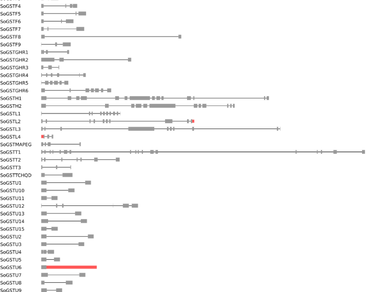
Glutathione S-transferase (GST) enzymes are key players in combatting oxidative stress in plants. Here, we identified GST genes from spinach using a genome-wide in silico approach. Our results showed that the 48 spinach GSTs (SoGSTs) are mapped onto six chromosomes and that the tau-class GSTs are the most abundant, being represented by 15 genes, followed by the phi-class, with 10 genes, making these two the largest classes within the spinach GST superfamily. The studies also showed that GST proteins are predominantly hydrophilic and localized in cytoplasm. Number of exons within SoGST genes varied from 1 to 18. Various conserved motifs have been identified within the tau- and phi-classes. Studies also revealed that the active-site serine residues are conserved in all phi, theta, tau and zeta classes whereas cysteine residues are found in GHR, lambda, DHAR, mPGES, hemerythrin and metaxin classes. Segmental gene duplication played a major role in generating member-encoding genes of families within spinach GST superfamily. Promoters were found to contain 25 different cis-regulatory elements involved in stress-responsive pathways. In silico expression profiling flagged SoGSTU9 and SoDHAR1 as the most stress-inducible members. Predictive knockout and overexpression modeling, combined with AlphaFold2-based docking, highlighted SoGSTU9, SoDHAR1, and SoGSTU1 as priority candidates.
References
Alderete LGS, Guido ME, Agostini E, Mas P (2018) Identification and characterization of key circadian clock genes of tobacco hairy roots: putative regulatory role in xenobiotic metabolism. Environ Sci Pollut Res Int 25:1597–1608
Armenteros JJA, Sønderby CK, Sønderby SK, Nielsen H, Winther O (2017) DeepLoc: prediction of protein subcellular localization using deep learning. Bioinformatics 21:3387–3395
Bailey TL, Bodén M, Buske FA, Frith M, Grant CE, Clementi L et al (2009) MEME SUITE: tools for motif discovery and searching. Nucleic Acids Res 37(Web Server Issue):202–208
Chou KC, Shen HB (2010) Plant-mPLoc: a top-down strategy to augment the power for predicting plant protein subcellular localization. PLoS ONE 5(6):e11335. https://doi.org/10.1371/journal.pone.0011335
Collins K, Zhao K, Jiao C, Xu C, Cai X, Wang X, Ge C, Dai S, Wang Q, Wang Q, Fei Z, Zheng Y (2019) SpinachBase: a central portal for spinach genomics. Database: J Biol Databases Curation baz072.
Dos Santos RN, Machado BR, Hefler SM, Zanette J (2021) Glutathione S-transferase activity in aquatic macrophytes and halophytes and biotransformation potential for biocides. J Plant Res 134(3):577–584
Dumanović J, Nepovimova E, Natić M, Kuča K, Jaćević V (2021) The significance of reactive oxygen species and antioxidant defense system in plants: a concise overview. Front Plant Sci 11:552969
Gasteiger E, Hoogland C, Gattiker A, Duvaud S, Wilkins MR, Appel RD, et al., (2005) Protein Identification and Analysis Tools on the ExPASy server. The Proteomics Protocols Handbook Springer Protocols Handbooks Humana Press pp. 571–607.
Horton P, Park K, Obayashi T, Fujita N, Harada H, Adams-Collier CJ et al (2007) WoLF PSORT: protein localization predictor. Nucleic Acids Res 35(Web Server Issue):W585–W587
Hu B, Jin J, Guo A-Y, Zhang H, Luo J, Gao G (2015) GSDS 2.0: an upgraded gene feature visualization server. Bioinformatics 31:1296–1297
Jain M, Ghanashyam C, Bhattacharjee A (2010) Comprehensive expression analysis suggests overlapping and specific roles of glutathione S-transferases during development and stress responses in rice. BMC Genomics 11:73
Jumper J et al (2021) Highly accurate protein structure prediction with AlphaFold. Nature 596:583–589
Koch MA, Haubold B, Mitchell-Olds T (2000) Comparative evolutionary analysis of chalcone synthase and alcohol dehydrogenase loci in Arabidopsis, Arabis, and related genera (Brassicaceae). Mol Biol Evol 17:1483–1498
Kong X, Lv W, Jiang S, Zhang D, Cai G, Pan J, Li D (2013) Genome-wide identification and expression analysis of calcium-dependent protein kinase in maize. BMC Genomics 14:433
Kumar S, Stecher G, Tamura K (2016) MEGA7: molecular evolutionary genetics analysis version 7.0 for bigger datasets. Mol Biol Evol 33:1870–1874
Lescot M, Déhais P, Thijs G, Marchal K, Moreau Y, Van de Peer Y et al (2002) PlantCARE, a database of plant cis-acting regulatory elements and a portal to tools for in silico analysis of promoter sequences. Nucleic Acids Res 30:325–327
Liu L, Zheng S, Yang D, Zheng J (2023) Genome-wide in silico identification of glutathione S-transferase (GST) gene family members in fig (Ficus carica L.) and expression characteristics during fruit color development. PeerJ 11:e14406
Love MI, Huber W, Anders S (2014) Moderated estimation of fold change and dispersion for RNA-seq data with DESeq2. Genome Biol 15:550
Noctor G, Reichheld JP, Foyer CH (2018) ROS-related redox regulation and signalling in plants. Semin Cell Dev Biol 80:3–12
Oztetik E (2008) A tale of plant Glutathione S-transferases: since 1970. Bot Rev 74:419–437
Robert X, Gouet P (2014) Deciphering key features in protein structures with the new ENDscript server. Nucleic Acids Res 42:W320–W324
Sievers F, Wilm A, Dineen DG, Gibson TJ, Karplus K, Li W et al (2011) Fast, scalable generation of high-quality protein multiple sequence alignments using Clustal Omega. Mol Syst Biol 7:539
Suyama M, Torrents D, Bork P (2006) PAL2NAL: robust conversion of protein sequence alignments into the corresponding codon alignments. Nucleic Acids Res 34:W609–W612
Tiwari S, Vaish S, Singh N, Basantani M, Bhargav (2023), Genome-wide identification and characterization of glutathione S-transferase gene family in quinoa (Chenopodium quinoa Willd.). 3 Biotech 13:230.
Vaish S, Gupta D, Mehrotra R, Mehrotra S, Basantani MK (2020) Glutathione S-transferase: a versatile protein family. 3 Biotech 10:321
Wang L, Qian M, Wang R et al (2018) Characterization of the glutathione S-transferase (GST) gene family in Pyrus bretschneideri and their expression pattern upon superficial scald development. Plant Growth Regul 86:211–222
Wei L, Zhu Y, Liu R, Zhang A, Zhu M, Xu W et al (2019) Genome wide identification and comparative analysis of glutathione transferases (GST) family genes in Brassica napus. Sci Rep 9:9196
Xiaolin Z, Baoqiang W, Xian W, Xiaohong W (2022) Identification of the CIPK-CBL family gene and functional characterization of CqCIPK14 gene under drought stress in quinoa. BMC Genomics 23:447
Author Information
Department of Biotechnology, Meerut Institute of Engineering and Technology, Meerut, India