Vegetos

(An International Journal of Plant Research & Biotechnology)
(eISSN: 2229-4473)
Phytochemical profiling of Ocimum basilicum citriodorum callus and therapeutic potential of callus-derived n-Hexadecanoic acid
*Article not assigned to an issue yet
Research Article | Published: 29 May, 2026
First Page: 0
Last Page: 0
Views: 87
Keywords: Bioactivity, Callus, Molecular docking, n-hexadecanoic acid, Phytochemical
Abstract
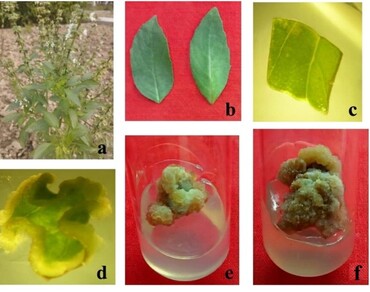
Ocimum basilicum citriodorum (lemon basil) is a medicinal herb recognized for its wide range of therapeutic benefits. The leaf tissues cultured on MS medium having different concentrations of 2,4-dichlorophenoxyacetic acid (2,4-D; 0.01, 0.1, 1.0, 5.0, and 10 mg/L) showed maximum percent response for callus initiation and callus biomass accumulation on medium having 1.0 mg/L 2,4-D. Of the three solvents (methanol, acetone, petroleum ether) used for phytochemical extraction, highest total phytochemical yield was recorded in methanol. Qualitative analysis confirmed the accumulation of phenolics, flavonoids, terpenoids, tannins, and coumarins in callus. Total 20 compounds were identified by Gas Chromatography–Mass Spectrometry in methanolic extract of callus and among these compounds n-hexadecanoic acid showed the maximum retention time. Bioactivity analysis of n-hexadecanoic acid performed by in silico molecular docking exhibited binding affinity of n-hexadecanoic acid with five different protein targets (Cyclooxygenase-2, Epidermal Growth Factor Receptor, Enoyl-ACP Reductase, Acetylcholinesterase, α-Glucosidase) associated with anti-inflammatory, anticancer, antituberculosis, neuroprotective, and antidiabetic activity. This predicts the ability of callus of O. basilicum citriodorum as a sustainable source for therapeutic phytochemicals.
References
Chang CC, Yang MH, Wen HM, Chern JC (2002) Estimation of total flavonoid content in propolis by two complementary colorimetric methods. J Food Drug Anal 10:178–182. https://doi.org/10.38212/2224-6614.2748
Dalal VK, Dantu PK (2023) Induction of rosmarinic acid in callus cultures of Ocimum sanctum. J Plant Biochem Biotechnol 32:388–392. https://doi.org/10.1007/s13562-022-00794-1
Dasoondi RS, Blundell TL, Pandurangan AP (2023) In silico analyses of isoniazid and streptomycin resistance-associated mutations in Mycobacterium tuberculosis. Comput Struct Biotechnol J 21:1874–1884. https://doi.org/10.1016/j.csbj.2023.02.035
Dharsono HDA, Putri SA, Kurnia D et al (2022) Ocimumspecies: a review on chemical constituents and antibacterial activity. Molecules 27:6350–6373. https://doi.org/10.3390/molecules27196350
El-Salam MA, Mekky H, El-Naggar EMB, Ghareeb D, El-Demellawy M, El-Fiky F (2015) Hepatoprotective properties and biotransformation of berberine and berberrubine by cell suspension cultures of Dodonaea viscosa and Ocimum basilicum. S Afr J Bot 97:191–195. https://doi.org/10.1016/j.sajb.2015.01.005
Eltayeb K, La Monica S, Tiseo M, Alfieri R, Fumarola C (2022) Reprogramming of lipid metabolism in lung cancer: an overview with focus on EGFR-mutated non-small cell lung cancer. Cells 11:413–432. https://doi.org/10.3390/cells11030413
Harborne JB (1973) Phenolic compounds. In: Phytochemical Methods: A Guide to Modern Techniques of Plant Analysis. Chapman and Hall, London, pp 33–88. https://doi.org/10.1007/978-94-009-5921-7_2
Ismail SM, Rao KRSS, Bhaskar M (2016) Evaluation of anti-inflammatory activity of Boswellia serrata on carrageenan induced paw edema in albino Wistar rats. Int J Res Med Sci 4:2980–2986. https://doi.org/10.18203/2320-6012.ijrms20161989
Majdi C, Pereira C, Dias MI, Calhelha RC, Alves MJ, Rhourri-Frih B, Charrouf Z, Barros L, Amaral JS, Ferreira ICFR (2020) Phytochemical characterization and bioactive properties of cinnamon basil (Ocimum basilicum cv. ‘Cinnamon’) and lemon basil (Ocimum×citriodorum). Antioxidants 9:369–386. https://doi.org/10.3390/antiox9050369
Manjudevi M, Thirugnanasampandan R, Vishnupriya B, Gogul Ramnath M (2022) In vitro propagation of Ocimum sanctum L., Ocimum canum Sims., and Ocimum tenuiflorum L., and evaluation of antioxidant, MMP-9 down regulation of eugenol and camphor. S Afr J Bot 151:208–217. https://doi.org/10.1016/j.sajb.2022.01.006
Mansouri S, Hosseini M, Alipour F, Beheshti F, Rakhshandeh H, Mohammadipour A, Jahani A (2022) Neuroprotective effects of the fractions of Ocimum basilicum in seizures induced by pentylenetetrazole in mice. Avicenna J Phytomed 12:614–627. https://doi.org/10.22038/AJP.2022.20470
Mohaddab M, El Goumi Y, Gallo M, Montesano D, Zengin G, Bouyahya A, Fakiri M (2022) Biotechnology and in vitro culture as an alternative system for secondary metabolite production. Molecules 27:8093–8113. https://doi.org/10.3390/molecules27228093
Murashige T, Skoog F (1962) A revised medium for rapid growth and bioassays with tobacco tissue cultures. Physiol Plant 15:473–497. https://doi.org/10.1111/j.1399-3054.1962.tb08052.x
Muzari K, Mufidah N, Budi HS et al (2025) A promising oral anticancer of hexadecanoic acid on genotoxicity evaluation of micronuclei and apoptosis induction. Braz J Biol 85:291091–291098. https://doi.org/10.1590/1519-6984.291091
Nazir M, Tungmunnithum D, Bose S, Drouet S, Garros L, Giglioli-Guivarc’h N, Hano C (2019) Differential production of phenylpropanoid metabolites in callus cultures of Ocimum basilicum L. with distinct in vitro antioxidant activities and in vivo protective effects against UV stress. J Agric Food Chem 67:1847–1859. https://doi.org/10.1021/acs.jafc.8b05647
Shaukat A, Zaidi A, Anwar H, Kizilbash N (2023) Mechanism of the antidiabetic action of Nigella sativa and Thymoquinone: a review. Front Nutr 10:1126272–1126300. https://doi.org/10.3389/fnut.2023.1126272
Singh VK, Trivedi S, Shukla K, Singh M (2022) Phytochemical assessment from callus and shoot cultures of a potential medicinal herb: Phyllanthus amarus (Schum. & Thonn). Plant Arch 22:109–114. https://doi.org/10.51470/PlantArchives.2022.v22.no1.017
Singleton VL, Rossi JA (1965) Colorimetry of total phenolics with phosphomolybdic–phosphotungstic acid reagents. Am J Enol Vitic 16:144–158. https://doi.org/10.5344/ajev.1965.16.3.144
Xiong Q, Wilson WK, Pang J (2007) The Liebermann-Burchard reaction: sulfonation, desaturation, and rearrangement of cholesterol in acid. J Am Oil Chem Soc 84:105–114. https://doi.org/10.1007/s11746-006-1015-8
Zhang X, Zhao R, Qi Y, Yan X, Qi G, Peng Q (2024) The progress of Mycobacterium tuberculosis drug targets. Front Med 11:1455715–1455726. https://doi.org/10.3389/fmed.2024.1455715
Author Information
Department of Life Sciences and Biotechnology, Chhatrapati Shahu Ji Maharaj University, Kanpur, India