Vegetos

(An International Journal of Plant Research & Biotechnology)
(eISSN: 2229-4473)
Population dynamics of sucking pests and their association with leaf morphological traits in Bt cotton (Gossypium hirsutum L.)
*Article not assigned to an issue yet
Sharma Bhaarat, Baig K. S., Kalpande H. V., Chinchane V. N., Bhede B. V., Deshmukh S. S., Pallavi N., Praveenkumar G., Prakash Om
Research Article | Published: 15 June, 2026
First Page: 0
Last Page: 0
Views: 77
Keywords: n Bt cotton, Leaf pubescence, Leaf thickness, Sucking pest, Trichome density
Abstract
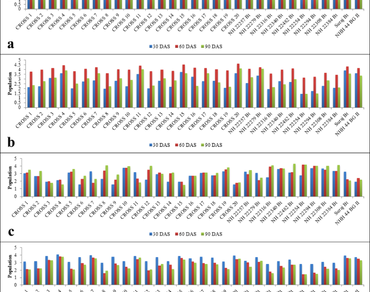
Sucking pests, including thrips (Thrips tabaci), aphids (Aphis gossypii), jassids (Amrasca biguttula biguttula) and whiteflies (Bemisia tabaci), are among the most destructive insect pests limiting cotton (Gossypium spp.) productivity. Understanding their population dynamics in relation to plant morphological traits is essential for developing pest-tolerant genotypes. An experiment was conducted during Kharif 2023–24 using five lines, four testers, their twenty F1 hybrids, and two checks in a randomized block design at the Cotton Research Station, Nanded, Maharashtra, India. The study examined pest dynamics (30–90 DAS) and their association with trichome density and leaf thickness. Among hybrids, the lowest mean aphid population (2.73 aphids per 3 leaves) was observed at 90 DAS. Similarly, the lowest mean populations of jassids, thrips and whiteflies were recorded at 2.87, 2.72 and 2.56 per 3 leaves, respectively, at all 30 DAS. Significant genotypic variation was also observed for trichome density and leaf thickness. Leaf pubescence pattern showed light hairy on the adaxial surface and both light hairy and hairy on the abaxial surface. Trichome density showed a significant negative correlation with jassids, thrips, and aphids, but a significant positive correlation with whiteflies, whereas leaf thickness exhibited the opposite trend, with significant positive correlations with jassids, thrips, and aphids and a significant negative correlation with whiteflies. The findings highlight the role of leaf morphological traits in conferring resistance to sucking pests and provide useful insights for breeding cotton cultivars with improved pest tolerance.
References
Aherkar SS, Deshmukh SB, Konde NM, Paslawar AN, Joshi T, Messmer MM, Riar A (2023) Studies on morphophysiological and biochemical parameters for sucking pest tolerance in organic cotton. Agriculture 13:1402. https://doi.org/10.3390/agriculture13071402
Ali A, Khaliq A, Ashraf M (1995) Physical factors affecting resistance in cotton against jassid, Amrasca devastans (Dist.) and thrips, Thrips tabaci (Lind). J Agric Res 33:173–178
Ali A, Aheer GM, Saeed M (1999) Physico-morphic factors influencing resistance against sucking insect pests of cotton. Pak Entomol 21:53–55
Arif MJ, Sial IA, Saif Ullah S, Gogi MD, Sial MA (2004) Some morphological plant factors affecting resistance in cotton against thrips (Thrips tabaci L). Int J Agric Biol 6:544–546
Arif MJ, Gogi MD, Ahmad G (2006) Role of morpho-physical plant factors imparting resistance in cotton against thrips, Thrips tabaci Lind. (Thripidae: Thysanoptera). Arab J Plant Prot 24:57–60
Ashfaq M, Ane MN, Zia K, Nasreen A, Hasan M (2010) Correlation of abiotic factors and physico-morphic characteristics of Bt cotton with whitefly (Bemisia tabaci) and jassid (Amrasca devastans) populations. Afr J Agric Res 5:3102–3107
Aslam M, Saeed NA, Naveed M, Razaq M (2004) Comparative resistance of different cotton genotypes against sucking insect pest complex. Sarhad J Agric 20:441–445
Bashir MH, Afzal M, Sabri MA, Raza ABM (2001) Relationship between sucking insect pests and physico-morphic plant characters in cotton genotypes. Pak Entomol 23:75–78
Bhatti JA, Suhail A, Khan MA, Javed N (2015) The role of physico-morphic and chemical plant characters of different genotypes of Bt cotton (Gossypium hirsutum L.) in the population fluctuation of jassid (Amrasca biguttula biguttula). J Anim Plant Sci 25:1626–1632
Bourland FM, Hornbeck JM, McFall AB, Calhoun SD (2003) A rating system for leaf pubescence of cotton. J Cotton Sci 7:8–15
Cotton Association of India (2026) CAB area and production. In: Cotton Association of India. https://caionline.in/news_reports/cab_area_production. Accessed 2 June 2026
Grover G, Kaur B, Pathak D, Kumar V (2016) Genetic variation for leaf trichome density and its association with sucking insect-pests incidence in Asiatic cotton. Indian J Genet Plant Breed 76:365–368. https://doi.org/10.5958/0975-6906.2016.00055.9
Hassan M, Ahmad F, Mushtaq F (1999) Role of physico-morphic characters imparting resistance in cotton against insect pests. Pak Entomol 21:61–62
Irfan M, Mumtaz I, Raza ABM, Ahmad K, Khan ZI, Arif N (2008) Effect of leaf morphology on the incidence of sucking insect pests in cotton genotypes. Int J Cell Mol Biol 1:285–291
Khalil H, Raza ABM, Afzal M, Aqueel MA, Khalil MS, Mansoor MM (2017) Effects of plant morphology on the incidence of sucking insect pests complex in few genotypes of cotton. J Saudi Soc Agric Sci 16:344–349. https://doi.org/10.1016/j.jssas.2015.11.003
Kulkarni KA, Patil SB, Udikeri SS (2003) Status of sustainable IPM of cotton pests: a scenario in Karnataka. In: Proceedings of national symposium on sustainable insect pest management, 6–7 Feb 2003, ERI, Loyola College, Chennai, pp 42–52
Kumar V, Dhawan AK, Shera PS (2015) Transgenic cotton in India: ten years and beyond. In: Singh B, Arora R, Gosal SS (eds) Biological and molecular approaches in pest management. Scientific, Jodhpur, pp 202–227
Kumbhalkar HB, Gawande VL, Gotmare V, Waghmare VN (2022) Physico-morphological and biochemical studies related to sucking pests in upland cotton (Gossypium hirsutum L). Emerg Life Sci Res 8:41–51. https://doi.org/10.31783/elsr.2022.824151
Murugesan N, Kavitha A (2010) Host plant resistance in cotton accessions to the leafhopper, Amrasca devastans. J Biopesticides 3:526–533. https://doi.org/10.57182/jbiopestic.3.3.526-533
Nagrare VS, Naik VCB, Fand BB, Gawande SP, Nagrale DT, Narkhedkar NG, Waghmare VN (2019) Cotton: integrated pest, disease and nematode management. Technical Bulletin No. 1/2019. ICAR-Central Institute for Cotton Research, Nagpur, Maharashtra, India
Naveed M, Anjum ZI, Khan JI, Rafiq M, Hamza A (2011) Morphophysical factors affecting resistance against Bemisia tabaci in cotton genotypes. Pak J Zool 43:229–236
Panda D, Kumar M, Senguttuvan K (2026) Harnessing cotton leaf hopper resistance from wild gene pool. In: Panda D, Palita SK, Banerjee K (eds) Biodiversity and agriculture for a sustainable future. Central University of Odisha, Koraput, pp 108–113
Pathan AK, Chohan S, Leghari MA et al (2007) Comparative resistance of cotton genotypes against insect pest complex. Sarhad J Agric 23:141–143
Raza ABM, Afzal M, Sarfraz M, Bashir MH, Gogi MD, Sarwar MS (2000) Physico-morphic plant characters in relation to resistance against sucking insect pests in some new cotton genotypes. Pak Entomol 22:73–77
Riaz M, Chaudhry MA, Ali A, Khan L (1987) Physico-chemical aspects of resistance in cotton to insect pest complex. Sarhad J Agric 3:491–497
Rushpam R, Ravikesavan R (2019) Morphological and biochemical basis of resistance to jassid (Amrasca devastans) in cotton (Gossypium hirsutum L). J Cotton Res Dev 33:116–122
Saleem MJ, Hafeez F, Arshad M, Atta B, Maan NA, Ayub MA, Zubair M (2018) Population dynamics of sucking pests on Bt cotton in relation to abiotic and physio-morphological traits. J Entomol Zool Stud 6:163–166
Sharma B, Baig KS, Deshmukh SS, Praveenkumar G (2025) Heterosis and gene action studies in Bt cotton (Gossypium hirsutum L). Plant Arch 25:2281–2292. https://doi.org/10.51470/plantarchives.2025.v25.supplement-1.314
Sharma S, Kooner R, Arora R (2017) Insect pests and crop losses. In: Arora R, Sandhu S (eds) Breeding insect resistant crops for sustainable agriculture. Springer, Singapore, p 45
Shera P, Kumar V, Jindal V (2020) Sucking pests of cotton. In: Omkar (ed) Sucking pests of crops. Springer, Singapore, pp 249–284. https://doi.org/10.1007/978-981-15-6149-8_8
Stipanovic RD (1983) Function and chemistry of plant trichomes and glands in insect resistance. In: Hedin PA (ed) Plant resistance to insects. American Chemical Society, Washington, DC, pp 69–100
Wakode YS, Deshmukh SB, Yadav YM, Nagrale SC (2019) Role of morpho-physio characters imparting tolerance in cotton sucking pest. J Pharmacogn Phytochem 8:2965–2968
Zafar MM, Razzaq A, Farooq MA, Rehman A, Firdous H, Shakeel A, Mo H, Ren M (2020) Insect resistance management in Bacillus thuringiensis cotton by MGPS (multiple genes pyramiding and silencing). J Cotton Res 3:33. https://doi.org/10.1186/s42397-020-00074-0
Author Information
Department of Genetics and Plant Breeding, College of Agriculture, V.N.M.K.V, Parbhani, India